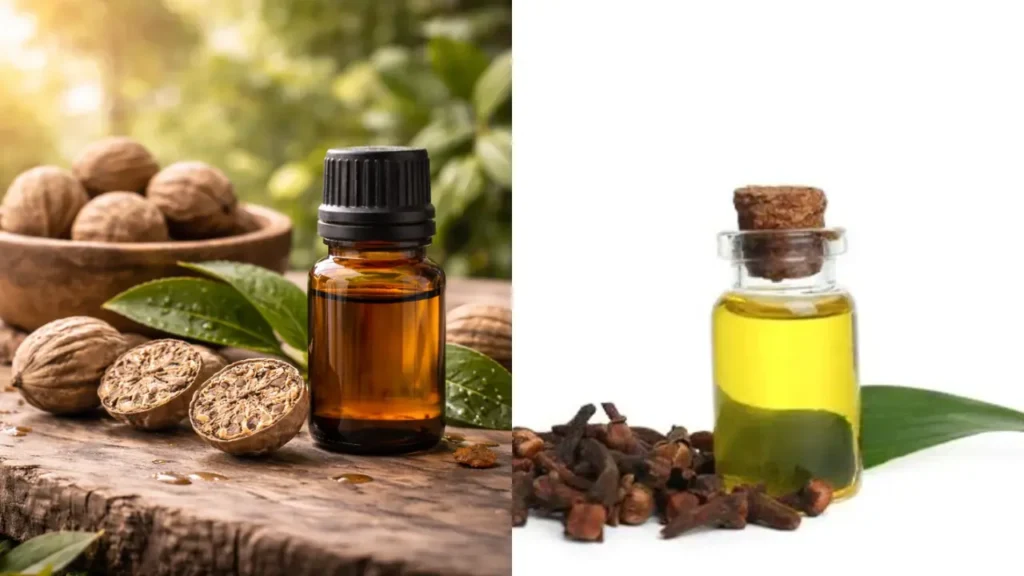
Nutmeg oil and clove oil are both warm, spicy essential oils, but they do not smell or behave the same in a fragrance.
Nutmeg oil tends to be softer, woody, fresh-spicy and slightly sweet; clove bud oil is usually more pronounced, phenolic and distinctly clove-like.
Their different plant sources and chemical profiles also influence how formulators select them for perfume, home fragrance and other products.
This comparison focuses on steam-distilled nutmeg seed oil and clove bud oil.
It explains their scent differences, typical constituents, applications and safety considerations, with a practical framework for choosing the right material for an intended formulation.
Nutmeg Oil vs Clove Oil: Quick Comparison
Use this overview as a starting point, not as a specification for every origin or batch.
Actual aroma and constituent levels should be checked against the material being purchased.
| Factor | Nutmeg Essential Oil | Clove Bud Essential Oil |
|---|---|---|
| Botanical source | Myristica fragrans | Syzygium aromaticum |
| Plant part | Dried seed/kernel | Dried flower buds |
| Common extraction | Steam distillation | Steam distillation |
| Typical scent | Warm, fresh-spicy, woody, lightly sweet | Rich, pungent, warm-spicy, phenolic |
| Notable constituents | Often sabinene and pinenes; myristicin may also be present | Typically eugenol-rich; also eugenyl acetate and β-caryophyllene |
| Role in fragrances | Rounds and brightens a spicy accord | Adds a recognizable, assertive clove accent |
| Main selection factor | Nuanced spice character and balance | Eugenol-rich character, intensity and safety review |
| Important caution | Review variable constituents and intended use | Review eugenol-related sensitization and use restrictions |
What Is Nutmeg Essential Oil?
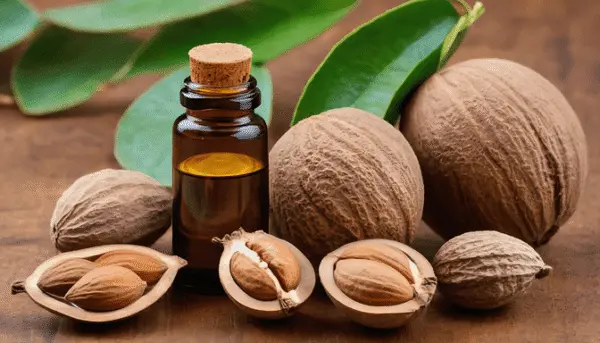
Nutmeg essential oil is obtained mainly by distilling the dried seed kernels of Myristica fragrans.
Unlike ground nutmeg, the distilled oil contains the volatile aromatic fraction rather than the whole spice matrix.
Its odor may combine nutty-spicy warmth with fresh, terpenic, woody or subtly peppery nuances.
The balance changes with seed origin, maturity, processing and distillation. A scientific nutmeg essential oil composition review documents substantial chemical variability across samples.
That is why a fragrance buyer should compare actual samples rather than rely on a single generic descriptor.
What Is Clove Essential Oil?

Clove essential oil comes from Syzygium aromaticum. Commercial clove oils can be distilled from buds, leaves or stems, but these are not interchangeable grades.
This article compares clove bud oil with nutmeg seed oil because bud oil is a useful reference for fragrance selection: it generally offers a full, warm, sweet-spicy aroma with a pronounced phenolic character.
Clove leaf and stem oils may differ in odor balance and constituent profile. For those distinctions, see Global Essential Oil’s comparison of clove bud, leaf and stem oils.
The type of clove oil should always be specified in an ingredient brief or purchase request.
What Is the Difference Between Nutmeg and Clove Oil Scents?
What Does Nutmeg Oil Smell Like?
Nutmeg oil can give a fragrance a polished, warm-spicy character without immediately reading as a single culinary spice.
Depending on the sample, the opening may feel fresh and lightly peppery, while the body develops softer woody and sweet facets.
It often works well where a perfumer wants spice to support woods, amber materials or floral notes rather than dominate them.
What Does Clove Oil Smell Like?
Clove bud oil is usually more recognizable: warm, intense, sweet-spicy and distinctly phenolic.
It can suggest dried clove buds, carnation-style spice or a rich, slightly medicinal warmth.
Small changes in concentration can noticeably change the balance of a composition, so it is best evaluated in the context of the complete fragrance.
Do Nutmeg and Clove Essential Oils Smell Similar?
They overlap in warmth and spice, but they are not close substitutes.
Nutmeg generally feels rounder, airier and more woody-terpenic; clove bud oil often supplies a denser and sharper signature.
Two oils can be described as “spicy” while creating very different results when tested side by side on fragrance blotters.
6 Key Differences Between Nutmeg Oil and Clove Oil
1. Botanical Source and Plant Parts
Nutmeg seed and clove buds come from different botanical families and plant structures.
This matters for identity, sourcing and quality evaluation.
A product specification should name the botanical species and plant part, rather than using only a broad trade name such as “spice oil.”
2. Extraction and Types of Oil
Both oils are commonly steam-distilled, but an essential oil is not the same ingredient format as a spice powder, oleoresin or isolated aroma compound.
Clove bud, leaf and stem oils also require separate identification. If a supplier proposes an alternative grade, request a sample and a matching specification before treating it as equivalent.
3. Chemical Composition: Sabinene and Pinenes vs Eugenol
Nutmeg seed oil commonly includes monoterpenes such as sabinene, α-pinene and β-pinene, alongside other constituents that can include myristicin, elemicin and safrole.
Their relative amounts vary. Clove bud oil, by contrast, is often dominated by eugenol, with eugenyl acetate and β-caryophyllene contributing to its overall profile. The exact composition is batch-specific.
These differences help explain the contrasting odor characters, but a single peak in a GC-MS report cannot fully describe how a material smells.
Consult the nutmeg review and the PubChem clove oil reference for additional chemical background.
4. Aroma Intensity and Character
Clove bud oil often creates a stronger recognizable signature in a blend, while nutmeg oil may offer a less literal, more flexible spice effect.
This is a sensory tendency, not a universal ranking of strength. Evaluation should use comparable sample concentrations and the same blotter or trial-formula conditions.
5. Behavior in Fragrance Blends
Nutmeg may connect fresh spices with woody, amber or citrus elements. Clove can bring body to carnation-style, resinous, gourmand or traditional spicy compositions.
Neither material automatically lasts longer or performs better; the dry-down, dosage, other ingredients and finished product format will determine the result.
6. Safety and Application Considerations
Clove bud oil’s eugenol content makes fragrance-allergen and sensitization review especially important.
Nutmeg oil also requires a constituent-based safety assessment because its profile may include substances subject to application-specific controls.
Natural origin does not remove the need for a finished-product safety review.
Nutmeg Oil vs Clove Oil in Perfumery
When to Choose Nutmeg Oil
Choose nutmeg as an early trial material when the creative brief calls for warm spice that still leaves room for citrus, woods, florals or amber notes.
It can add lift and roundness without making the accord smell unmistakably of clove. For more formulation context, see Global Essential Oil’s nutmeg oil perfumery guide.
When to Choose Clove Bud Oil
Start with clove bud oil when a pronounced clove-like signature is desirable: for example, a spicy floral, cozy amber or dark gourmand direction.
Its assertive odor means that even a small adjustment may change the overall identity of the fragrance. Use the material only after confirming the intended product category and relevant restrictions.
Can Nutmeg and Clove Oils Be Used Together?
Yes. The pair can create layered spice: nutmeg can broaden the opening and woody warmth, while clove supplies a more identifiable phenolic center.
A useful development approach is to make separate nutmeg-led, clove-led and balanced trial accords, then compare their opening, middle and dry-down.
The final ratio should come from sensory testing and safety calculations, not a universal recipe.
Can You Substitute Clove Oil for Nutmeg Oil?
Not on a simple one-to-one basis. Replacing nutmeg oil with clove bud oil may increase the perceived pungency and alter the spice identity of the finished fragrance.
Replacing clove with nutmeg can make a blend softer and less recognizably clove-like. Either change may also affect allergen calculations, stability and compliance.
When substituting an ingredient, first identify its role: does it provide warmth, a recognizable clove note, freshness, or a bridge between other fragrance notes?
Then reformulate and evaluate the finished composition rather than only comparing the oils in their bottles.
Nutmeg Oil vs Clove Oil for Industrial Applications
Perfume and Home Fragrance
Both oils can appear in perfume, candles, room fragrances and other aromatic products when compatible with the intended system. Their aroma profile is only one part of material selection.
Formulators must also assess color, odor changes during storage, ingredient compatibility and product-specific safety requirements.
Performance in a neat sample does not guarantee performance in wax or another carrier.
Cosmetic and Personal Care Formulations
A cosmetic formula requires a review of the exact oil, its allergens or restricted constituents, exposure level and the applicable market rules.
The IFRA Standards guidance explains how fragrance ingredients and naturally occurring restricted constituents are evaluated in fragrance mixtures.
Use relevant current standards and a qualified safety assessment; do not assume any fixed dilution percentage applies to both oils.
Food and Flavor Manufacturing
Nutmeg and clove are familiar culinary spices, and their aromatic fractions may be evaluated by flavor manufacturers.
However, a general essential oil sold for fragrance use is not automatically suitable for food or beverages.
Food applications require appropriate material specifications, regulatory review, supplier documentation and use-level assessment for the destination market.
For a separate comparison of a distilled oil with the whole powdered spice, read nutmeg oil vs ground nutmeg.
Safety Considerations When Using Nutmeg and Clove Essential Oils
The most useful safety decision is not “which natural oil is safer?” but “what does the exact batch contain, and how will the finished product be used?” Clove bud oil’s eugenol-rich profile requires careful consideration of skin sensitization and fragrance-allergen obligations.
Nutmeg oil may contain varying amounts of myristicin, safrole and other constituents that warrant a formulation-specific review.
Request the current safety data sheet (SDS), appropriate composition information and any needed fragrance-allergen documentation.
Do not apply neat essential oils to skin, assume either oil is suitable for ingestion, or use a single dilution number as proof of safety.
Global Essential Oil’s clove oil safety guide for cosmetic formulators provides a related, application-focused discussion.
How to Choose Between Nutmeg and Clove Oil for Manufacturing
A buyer comparing two warm-spicy raw materials should assess sensory fit and documentation together.
The following decision guide can help define a first sample request.
| Formulation goal | Suggested starting point | Reason to test |
|---|---|---|
| Soft, layered spice over woods | Nutmeg oil | Generally rounder, terpenic and less distinctly clove-like |
| Recognizable clove-spice accent | Clove bud oil | Phenolic, rich and assertive odor character |
| Complex warm-spice accord | Both, tested separately and together | Potentially complementary but easy to overbalance |
| Ingredient substitution | Reformulation trial, not 1:1 replacement | Different chemistry, odor and safety profile |
Compare Aroma Through Sensory Evaluation
Evaluate samples at comparable concentrations on blotters, recording the opening, development and dry-down. Use the same carrier, dilution and evaluation intervals.
Keep notes on clarity of the spice character, fit with the fragrance brief and any off-notes. Sensory testing is especially helpful when comparing origins or different distillation batches.
Review COA and GC-MS Profiles
Confirm botanical identity, plant part, batch number, specification parameters and chemical fingerprint where available.
For nutmeg, pay attention to the overall terpene profile and any restricted constituents relevant to use.
For clove bud oil, assess eugenol and other key components in context.
A COA and GC-MS interpretation guide can help procurement teams understand what these documents do—and do not—prove.
Check Grade, Batch Consistency and Documentation
Ask whether the proposed lot matches a previously approved reference sample and whether alternate lots are available for repeat orders.
Confirm packaging, storage guidance, lead time, sampling process and destination-market documents with the supplier.
Claims such as “premium,” “pure” or “high eugenol” should be supported by a clear specification rather than used as substitutes for testing.
Sourcing Nutmeg and Clove Essential Oils from Indonesia
Indonesia is an established source of both nutmeg and clove aromatic materials, but the right purchase depends on the oil type and the buyer’s intended application.
Global Essential Oil works with businesses sourcing Indonesian essential oils and can discuss product specifications, availability, documentation, packaging and sample requirements before a quotation.
Buyers can review the Indonesian nutmeg essential oil product page and the clove essential oil product page.
When contacting the team, specify whether you need nutmeg seed oil or clove bud, leaf or stem oil, along with your intended application and approximate order quantity.
Final Thoughts
For fragrance development, nutmeg oil and clove bud oil solve different creative problems.
Nutmeg is often a useful starting point for subtle woody-spice warmth; clove bud oil provides a bolder, recognizable clove accent.
Neither is automatically the better ingredient. Compare samples, review constituent data and choose according to the desired scent and the finished product’s safety requirements.
For commercial sourcing, contact Global Essential Oil to discuss Indonesian nutmeg or clove oil specifications, samples, available documentation and bulk quotation requirements.
Frequently Asked Questions
What is the main difference between nutmeg oil and clove oil?
Nutmeg seed oil generally offers softer, woody and fresh-spicy nuances, while clove bud oil usually has a stronger clove-like, phenolic character. Their botanical sources and constituent profiles also differ.
Does nutmeg oil smell like clove oil?
Both can smell warm and spicy, but they are not identical. Nutmeg often reads as rounder and more terpenic; clove bud oil is usually more recognizable as clove spice.
Which essential oil has a stronger aroma, nutmeg or clove?
Clove bud oil often has a more assertive, recognizable odor, but perceived strength depends on batch, concentration and the surrounding formula. Test both materials under comparable conditions.
Can you blend nutmeg and clove essential oils?
Yes, in a suitably designed fragrance formula. They can provide complementary spice facets, but the blend needs sensory evaluation and safety assessment for the intended product.
Can clove oil replace nutmeg oil in perfume?
It may replace some spicy character, but not without changing the fragrance. Direct one-to-one substitution is not a reliable formulation method.
What are the main chemical components of nutmeg and clove oil?
Nutmeg seed oil commonly features sabinene and other monoterpenes, with variable phenylpropanoids such as myristicin. Clove bud oil is often eugenol-rich and may also contain eugenyl acetate and β-caryophyllene.
Is clove oil the same as eugenol?
No. Clove essential oil is a complex mixture containing eugenol and other constituents. Isolated eugenol is a single chemical substance with its own specifications and use considerations.