
Patchouli oil and vetiver oil both have deep, earthy aromas, but they bring different qualities to a fragrance.
Patchouli is generally warmer, rounder and more balsamic, with woody, sweet or musky nuances. Vetiver tends to be drier and more root-like, with grassy, woody and sometimes smoky facets.
Although both are valued as base notes, they are not direct substitutes.
This guide compares their scent, composition and applications, and explains how to choose between them for perfume and commercial fragrance development.
Patchouli Oil vs Vetiver Oil: Quick Comparison
| Characteristic | Patchouli oil | Vetiver oil |
| Botanical source | Pogostemon cablin | Chrysopogon zizanioides (syn. Vetiveria zizanioides) |
| Plant part | Mainly dried leaves | Roots |
| Extraction | Usually steam distillation | Usually steam distillation |
| Core aroma | Rich, earthy, woody, balsamic | Dry, earthy, rooty, woody |
| Sweetness | Often warmer and sweeter | Often drier; may have sweet facets |
| Notable constituents | Patchoulol, α-guaiene, α-bulnesene | Khusimol, α-vetivone, β-vetivone |
| Persistence | Generally tenacious base note | Generally tenacious base note |
| Fragrance direction | Amber, floral, chypre, gourmand | Woody, citrus, fougère, amber |
| Typical uses | Perfume, personal care, home fragrance | Perfume, personal care, home fragrance |
These descriptions are general tendencies, not fixed specifications. Origin, distillation, grade and batch can all influence the actual scent and physical properties.
What Is Patchouli Essential Oil?
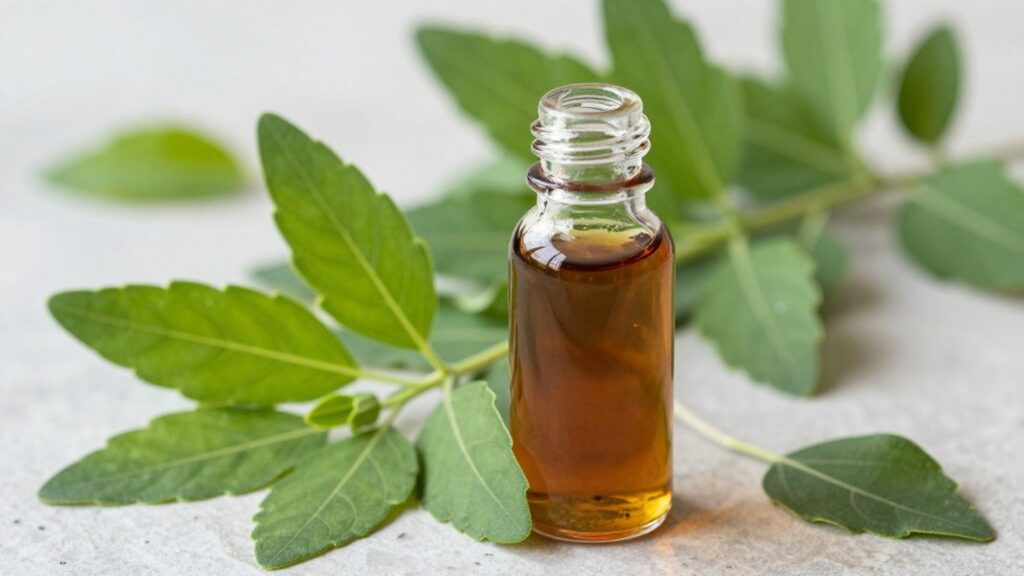
Patchouli essential oil comes from an aromatic plant in the mint family.
The dried leaves are commonly distilled to obtain a complex mixture of sesquiterpenes and their oxygenated derivatives.
Its distinctive earthy sweetness makes it useful when a perfumer wants to add fullness to a composition.
Our guide to the scent profile of patchouli in perfume explores its fragrance role in more detail.
What Is Vetiver Essential Oil?
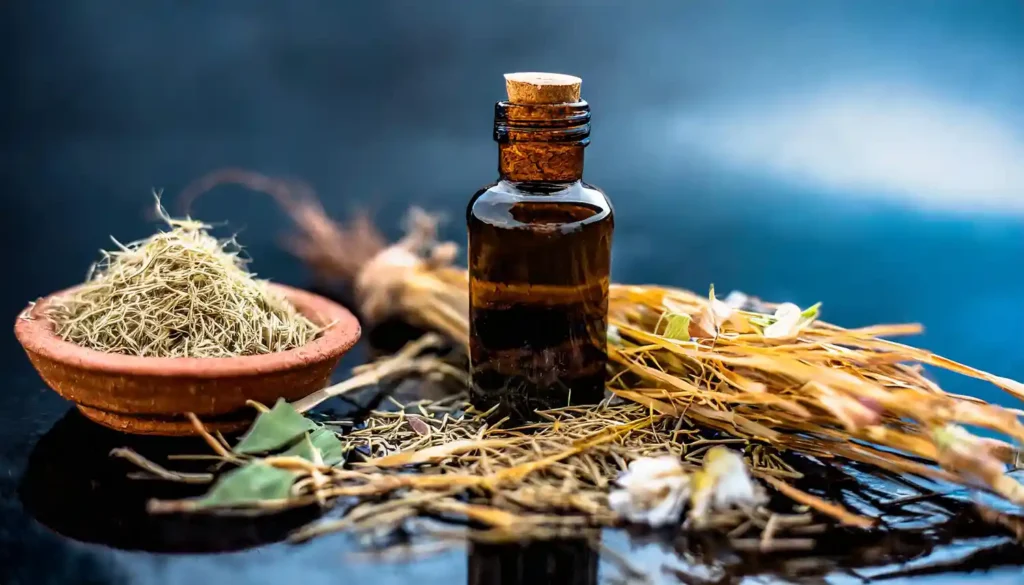
Vetiver is a perennial grass grown in tropical and subtropical regions. Unlike patchouli, its aromatic oil is obtained from the roots.
The resulting material is often viscous and has a layered woody character that can range from clean and grassy to deep and smoky.
It is particularly useful when a fragrance needs a substantial base without relying entirely on sweet notes.
What Is the Difference Between Patchouli and Vetiver Scents?
What Does Patchouli Oil Smell Like?
Think of damp woodland earth, dried leaves and soft woods, with a warmer balsamic or slightly sweet background.
Some patchouli samples lean toward cocoa, tobacco or camphoraceous impressions.
In a perfume, this material can make a floral heart feel richer or give a resinous amber accord more depth.
What Does Vetiver Oil Smell Like?
Vetiver often suggests dry roots, earth and wood, sometimes with green, smoky or grapefruit-like accents. Its drier facets can give a fragrance a crisp, structured finish.
A particular vetiver sample may also be rounded and sweet rather than sharply smoky, so it is worth smelling the exact material before choosing an origin or grade.
Does Vetiver Smell Like Patchouli?
Yes, in the sense that both have an earthy, woody foundation. The difference becomes clearer as they develop: patchouli often gives a fuller, warmer impression, while vetiver tends to emphasize dry wood and roots.
Perfumers describe these materials through their own sensory experiences, as illustrated by Jean-Claude Ellena’s reflections on patchouli and vetiver. Neither aroma belongs to a particular gender.
7 Key Differences Between Patchouli Oil and Vetiver Oil
1. Botanical Source and Plant Parts
Patchouli is a leafy herb, while vetiver is a grass with an aromatic root system.
Their different plant tissues and biosynthetic pathways produce distinct aromatic mixtures.
Similar scent descriptions do not imply that the two oils have similar chemical compositions.
2. Extraction and Processing
Both oils are commonly steam-distilled, but preparing dried leaf material is different from preparing dense, fibrous roots.
Raw material preparation, distillation conditions and subsequent refinement may affect the resulting oil.
Buyers should identify not just the plant but also whether the sample is a conventional distillate or a further-processed grade.
3. Chemical Composition
Patchoulol, also called patchouli alcohol, is a prominent constituent of patchouli oil, alongside compounds such as α-guaiene and α-bulnesene.
A scientific review of patchouli oil documents its complex chemistry. Vetiver contains a different mixture, commonly including khusimol and vetivones, although their relative abundance varies.
A study of vetiver oils from southern India identified numerous constituents associated with its characteristic odor.
Neither oil can be judged by one marker compound alone: low-abundance odor-active molecules may also influence the scent.
4. Scent Character and Intensity
Patchouli often adds weight and warmth, while vetiver can introduce a more angular, dry contrast. Intensity is not the same as odor character.
A smoky vetiver may stand out even at a modest concentration, but a rich patchouli can dominate a softer floral accord.
Compare them at consistent evaluation concentrations rather than relying on impressions from the bottle.
5. Longevity and Dry-Down
Both are relatively persistent materials used toward the base of a fragrance. Patchouli may leave a mellow, earthy sweetness, while vetiver can retain a dry root-like or woody character.
The balance changes with the specific material, concentration, substrate and other ingredients. There is no reliable universal ranking in hours for the two oils.
6. Color, Viscosity and Grade
Conventional patchouli and vetiver oils can range from amber to deeper brown and may be quite viscous. Further processing can alter their color and aromatic balance.
Patchouli is marketed in grades such as dark, light, low-iron and molecular-distilled oil; vetiver may also be offered as rectified oil or selected fractions. Grade names are not a complete specification.
See our guide to different grades of patchouli oil for the distinctions to discuss with a supplier. A paler oil is not automatically a better fragrance ingredient.
7. Applications and Formulation Considerations
Both oils can be evaluated for fine fragrance, soaps, personal care and home-fragrance products.
Patchouli is useful for building richness, whereas vetiver can counterbalance sweetness or extend a woody theme.
Suitability depends on the actual formulation: color, clarity, odor changes, compatibility and applicable safety limits all need review. Natural origin alone does not establish safe use.
Patchouli vs Vetiver in Perfumery
Patchouli as a Warm, Rich Base Note
In an amber fragrance, patchouli can connect balsamic, spicy and woody materials. It can also add an earthy counterpoint to rose or jasmine, or provide contrast to a sweet gourmand concept.
In chypre-inspired compositions, it is often used as part of a darker base behind brighter citrus and floral notes.
The choice depends on whether the perfumer wants patchouli to be recognizable or simply to add body.
Vetiver as a Dry, Woody Base Note
Vetiver can support a citrus opening without making the base excessively sweet. Its rooty facets work well with cedarwood, green notes or aromatic accords, and selected samples can add a smoky accent.
For further application details, read our guide to vetiver oil in perfumery.
Which One Lasts Longer in Perfume?
Neither is inherently the winner. Both can contribute a persistent base, but the perceived longevity of a finished fragrance depends on its complete composition and application.
A material may remain detectable on a blotter even when the overall fragrance no longer projects strongly. Evaluate persistence and projection separately.
Can You Blend Patchouli and Vetiver Together?
Yes. Patchouli can soften a dry vetiver direction, while vetiver can give structure to a rounded patchouli base.
Their shared earthy qualities make them compatible starting points, but using both heavily may obscure lighter parts of the fragrance.
Fragrance Notes That Pair Well with Both Oils
| Note or accord | Possible effect |
| Bergamot and other citrus notes | Lift and contrast against earthy base notes. |
| Cedarwood or sandalwood | Reinforce woody structure or add softer texture. |
| Rose or jasmine | Contrast floral brightness with darker base materials. |
| Frankincense or labdanum | Build resinous or ambery depth. |
| Lavender or aromatic herbs | Introduce a fresher, greener direction. |
For additional pairing ideas, explore essential oils that blend well with vetiver. Treat these as creative starting points, not finished formulas.
Patchouli-Led, Vetiver-Led and Balanced Accords
A patchouli-led accord can emphasize warmth and richness, with vetiver acting as an accent.
A vetiver-led accord may feel drier and more architectural, while patchouli gives it weight.
A balanced accord can highlight the contrast between the two materials.
Compare these directions using small, documented fragrance trials and adjust according to the actual strength of each sample.
A balanced ratio by weight does not necessarily create a balanced scent.
Can Vetiver Oil Replace Patchouli Oil?
Vetiver may be a useful alternative when the desired effect is earthy or woody rather than specifically patchouli-like.
However, a direct substitution can reduce warmth or sweetness and introduce grassy, rooty or smoky nuances.
In an existing perfume, compare the original and revised accords at the same total fragrance concentration, then evaluate the full dry-down. Reformulation may be needed to recover the intended character.
Patchouli or Vetiver: Which Essential Oil Should You Choose?
Start with the fragrance brief rather than a general preference for one oil. The following table suggests materials to evaluate first.
| Desired fragrance direction | Starting ingredient |
| Warm, earthy, musky | Patchouli |
| Dry, rooty, woody | Vetiver |
| Rich amber or resinous | Patchouli or both |
| Fresh citrus-woody | Vetiver |
| Floral with earthy depth | Patchouli |
| Smoky woody | Vetiver or both, depending on sample |
| Sweet, dark gourmand | Patchouli |
| Complex earthy base | Both, after testing balance |
If the product must remain pale or clear, include color and clarity in the screening criteria.
For soap or home fragrance, check the actual performance in the intended base rather than assuming results from a perfume trial will transfer.
How to Evaluate Patchouli and Vetiver Oil for Commercial Fragrance Formulation
Side-by-Side Sensory and Dry-Down Evaluation
A useful sample evaluation starts with an approved reference and a consistent method.
The following workflow is a suggested screening process, not a report of tests performed by Global Essential Oil.
- Confirm each sample’s botanical identity, grade, batch and supplier information.
- Use comparable fragrance blotters and a consistent, suitable evaluation dilution and amount. Follow the applicable handling guidance.
- Record the initial aroma and revisit both strips at consistent intervals, such as 30 minutes, several hours and the following day.
- Note warmth, dryness, sweetness, smokiness, unwanted off-notes and persistence. Compare the results with the intended fragrance brief.
- Test shortlisted materials in the actual product base before approving a purchasing specification.
Comparing Grades, COA and GC-MS Profiles
Ask for the specification, Certificate of Analysis (COA), available batch-specific GC-MS data and relevant Safety Data Sheet (SDS).
Chemical profiles help establish identity and assess consistency; they do not replace sensory approval. The review of root-derived essential oils illustrates how vetiver composition varies across samples and regions.
Compare analytical results with appropriate product-specific limits rather than assuming one universal khusimol or patchoulol target.
Checking Batch Consistency and Application Suitability
Keep an approved reference sample and agreed acceptance criteria for odor, appearance and relevant analytical properties.
For commercial orders, discuss how future batches are identified, sampled and reviewed.
Evaluate the intended product category, stability, regulatory requirements and safety documentation before scaling up.
A successful blotter comparison does not establish finished-product safety or market compliance.
Sourcing Indonesian Patchouli and Vetiver Oil
Indonesia is an established origin for both aromatic materials. However, country of origin is only one consideration when choosing an oil: cultivation, distillation, processing and batch quality influence the final material.
Global Essential Oil supplies Indonesian patchouli essential oil and Indonesian vetiver essential oil for business sourcing discussions.
If you are developing a fragrance or evaluating alternatives to an existing raw material, contact our team with your intended application, preferred aroma, required quantity and documentation needs.
Ask about available grades, specifications, samples and quotation options before making a bulk purchasing decision.
Final Thoughts
The choice between patchouli oil and vetiver oil comes down to the type of depth you want in a fragrance.
Choose patchouli when warmth and earthy richness are important, and start with vetiver when you need a drier woody structure.
Consider both when the brief calls for a more complex earthy base.
For commercial applications, combine sensory evaluation with documentation and finished-product testing before choosing a grade or approving a bulk order.
Frequently Asked Questions
What is the main difference between patchouli and vetiver oil?
Patchouli comes mainly from leaves and generally has a warmer, sweeter earthy-woody aroma. Vetiver is obtained from roots and often has a drier, grassy or smoky woody character.
Does vetiver smell like patchouli?
They share earthy and woody facets, but vetiver typically feels drier and more root-like. Patchouli often has a fuller balsamic or musky character.
Is vetiver oil stronger than patchouli oil?
Not necessarily. Strength depends on the sample, concentration and surrounding fragrance materials. Compare both under the same evaluation conditions.
Which lasts longer, patchouli or vetiver?
Both are persistent base notes. There is no fixed duration or universal longevity winner because the grade, formula and application influence performance.
Can patchouli and vetiver be blended together?
Yes. Their earthy qualities can complement each other. Test the balance in the intended formula and review applicable safety requirements before use.
Can vetiver essential oil replace patchouli oil in perfume?
It can replace some of the earthy or woody function, but it will change the scent. A direct one-for-one substitution is not guaranteed to reproduce the original accord.
Which is better for woody fragrances, patchouli or vetiver?
Vetiver is often a useful starting point for dry, rooty woody fragrances, while patchouli suits warmer, rounder woody compositions. Both can work well together.
Why do patchouli and vetiver oils smell different between batches?
Plant material, growing conditions, distillation, refinement and storage all contribute to variation. Evaluate the actual batch against an approved reference rather than relying on its name alone.