
Vetiver essential oil has been used in traditional aromatherapy for insomnia and anxiety relief for centuries — but what does modern science actually say?
The short answer is: the evidence is promising, though most studies are animal-based.
For people looking for a natural, non-habit-forming sleep support, vetiver oil is worth understanding properly.
This article breaks down the scientific studies on vetiver's sedative properties, explains exactly how it works on the brain, and gives you a practical guide to using it effectively for better sleep quality.
| Does Vetiver Essential Oil Help with Sleep? Yes — vetiver essential oil has documented sedative properties supported by scientific research: • A 2003 study by Thailand's TISTR research institute found that inhaling vetiver oil significantly reduced rearing motility in rats, indicating a sedative effect comparable to lavender oil. • Vetiver's primary active compound, khusimol, is a sesquiterpene alcohol believed to interact with GABA receptors in the central nervous system — the same pathway targeted by many sleep medications. • A PMC-indexed systematic review (PMC4805151) identified vetiver among essential oils with evidence for improving sleep quality through inhalation. • Vetiver's deep, earthy scent activates the olfactory-limbic pathway, promoting a grounding, calming effect that can reduce sleep latency. Best method: Diffuse 4–6 drops of vetiver oil in a bedroom diffuser 30–60 minutes before sleep, or blend with lavender (3 drops vetiver + 3 drops lavender). Note: Most studies are animal-based. Human clinical trials are limited but ongoing. |
What Is Vetiver Essential Oil?
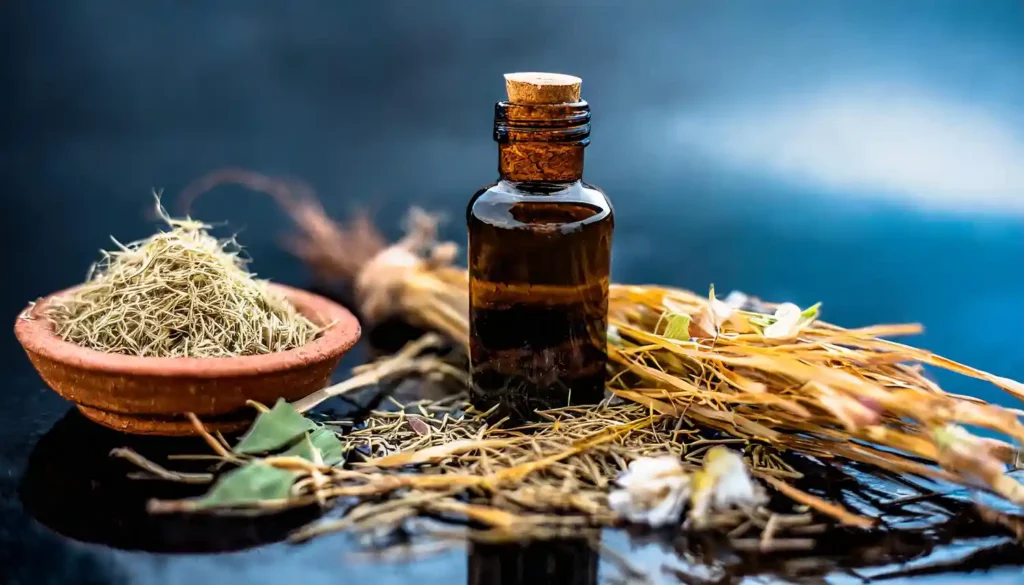
Vetiver essential oil is extracted via steam distillation from the roots of Vetiveria zizanioides (also classified as Chrysopogon zizanioides), a perennial grass native to South and Southeast Asia.
Indonesia — particularly Java — is one of the world's top producers, supplying a significant portion of the global fragrance and aromatherapy industry.
Unlike most essential oils extracted from flowers or leaves, vetiver oil comes from the roots — which gives it a distinctively rich, earthy, smoky, and woody aroma with strong fixative properties.
It is one of the most complex essential oils in terms of chemical composition, containing over 100 identified compounds.
The primary bioactive compounds include khusimol (12–15%), alpha-vetivone, beta-vetivone, valerenol, and epizizanal — a combination of sesquiterpene alcohols and ketones that gives vetiver its characteristic scent and therapeutic properties.
→ Explore the broader applications: What Is Vetiver Oil Good For?
The Science: Vetiver Essential Oil Sedative Effect Studies

The claim that vetiver oil has sedative properties is not just anecdotal. Several peer-reviewed studies have investigated this, though it is important to understand what the research actually shows — and what it does not.
Study 1: TISTR Thailand (2003) — Inhalation & Open-Field Test
The most frequently cited study on vetiver's sedative effect was conducted by the Thailand Institute of Scientific and Technological Research (TISTR). Published in the ICV3 Proceedings and later indexed in Semantic Scholar and ResearchGate:
- Researchers used male Wistar rats divided into 3 groups: vetiver oil, lavender oil (positive control), and distilled water (control)
- Rats inhaled the oils for 1 hour, then rested 30 minutes before an open-field motility test
- Vetiver oil significantly reduced rearing motility — a key indicator of sedation and reduced anxiety
- Vetiver outperformed lavender in reducing rearing motility, though lavender reduced overall crossing motility more
- Conclusion: 'Vetiver oil possesses sedation effect in agreement with traditional use' (Thubthimthed et al., 2003)
| Key Compound Identified The study identified khusimol as the dominant compound (12.71%) — a sesquiterpene alcohol that was previously found to inhibit vasopressin binding in rat liver, suggesting CNS activity. |
Study 2: PMC4805151 — Systematic Review of Essential Oils for Insomnia
A comprehensive systematic review published on PubMed Central (PMC4805151) examined the evidence for essential oils in treating insomnia. Key findings relevant to vetiver:
- The review covered multiple essential oils including lavender, chamomile, valerian, and vetiver
- Vetiver was identified among oils with sedative and anxiolytic properties based on preclinical evidence
- The olfactory stimulation pathway was confirmed as the primary mechanism: aromatic compounds activate the olfactory nerve → limbic system → hypothalamus
- The authors noted that while animal studies are promising, well-controlled human clinical trials remain limited
Study 3: Lavender, Cedarwood & Vetiver Comparison (Indonesian University)
A study from Universitas Katolik Widya Mandala Surabaya compared the sedative effects of lavender, cedarwood, and vetiver essential oils. This is one of the few studies directly comparing vetiver against other commonly used sleep-support oils:
- All three oils demonstrated sedative properties via inhalation
- The comparative study supports the traditional use of vetiver as part of a multi-oil sleep protocol
- Cedarwood's cedrol was identified as having a similar CNS-calming mechanism to vetiver's khusimol
How Does Vetiver Oil Work for Sleep? The Mechanism Explained
Understanding the mechanism helps explain why inhalation — not topical use — is the most scientifically supported method for sleep benefits.
Khusimol and the CNS: The Active Compound
Khusimol is a sesquiterpene alcohol and the dominant compound in vetiver oil (12–15% of total composition). Research has identified several ways it may interact with the central nervous system:
- Inhibits vasopressin V1a receptor binding in rat liver (Rao et al., 1994) — vasopressin is a neuropeptide involved in stress response
- Potential GABAergic activity — GABA (gamma-aminobutyric acid) is the primary inhibitory neurotransmitter; compounds that enhance GABA activity promote relaxation and sleep
- Reduces locomotor activity in open-field tests, a well-established marker of CNS sedation
The Olfactory-Limbic Pathway: How Aromatherapy Reaches the Brain
When you inhale vetiver oil, the mechanism works as follows:
- Aromatic molecules (khusimol, vetivone) enter the nasal cavity
- They bind to olfactory receptor neurons in the olfactory epithelium
- Signals travel directly to the olfactory bulb — bypassing the blood-brain barrier
- The olfactory bulb connects directly to the limbic system, including the amygdala (emotion regulation) and hippocampus (memory and stress)
- The hypothalamus receives signals that modulate cortisol production, heart rate, and sleep-wake cycles
- Result: reduced arousal, decreased anxiety, and increased readiness for sleep
This pathway explains why vetiver works faster via inhalation than topical application for sleep — the olfactory nerve provides a direct route to the brain regions that govern sleep.
Vetiver Oil Benefits for Brain Function
Beyond sleep, the same sedative mechanism contributes to vetiver's broader cognitive and emotional benefits:
- Reduced anxiety and mental chatter — the primary reason people use vetiver for sleep is difficulty 'turning off' the mind
- Grounding effect — vetiver is often described as the most grounding essential oil, helping center attention and reduce rumination
- Potential support for ADHD: some practitioners use vetiver in focus protocols, though scientific evidence is limited
- Cortisol reduction: animal studies suggest vetiver inhalation may lower stress hormone levels
Evidence Review: Does Vetiver Essential Oil Really Help with Sleep?

Here is an honest summary of where the evidence stands:
| Evidence Type | Strength | What It Shows | Limitation |
| Animal studies (rat inhalation) | Moderate | Sedative effect via open-field test; rearing motility reduction | Animal-to-human extrapolation not guaranteed |
| Systematic reviews (PMC) | Moderate | Vetiver listed among EOs with sedative/anxiolytic properties | Based on preclinical evidence |
| Traditional use (centuries) | Supportive | Used in Ayurveda & Southeast Asian medicine for insomnia | Anecdotal; not controlled |
| Human RCTs | Weak | Very limited — no large-scale controlled trials specifically on vetiver & sleep | Gap in research — needed for clinical recommendations |
| Mechanism research | Moderate | Khusimol → CNS activity via olfactory-limbic pathway | Exact receptor binding in humans not fully mapped |
Bottom line: vetiver essential oil has a sound theoretical mechanism and supporting preclinical evidence for sleep benefits. It is not a clinically proven sleep treatment, but it is a reasonable, low-risk addition to a sleep hygiene protocol. The evidence is comparable to — or stronger than — many other popular natural sleep aids.
How to Use Vetiver Essential Oil for Sleep
The scientific studies on vetiver's sedative effect all used inhalation as the delivery method. Here are the three most practical approaches, from most to least evidence-backed.
Method 1: Ultrasonic Diffuser (Most Evidence-Backed)
This is the closest home method to the inhalation protocols used in scientific studies.
- Add 4–6 drops of vetiver essential oil to an ultrasonic diffuser with water
- Run the diffuser in your bedroom 30–60 minutes before sleep
- If vetiver's earthy scent is too intense alone, blend with lavender (see blends section below)
- Session duration: 30–60 minutes — prolonged exposure throughout the night is not necessary
| Diffuser Tip Vetiver oil is thick and viscous — it may clog some diffusers. Use a diffuser with a wider reservoir or pre-dilute 2–3 drops in 1 tsp of carrier oil before adding to the water. |
Method 2: Pillow Spray (DIY Recipe)
A pillow spray is one of the simplest and most pleasant ways to use vetiver for sleep:
- Base: 60ml distilled water + 10ml witch hazel or vodka (as emulsifier)
- Essential oils: 8 drops vetiver + 6 drops lavender + 4 drops Roman chamomile
- Combine in a small dark glass spray bottle, shake well before each use
- Spray 2–3 times onto pillowcase 5–10 minutes before lying down
- Store in a cool, dark place — use within 3 months
Method 3: Topical Application — Dilution & Placement
For topical use before sleep, vetiver's grounding scent works well when applied to pulse points or the soles of feet:
| Application Area | Dilution | Drops in 1 tsp Carrier Oil | Notes |
| Soles of feet | 2% | 6 drops | Foot skin is thick; well-absorbed; traditional Ayurvedic application point |
| Wrists / inner elbows | 1–2% | 3–6 drops | Pulse points enhance scent diffusion through body heat |
| Back of neck / temples | 1% | 3 drops | Use sparingly; avoid eye area |
| Chest / décolletage | 2–3% | 6–9 drops | Allows inhalation throughout the night while lying down |
Recommended carrier oils for sleep blends: jojoba oil (skin-compatible, absorbs well), fractionated coconut oil (light, odorless), or sweet almond oil (slightly warming, traditional massage oil).
Best Essential Oil Blends with Vetiver for Sleep
Vetiver's deep base note pairs beautifully with other sleep-supporting essential oils. As the most grounding of all essential oils, it acts as a fixative in blends — extending the scent life of lighter top notes.
| Blend Name | Recipe | Sleep Benefit | Scent Profile |
| Classic Grounding Blend | 3 drops vetiver + 3 drops lavender + 2 drops Roman chamomile | Deep relaxation; addresses anxiety + sleep onset | Earthy-floral, calming |
| Forest Night Blend | 3 drops vetiver + 3 drops cedarwood + 2 drops sandalwood | Grounding + sedative; excellent for racing thoughts | Deep woody, masculine |
| Vetiver & Bergamot Blend | 2 drops vetiver + 4 drops bergamot + 2 drops ylang ylang | Mood-lifting + calming; good for stress-related insomnia | Citrus-earthy, exotic |
| Simple 2-Oil Blend | 4 drops vetiver + 4 drops lavender | Simplest evidence-backed combination; mirrors study protocols | Clean, earthy-floral |
→ For more blending ideas: Vetiver Oil Complementary Essential Oil Pairings
Indonesian Vetiver Oil: Why Origin Matters for Sleep Benefits
Not all vetiver oils are created equal. The geographic origin significantly affects the chemical composition — and therefore the therapeutic properties.
| Origin | Primary Compounds | Scent Profile | Purity / Market Grade |
| Indonesia (Java) | High khusimol content, balanced vetivone ratio | Smooth, woody, sweet-earthy — considered gold standard | Preferred by French perfumers and aromatherapists |
| Haiti | Higher alpha-vetivone, more pungent | Smoky, woody, more intense — slightly harsher | Strong market presence; common in US market |
| India (Rajasthan) | Different sesquiterpene ratio; aged preferred | Softer, more rosy-earthy when aged | Traditional Ayurvedic khus oil — different chemotype |
| Sri Lanka | Sri Lanka ecotype — used in TISTR study | Earthy, moderate intensity | Research grade; used in sedation studies |
Indonesian vetiver — particularly from Java — is prized for its smoother, more balanced khusimol-to-vetivone ratio.
This makes it suitable for both aromatherapy applications (where a smoother scent profile aids relaxation) and high-end perfumery.
→ Learn more about Indonesian vetiver: Vetiver Essential Oil History & Origins
Safety Considerations & Who Should Avoid Vetiver Oil
Vetiver essential oil is considered one of the safer essential oils — it has a low sensitization rate and is not photosensitizing. However, standard essential oil safety guidelines apply:
| Group | Recommendation |
| Pregnant women | Avoid in first trimester. Consult healthcare provider before use in second/third trimester. |
| Children under 6 | Not recommended. For children 6–12, dilute to 0.5% and limit use. |
| People with low blood pressure | Vetiver's sedative effect may further lower blood pressure — use cautiously. |
| People on CNS medications | Possible additive sedative effect — consult doctor before regular aromatherapy use. |
| Pets | Keep diffusers in ventilated rooms; cats and dogs are more sensitive to essential oil inhalation. |
| General topical use | Always dilute to 1–3% in carrier oil. Perform 48-hour patch test before first use. |
⚕️ Medical Disclaimer: This article is for informational purposes only and does not constitute medical advice. Vetiver essential oil is not a treatment for insomnia or any medical condition. If you have chronic sleep disorders, consult a qualified healthcare provider.
| How to Use Vetiver Essential Oil for Sleep The most evidence-backed method for using vetiver essential oil for sleep is inhalation via a diffuser: 1. Add 4–6 drops of vetiver essential oil to an ultrasonic diffuser with water 2. Run in your bedroom 30–60 minutes before sleep 3. Optional: blend with 3–4 drops of lavender oil for a more balanced scent 4. For topical use: dilute 2% in jojoba oil (6 drops per 1 tsp) and apply to soles of feet or wrists before bed 5. For a pillow spray: 8 drops vetiver + 6 drops lavender in 60ml distilled water + 10ml witch hazel Vetiver oil is the most grounding essential oil — its earthy, woody scent activates the olfactory-limbic pathway, reducing anxiety and promoting sleep readiness. |
Source Indonesian Vetiver Essential Oil in Bulk
For aromatherapy product manufacturers, cosmetic formulators, and fragrance houses looking for consistent, certified vetiver oil supply — Global Essential Oil offers:
- 100% pure Vetiveria zizanioides essential oil from Indonesian (Java) farms
- GC-MS certificate of analysis available on every batch
- Halal certified; MSDS and COA documentation provided
- Flexible MOQ for B2B buyers — from sample to bulk container
- Direct from manufacturer — no middleman pricing
→ Explore our Indonesian Vetiver Essential Oil product page or contact us for a quote.
→ Also available: Vetiver Oil Uses in Perfumery — guide for fragrance buyers.