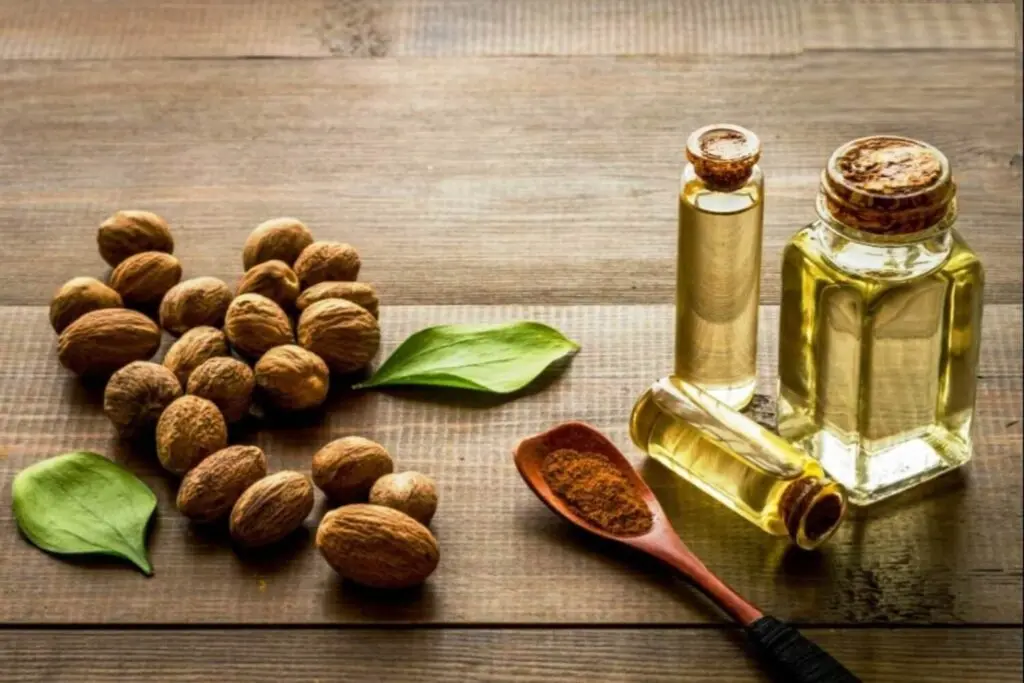
Nutmeg essential oil is made by distilling the aromatic compounds from the dried seeds, or kernels, of the nutmeg tree (Myristica fragrans).
In a typical steam-distillation process, prepared nutmeg material is exposed to steam, the aromatic vapor is cooled back into liquid, and the essential oil is separated from water.
What sounds like one simple extraction step actually depends on several earlier decisions: selecting sound seeds, drying them properly, and preparing the kernels for consistent distillation.
Below, we follow the process from the ripe nutmeg fruit to the finished oil, then explain what affects its quality and why production methods matter to commercial buyers.
What Part of the Nutmeg Plant Is Used to Make Essential Oil?
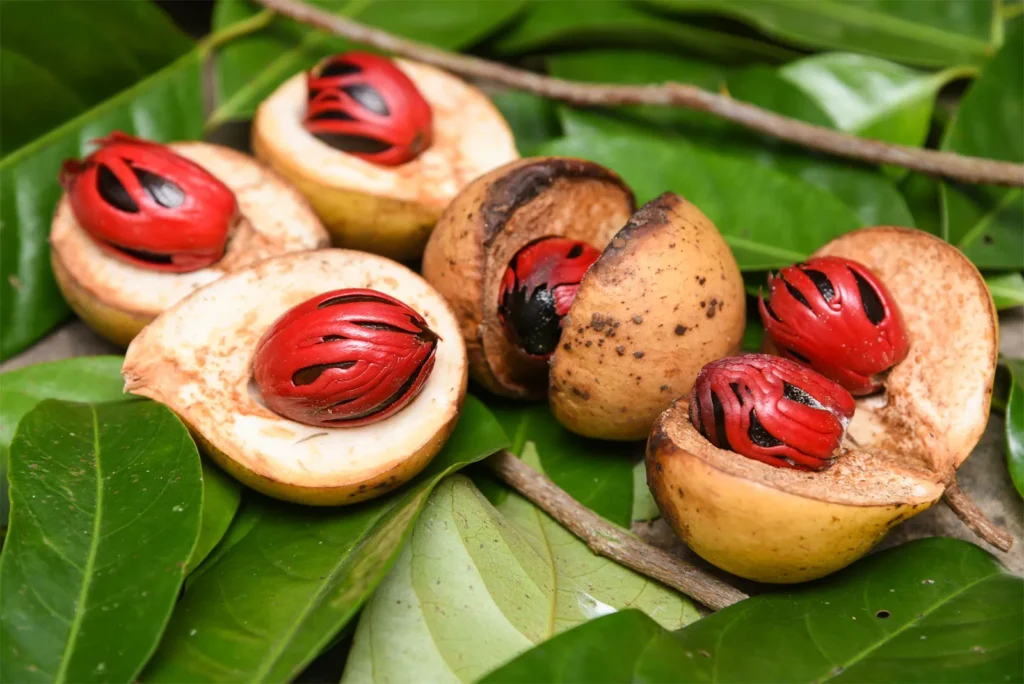
A ripe nutmeg fruit opens to reveal a seed wrapped in a bright red, lace-like covering called mace. Under the hard seed shell sits the kernel commonly sold as the spice nutmeg.
Nutmeg essential oil is most commonly distilled from dried kernels, while mace essential oil comes from the separate aril. Although both materials come from the same tree, they are not interchangeable.
The plant part matters because it affects the material being processed and the expected aroma profile. For a detailed comparison, read our guide to the difference between nutmeg oil and mace oil.
How Nutmeg Essential Oil Is Made: Step-by-Step Process
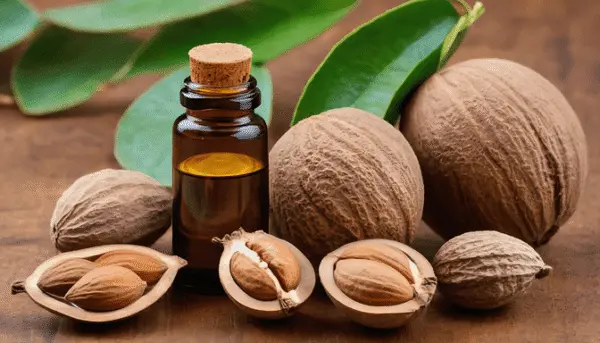
The following sequence describes a common industry production route. Exact equipment, drying conditions, batch sizes, and distillation settings vary between producers; it is not a claim that every facility uses one identical procedure.
1. Harvesting and Selecting Nutmeg Seeds
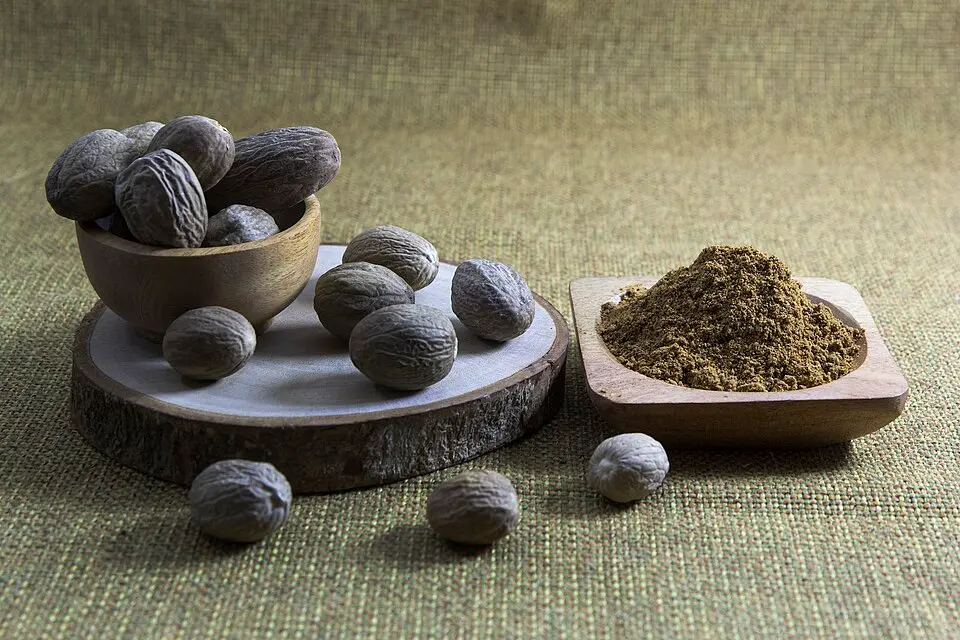
Production begins with mature fruit from Myristica fragrans trees.
Once the fruit ripens and splits, the seed can be collected and separated from the surrounding fleshy fruit and mace. The mace is handled as a different spice material.
Processors then sort the seeds, removing visibly damaged, contaminated, or unsuitable raw material.
This early selection helps reduce variability before the seeds reach the distillation stage.
Consistent raw material is especially important when multiple batches must meet the same buyer specification.
2. Drying and Preparing the Nutmeg Kernels
After harvest, nutmeg seeds are dried to prepare them for storage and processing. The dried seed is cracked to remove its hard shell, leaving the aromatic kernel.
Drying and storage need to be managed carefully: excessive moisture can compromise raw-material quality, while poor handling can affect aroma and cleanliness.
Before distillation, kernels may be crushed or ground to expose more of the aromatic material. Particle size matters.
Pieces that are too large may distill unevenly; material ground too finely can compact and interfere with vapor movement in some equipment designs. The correct preparation depends on the still and production method.
3. Extracting Nutmeg Oil Through Steam Distillation

Prepared nutmeg is placed in a distillation vessel where steam contacts the aromatic plant material. Heat and moisture help release volatile compounds, and the moving steam carries these compounds out of the vessel as part of a vapor mixture.
Unlike pressing nutmeg for its fatty oil, steam distillation targets the volatile aromatic fraction.
That distinction explains why nutmeg essential oil is a fluid fragrance or flavor ingredient rather than the semi-solid product sometimes called nutmeg butter.
If you want a broader explanation of stills and vapor separation across different botanicals, our essential oil steam distillation guide covers the general process. Here, the focus remains on nutmeg seeds.
4. Cooling and Condensing the Vapor
The vapor leaving the still enters a condenser. As it cools, the vapor turns into a liquid mixture containing water and distilled aromatic compounds.
This step captures the oil without requiring the collected product to remain at distillation temperature.
Stable cooling and appropriate equipment operation help maintain a controlled collection process.
However, there is no single condenser design or operating setting that should be assumed for every nutmeg producer.
5. Separating the Essential Oil from Water
The condensed liquid flows to a receiver or oil separator. Because the essential oil and water do not fully mix, the oil can be separated from the aqueous phase.
Depending on the equipment and the condition of the condensate, additional settling or careful handling may be needed to obtain a clean oil fraction.
The resulting nutmeg essential oil is typically colorless to pale yellow and has a distinctive warm, spicy, woody aroma.
Its exact appearance and sensory character should be evaluated against the specification for the batch, not assumed from a generic description alone.
The FAO reference on nutmeg constituents identifies steam distillation of dried kernels as a usual route to the essential oil.
6. Quality Checking and Storing the Finished Oil
After collection, the oil should be assessed according to its intended use and quality requirements.
Checks may include appearance, odor, identification of the botanical source, physical properties, and a chemical profile obtained by chromatography.
Producers or suppliers also need appropriate batch identification and handling records.
Finished oil is generally stored in properly closed, suitable containers with protection from excessive heat and light.
The aim is to preserve product condition and maintain traceability from the supplied batch to its records.
What Affects the Quality and Yield of Nutmeg Essential Oil?
Two nutmeg oil batches can differ even when both are correctly described as steam-distilled Myristica fragrans seed oil.
The final result depends on the raw material and the extraction process rather than on the plant name alone.
- Raw-material condition: maturity, origin, seed selection, and handling can influence the starting aromatic material.
- Drying and kernel preparation: moisture, storage, and particle size affect how the material behaves during distillation.
- Extraction method and settings: steam contact, equipment configuration, and collection practices can influence the recovered oil.
- Distillation duration: different aromatic compounds do not necessarily appear in identical proportions throughout a run.
- Post-distillation handling: separation, packaging, and storage affect the condition of the oil delivered for evaluation.
A 2020 peer-reviewed study of nutmeg seed hydrodistillation collected oil fractions at different times and reported substantial differences in their chemical compositions.
In that experiment, some compounds were relatively more prominent early in distillation while others became more concentrated in later fractions.
This is evidence that process timing can change an oil profile—not a universal instruction to distill every commercial batch for a particular number of minutes.
For buyers, the practical lesson is straightforward: quality cannot be judged by extraction method or an advertised yield alone.
A representative sample and agreed specification are more informative than a generic number.
Is Steam Distillation the Only Way to Extract Nutmeg Oil?
Steam distillation is a standard commercial route, but it is not the only technique used in studies of nutmeg’s aromatic constituents.
Hydrodistillation places plant material in water that is heated; water-and-steam systems and direct-steam systems use different ways of bringing vapor into contact with the material.
These setups can differ in how they transfer heat and collect the volatile fraction.
Research also explores alternatives such as supercritical CO₂ extraction. However, extracts obtained by different techniques may contain different proportions of volatile and less-volatile substances.
They should not automatically be treated as the same commercial ingredient or substituted without specification and formulation review.
Nutmeg oleoresin is another distinct product: it can contain a broader range of extracted spice constituents than the distilled essential oil.
Our nutmeg essential oil vs. oleoresin comparison explains why buyers should distinguish these ingredient formats.
How Is Nutmeg Essential Oil Quality Evaluated for Commercial Use?
For fragrance, cosmetics, or flavor development, a buyer usually needs more than a statement that an oil is “natural” or “steam-distilled.”
The evaluation should start with the product identity and intended application, then move to a batch-specific sample and the relevant supporting documents.
Useful questions to raise with a supplier include:
- Is the botanical name Myristica fragrans and is the declared plant part the seed/kernel?
- Which distillation method was used and how is the batch identified?
- Does the offered material match an agreed odor profile and applicable physical or chemical specifications?
- What batch-specific COA, GC-MS data, SDS, and other documents are available for review?
- Does a trial sample perform consistently in the buyer’s actual formulation?
A GC-MS report can help characterize the volatile composition, but it is only one part of material approval. Sensory assessment, intended-use requirements, documentation, and consistency between samples and supply batches also matter.
For commercial sourcing, Global Essential Oil offers Indonesian nutmeg essential oil.
Buyers can review the product overview and contact our team to confirm current specifications, available documentation, sample arrangements, packaging, and quantities for their requirements.
Final Thoughts
Nutmeg essential oil production starts long before steam enters a still.
Mature seed selection, controlled drying, kernel preparation, vapor collection, oil separation, and appropriate quality checks all help determine what reaches the final container.
Understanding these stages makes it easier to evaluate why two products from the same botanical species may differ in aroma and chemical profile.
If you are sourcing nutmeg essential oil from Indonesia for formulation or bulk purchasing, contact the Global Essential Oil team with your intended use, target specifications, required quantity, and destination.
We can discuss the available product information and next steps for evaluation.
Frequently Asked Questions
Is nutmeg essential oil made from the seed or mace?
Nutmeg essential oil is typically made from dried nutmeg seed kernels. Mace is the separate lacy aril surrounding the seed and can be used to produce mace oil, which is a different ingredient.
How long does nutmeg essential oil distillation take
There is no universally correct duration. It depends on the equipment, raw-material preparation, process conditions, and target oil profile. Research shows that collecting oil at different stages can produce fractions with different compositions, so a single fixed time should not be presented as an industry rule.
Can you make nutmeg essential oil at home?
True essential oil requires distillation equipment and careful handling of heat, steam, and concentrated aromatic material. Soaking ground nutmeg in a carrier oil makes an infused oil, not steam-distilled nutmeg essential oil. Home infusions should not be described or sold as the same product.
Is nutmeg essential oil the same as nutmeg oleoresin?
No. Nutmeg essential oil mainly contains the volatile fraction recovered by distillation, while oleoresin is produced through a different extraction route and may include non-volatile spice components. They can behave differently in manufacturing and are not automatic substitutes.