
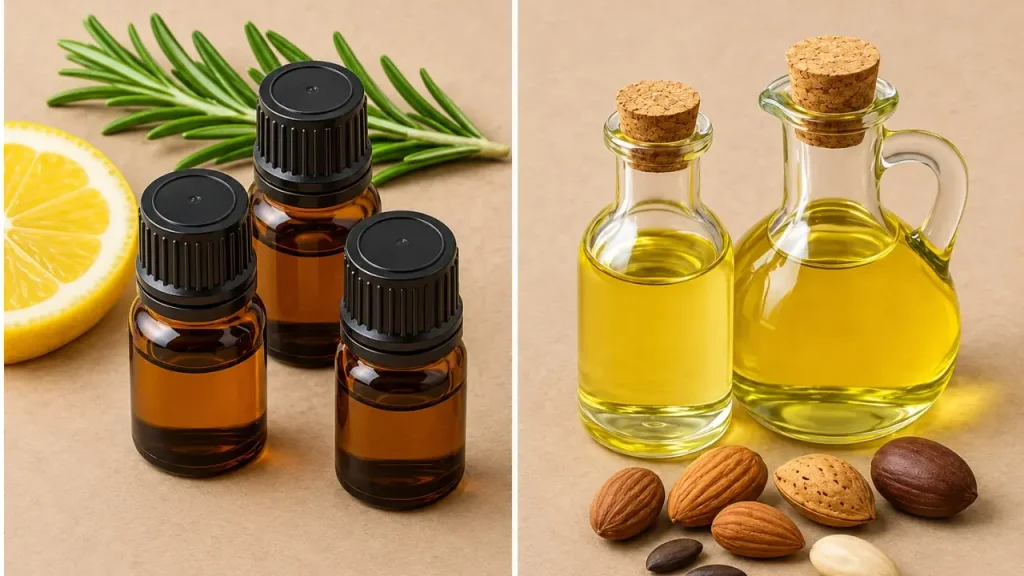
Essential oil vs carrier oil: what is the difference? Essential oils are concentrated, aromatic substances extracted from botanical materials. Carrier oils are generally nonvolatile, lipid-rich oils used as bases in skincare, massage, haircare, and other oil-based products. They can work together, but they do different jobs.
If you have ever wondered why a few drops of essential oil are often combined with a larger quantity of another oil, this guide explains the chemistry in plain language, how to choose a suitable carrier, and what safe dilution actually means.
What Is the Difference Between Essential Oil and Carrier Oil?
The easiest way to distinguish them is by purpose: essential oil usually contributes a concentrated botanical aroma; carrier oil provides the oily base that carries or disperses other ingredients. Neither category tells you, on its own, whether a particular product is safe for every application.
| Factor | Essential oil | Carrier oil |
|---|---|---|
| Typical source | Aromatic plant parts | Seeds, nuts, fruits, or other oil-rich materials |
| Main chemistry | Mostly volatile aromatic compounds | Mostly lipids; jojoba is rich in wax esters |
| Aroma | Often distinctive and concentrated | Usually mild; some have a noticeable natural scent |
| Evaporation | Relatively volatile | Generally low-volatility |
| Feel and texture | Not necessarily oily or greasy | Usually emollient and oily |
| Common role | Fragrance ingredient | Base, emollient, or diluent |
| Topical use | Requires ingredient-specific safety review and suitable dilution | Some can be used alone, depending on product and individual |
| Examples | Patchouli, nutmeg, citronella | Virgin coconut, jojoba, sweet almond |
Both are called “oils,” but essential oils are not the same as fatty oils such as coconut or almond oil. The difference affects how they behave in a formula, not just how they smell.
What Are Essential Oils and Carrier Oils?
What Is an Essential Oil?
An essential oil is an aromatic material obtained from a defined botanical source. Steam distillation is widely used for leaves, flowers, woods, and seeds; certain citrus peel oils are mechanically expressed instead. A finished oil contains a complex mixture of naturally occurring aroma compounds, and its profile can vary with plant part, origin, and processing.
For example, Indonesian patchouli essential oil comes from Pogostemon cablin leaves, nutmeg essential oil comes from Myristica fragrans seed, and citronella oil comes from aromatic grass. These are concentrated aromatic ingredients, not everyday moisturizing oils.
What Is a Carrier Oil?
A carrier oil is a lipid-rich material used as a base in products applied to the skin or hair. Many carrier oils are pressed or otherwise extracted from seeds, kernels, or fruits. Their fatty-acid composition influences feel, spreadability, oxidation stability, and whether they remain liquid at room temperature.
Jojoba is an important exception to the usual triglyceride description: it is technically a liquid wax, but it commonly functions as a carrier in cosmetic blends. Carrier oils are not merely “filler.” They influence the finished product’s texture and user experience.
5 Key Differences Between Essential Oils and Carrier Oils
1. How They Are Produced
Essential oils are commonly recovered by distillation or appropriate mechanical expression, which concentrates volatile aroma constituents. Carrier oils are obtained from oil-bearing plant materials through methods such as pressing and extraction. These different processes explain why their final compositions and uses are not interchangeable.
2. Chemical Composition and Concentration
Essential oils contain multiple volatile constituents, including terpenes and other aromatic molecules. Carrier oils are primarily made up of fatty substances. An essential oil may be used at a low proportion of a finished topical formulation, while a carrier oil may form most or all of that formulation.
3. Aroma, Texture, and Volatility
Patchouli smells earthy and woody; citronella has a green, lemon-like character. Jojoba and grapeseed oils tend to have relatively restrained aromas, while virgin coconut oil can retain a noticeable coconut scent. Essential oils are generally more volatile; carrier oils usually feel oily and evaporate much less readily.
4. Roles in Skincare and Haircare
In a body oil, the carrier creates slip and emollience while a suitably assessed essential oil may contribute fragrance. In hair products, carrier oils can help create a conditioning texture, while essential oils are usually included for their aromatic character. Neither type should be assigned treatment claims without appropriate evidence and product-specific evaluation.
5. Storage and Shelf Life
Carrier oils can degrade through oxidation, resulting in rancid odors and changes in quality. Essential oils can also oxidize, potentially altering both aroma and skin-sensitization risk. Shelf life depends on the material, container, storage, and handling—not simply on whether it is “natural.” Keep containers properly closed and follow supplier storage instructions.
Why Do Essential Oils Need Carrier Oils?
For many leave-on skin applications, essential oils must be used at carefully assessed concentrations. A compatible carrier oil makes it possible to spread a much smaller quantity of essential oil through the finished blend, while also contributing a usable texture. It does not chemically neutralize an irritating or sensitizing ingredient.
Dilution helps manage exposure, but it is not a guarantee of safety. Some essential oils have stricter dermal limits because of their constituent profile, and some skin conditions or users require extra caution. For a practical explanation of why the exact percentage matters, see the Tisserand Institute’s guidance on essential oil dilution.
How to Choose the Right Carrier Oil for Essential Oils
Start with the finished product: a roll-on, facial oil, body balm, scalp oil, or massage blend does not necessarily need the same base. Consider texture, natural scent, temperature behavior, oxidation stability, and any relevant allergies or ingredient restrictions.
| Carrier oil | Typical character | Selection consideration |
|---|---|---|
| Virgin coconut oil | Distinct coconut character; can become solid in cooler conditions | Useful in some body and hair products; check texture and compatibility |
| Fractionated coconut oil | More fluid, usually milder in aroma | Often selected for roll-ons and light oil blends; different from VCO |
| Jojoba | Light, smooth liquid wax | Useful for face and body oils; assess the finished feel |
| Sweet almond oil | Soft, emollient feel | Common in massage blends; consider individual allergy history |
| Grapeseed oil | Relatively lightweight texture | Consider oxidation stability and appropriate packaging |
Global Essential Oil has an organic virgin coconut oil product page for buyers evaluating coconut-derived ingredients. Virgin coconut oil should not be confused with fractionated coconut oil: their processing and room-temperature behavior differ. Availability of one does not imply availability of the other.
How to Dilute Essential Oils with Carrier Oils
A safe topical blend starts with knowing the exact essential oil, the intended application, and any material-specific restrictions. Use the following process as a formulation checklist rather than a universal recipe:
- Check the botanical identity, purity, and intended topical suitability of each essential oil.
- Choose a carrier oil appropriate for the desired texture and product type.
- Review ingredient-specific dermal limits and the total amount of restricted constituents in the blend.
- Calculate the essential oil percentage in the finished mixture using one consistent measurement basis, ideally by mass.
- Measure accurately, mix in a clean container, label the ingredients and batch, and evaluate the finished product.
For example, “1% essential oil” means that the essential oil contributes 1% of the total finished blend by the measurement basis used. It does not mean that 1% is appropriate for every essential oil or for every user. Drop counts are unreliable as a precise formulation method because drop size varies.
If you are unsure about a particular oil’s safe use level, do not guess a dilution. Consult reliable technical guidance or a qualified formulator before preparing a skin-contact product.
Essential Oil vs Carrier Oil: Which Should You Use?
For Skincare
A carrier oil can be used by itself in some facial or body oils when it suits the person and product. Essential oils may be introduced for scent, but they require a separate safety assessment. If you are exploring a specific aromatic ingredient, our patchouli oil skincare overview discusses a product-specific context rather than an all-purpose dilution rule.
For Haircare
Carrier oils can contribute shine, slip, and the feel of an oil-based hair product. Essential oils may supply a scent profile, but are not a substitute for the carrier’s emollient role. Choose ingredients according to whether the formula is a rinse-off product, leave-on scalp oil, or hair treatment, and assess accordingly.
For Massage and Body Oils
Massage oils commonly rely on a carrier oil to provide spreadability and a comfortable texture. Essential oils, if used, should be screened for skin-contact suitability and added at an appropriate, material-specific concentration. For a related example of oil-based fragrance formulation, see our beginner’s guide to perfume with essential oils.
Are Essential Oils and Carrier Oils Safe for Skin?
Neither category is universally risk-free. Undiluted essential oils can cause skin irritation or allergic sensitization. Some citrus essential oils have phototoxicity concerns in certain forms and uses. Carrier oils may also be unsuitable for certain individuals or applications, including where relevant allergies, product stability, or skin tolerance are concerns.
Natural origin alone is not evidence of safety. The US FDA’s aromatherapy guidance explains that plant-derived ingredients can still cause adverse skin reactions. For additional context on a specific botanical material, consult our patchouli oil safety guide.
For commercial products, evaluate the complete formula, intended user, application area, exposure, and destination-market requirements. A patch test may identify some reactions but cannot establish that an ingredient is safe for everyone.
Choosing Quality Oils for Cosmetic and Personal Care Manufacturing
For product developers, correct ingredient identification is as important as choosing a pleasant texture or scent. When evaluating essential oils, request botanical name, plant part, origin, product specification, batch information, and appropriate analytical documentation such as a COA or GC-MS report where relevant. For carrier oils, assess parameters appropriate to the material, such as fatty-acid profile, acid value, peroxide value, and storage requirements.
Global Essential Oil supplies Indonesian botanical ingredients for business buyers, including patchouli, nutmeg, citronella, and virgin coconut oil. Before committing to bulk sourcing, buyers can request information about available batches, packaging, samples, and documentation appropriate to their intended formulation. These details help manufacturers compare options on more than aroma or price alone.
Final Thoughts
The simplest difference between essential oil and carrier oil is their job: one contributes concentrated botanical aroma, while the other provides a fatty base, texture, and a way to dilute certain skin-contact formulations. Choosing well means looking beyond the label at composition, intended use, and safety.
If you are developing skincare, personal care, or fragrance products and want to evaluate Indonesian essential oils or virgin coconut oil, contact the Global Essential Oil team to discuss ingredient specifications, available documentation, samples, and sourcing requirements.
Frequently Asked Questions
Can you use carrier oil without essential oil?
Yes. Many carrier oils can be used alone as cosmetic oils, depending on the specific material, individual tolerance, and intended use. Essential oil is not required for a carrier oil to serve as a base or emollient.
Can you apply essential oil directly to your skin?
As a general consumer practice, avoid undiluted topical use. Essential oils are concentrated and may irritate or sensitize skin. Check the exact ingredient’s restrictions and use a suitable, assessed formulation.
Is coconut oil an essential oil or a carrier oil?
Coconut oil is a fatty oil typically used as a carrier or emollient, not a coconut essential oil. Virgin coconut oil and fractionated coconut oil also have different physical and formulation properties.
Is jojoba oil considered a carrier oil?
Yes. Although jojoba is chemically a liquid wax rather than a typical triglyceride oil, it commonly functions as a carrier in skincare and fragrance blends.
Can you use carrier oils in an essential oil diffuser?
Not automatically. Most ultrasonic diffusers are designed for water and manufacturer-approved aromatic materials, not fatty carrier oils. Reed diffusers require a compatible diffuser base; a typical skincare carrier oil may wick poorly. Always follow the device or base supplier’s instructions.