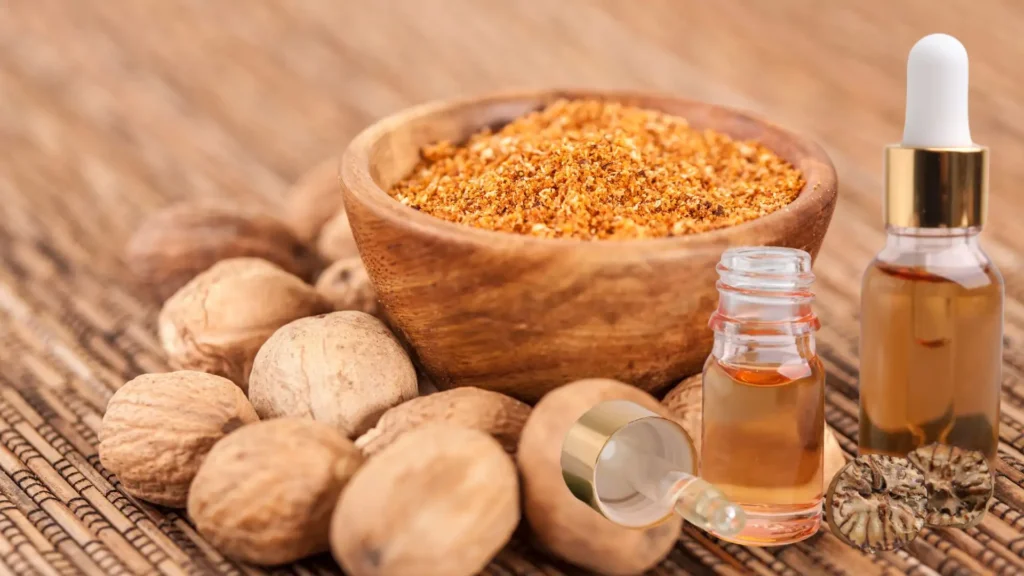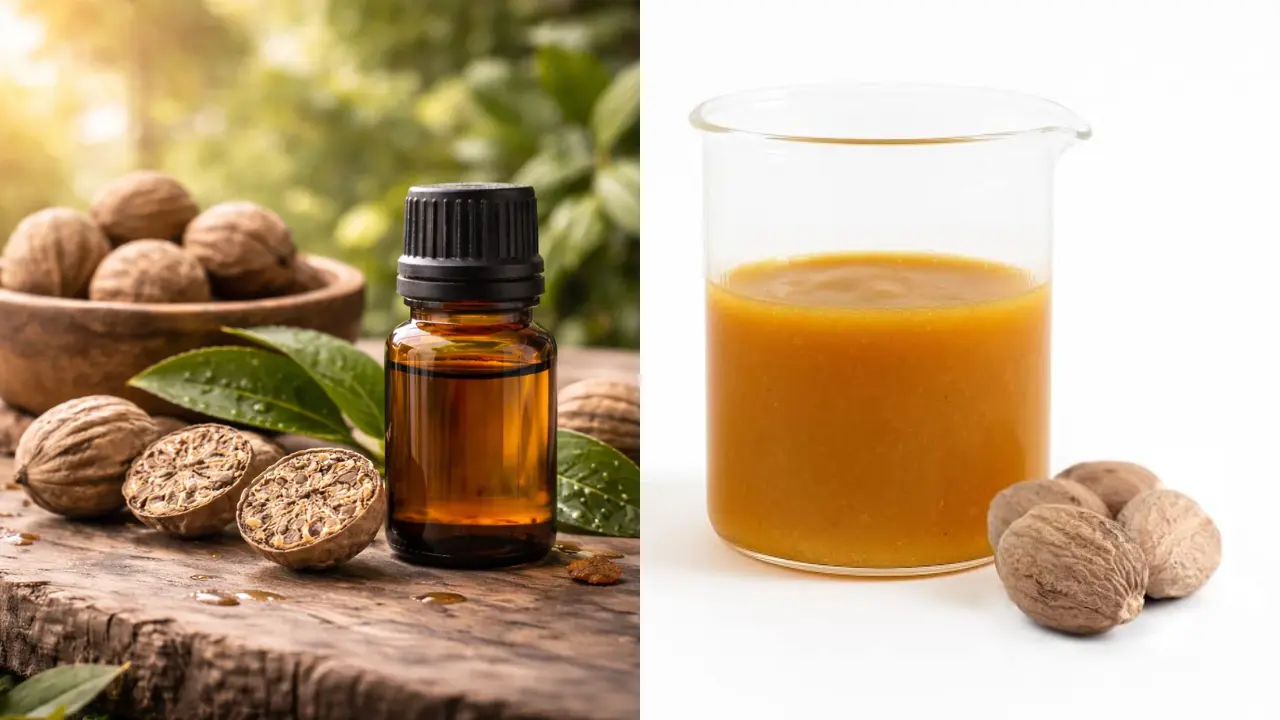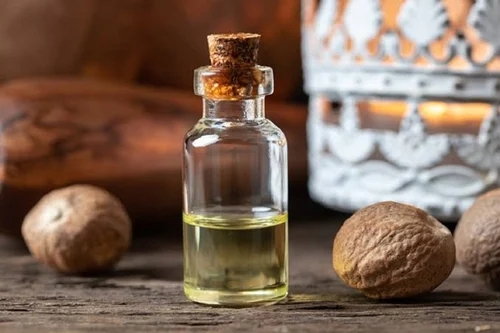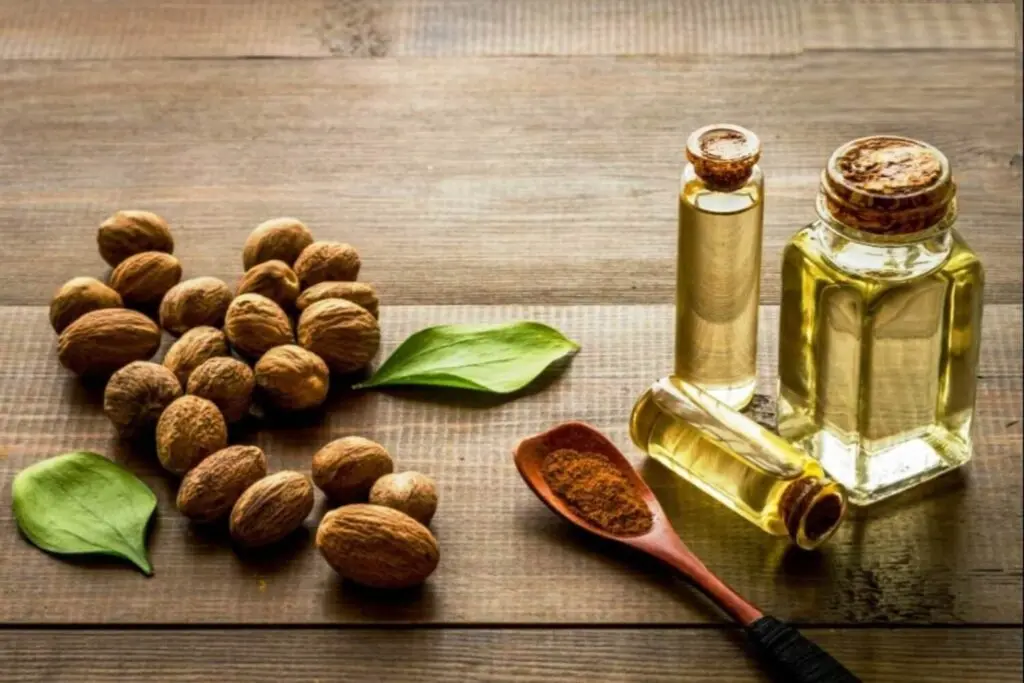
Category: Nutmeg Oil

  • How Nutmeg Essential Oil Is Made: From Seeds to Steam Distillation

    How Nutmeg Essential Oil Is Made: From Seeds to Steam Distillation

    How Nutmeg Essential Oil Is Made

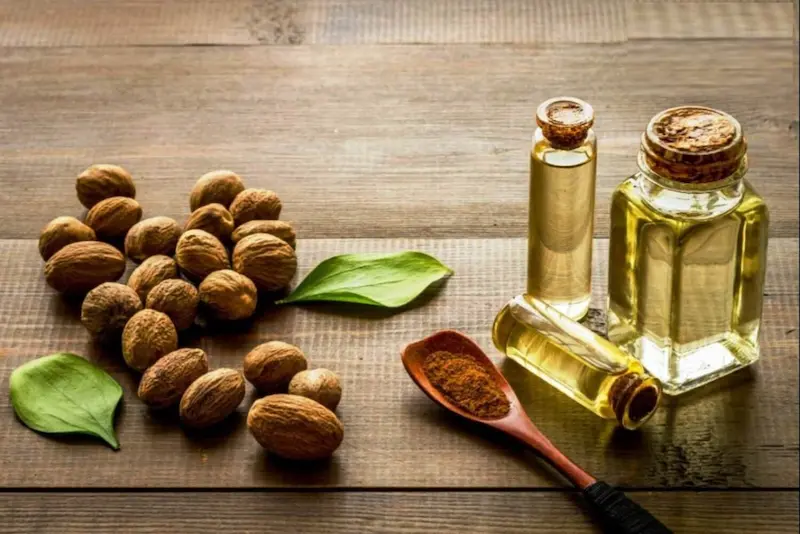
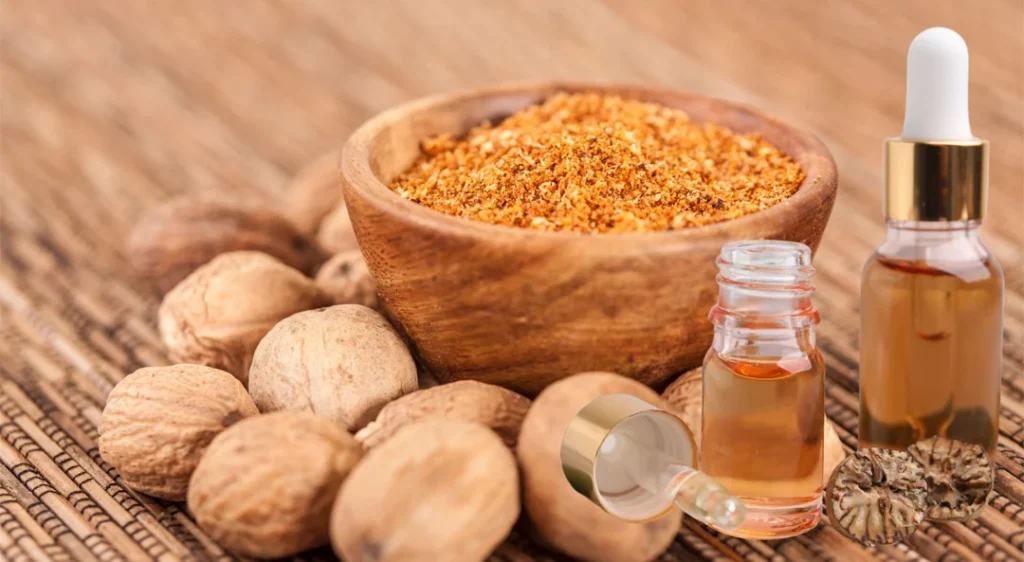
    Nutmeg essential oil is made by distilling the aromatic compounds from the dried seeds, or kernels, of the nutmeg tree (Myristica fragrans).

    In a typical steam-distillation process, prepared nutmeg material is exposed to steam, the aromatic vapor is cooled back into liquid, and the essential oil is separated from water.

    What sounds like one simple extraction step actually depends on several earlier decisions: selecting sound seeds, drying them properly, and preparing the kernels for consistent distillation.

    Below, we follow the process from the ripe nutmeg fruit to the finished oil, then explain what affects its quality and why production methods matter to commercial buyers.

    What Part of the Nutmeg Plant Is Used to Make Essential Oil?

    nutmeg plant

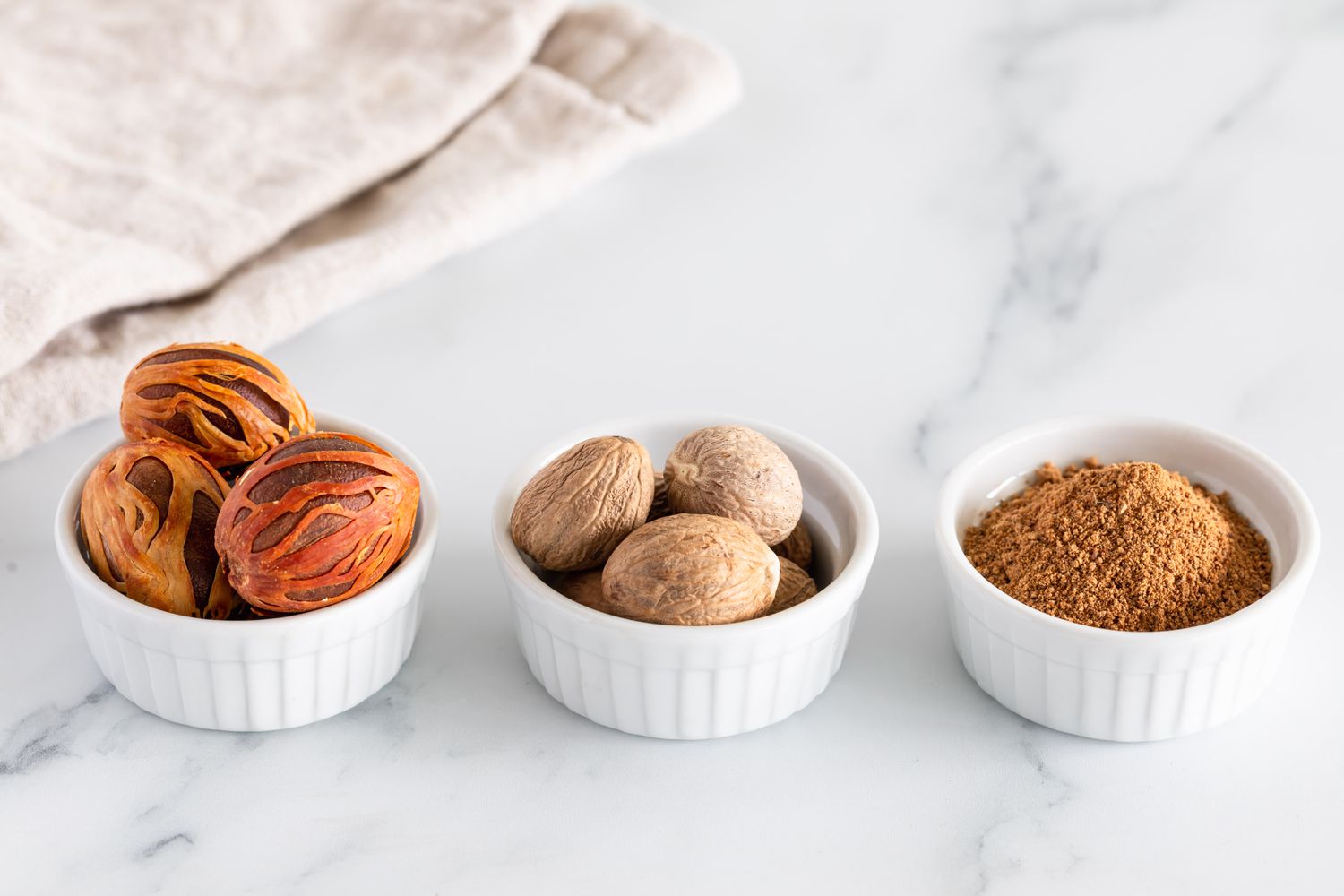
    A ripe nutmeg fruit opens to reveal a seed wrapped in a bright red, lace-like covering called mace. Under the hard seed shell sits the kernel commonly sold as the spice nutmeg.

    Nutmeg essential oil is most commonly distilled from dried kernels, while mace essential oil comes from the separate aril. Although both materials come from the same tree, they are not interchangeable.

    The plant part matters because it affects the material being processed and the expected aroma profile. For a detailed comparison, read our guide to the difference between nutmeg oil and mace oil.

    How Nutmeg Essential Oil Is Made: Step-by-Step Process
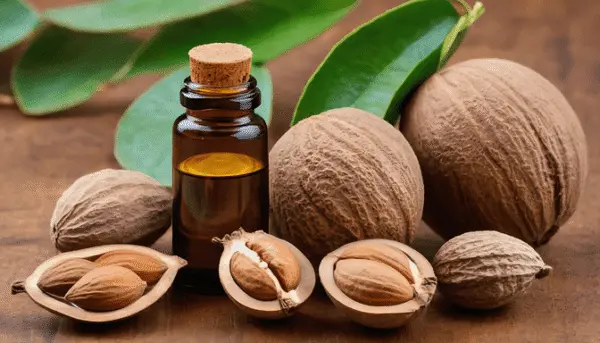
    step by step making nutmeg essential oil

    The following sequence describes a common industry production route. Exact equipment, drying conditions, batch sizes, and distillation settings vary between producers; it is not a claim that every facility uses one identical procedure.

    1. Harvesting and Selecting Nutmeg Seeds
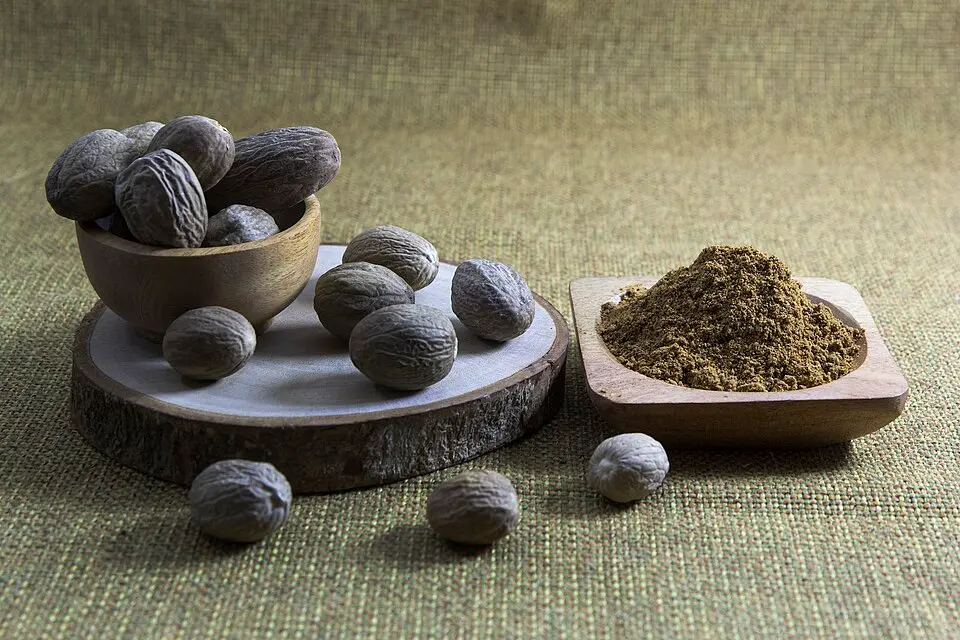
    nutmeg seeds

    Production begins with mature fruit from Myristica fragrans trees.

    Once the fruit ripens and splits, the seed can be collected and separated from the surrounding fleshy fruit and mace. The mace is handled as a different spice material.

    Processors then sort the seeds, removing visibly damaged, contaminated, or unsuitable raw material.

    This early selection helps reduce variability before the seeds reach the distillation stage.

    Consistent raw material is especially important when multiple batches must meet the same buyer specification.

    2. Drying and Preparing the Nutmeg Kernels

    After harvest, nutmeg seeds are dried to prepare them for storage and processing. The dried seed is cracked to remove its hard shell, leaving the aromatic kernel.

    Drying and storage need to be managed carefully: excessive moisture can compromise raw-material quality, while poor handling can affect aroma and cleanliness.

    Before distillation, kernels may be crushed or ground to expose more of the aromatic material. Particle size matters.

    Pieces that are too large may distill unevenly; material ground too finely can compact and interfere with vapor movement in some equipment designs. The correct preparation depends on the still and production method.

    3. Extracting Nutmeg Oil Through Steam Distillation

    Extracting Nutmeg Oil Through Steam Distillation

    Prepared nutmeg is placed in a distillation vessel where steam contacts the aromatic plant material. Heat and moisture help release volatile compounds, and the moving steam carries these compounds out of the vessel as part of a vapor mixture.

    Unlike pressing nutmeg for its fatty oil, steam distillation targets the volatile aromatic fraction.

    That distinction explains why nutmeg essential oil is a fluid fragrance or flavor ingredient rather than the semi-solid product sometimes called nutmeg butter.

    If you want a broader explanation of stills and vapor separation across different botanicals, our essential oil steam distillation guide covers the general process. Here, the focus remains on nutmeg seeds.

    4. Cooling and Condensing the Vapor

    The vapor leaving the still enters a condenser. As it cools, the vapor turns into a liquid mixture containing water and distilled aromatic compounds.

    This step captures the oil without requiring the collected product to remain at distillation temperature.

    Stable cooling and appropriate equipment operation help maintain a controlled collection process.

    However, there is no single condenser design or operating setting that should be assumed for every nutmeg producer.

    5. Separating the Essential Oil from Water

    The condensed liquid flows to a receiver or oil separator. Because the essential oil and water do not fully mix, the oil can be separated from the aqueous phase.

    Depending on the equipment and the condition of the condensate, additional settling or careful handling may be needed to obtain a clean oil fraction.

    The resulting nutmeg essential oil is typically colorless to pale yellow and has a distinctive warm, spicy, woody aroma.

    Its exact appearance and sensory character should be evaluated against the specification for the batch, not assumed from a generic description alone.

    The FAO reference on nutmeg constituents identifies steam distillation of dried kernels as a usual route to the essential oil.

    6. Quality Checking and Storing the Finished Oil

    After collection, the oil should be assessed according to its intended use and quality requirements.

    Checks may include appearance, odor, identification of the botanical source, physical properties, and a chemical profile obtained by chromatography.

    Producers or suppliers also need appropriate batch identification and handling records.

    Finished oil is generally stored in properly closed, suitable containers with protection from excessive heat and light.

    The aim is to preserve product condition and maintain traceability from the supplied batch to its records.

    What Affects the Quality and Yield of Nutmeg Essential Oil?

    Two nutmeg oil batches can differ even when both are correctly described as steam-distilled Myristica fragrans seed oil.

    The final result depends on the raw material and the extraction process rather than on the plant name alone.

    • Raw-material condition: maturity, origin, seed selection, and handling can influence the starting aromatic material.
    • Drying and kernel preparation: moisture, storage, and particle size affect how the material behaves during distillation.
    • Extraction method and settings: steam contact, equipment configuration, and collection practices can influence the recovered oil.
    • Distillation duration: different aromatic compounds do not necessarily appear in identical proportions throughout a run.
    • Post-distillation handling: separation, packaging, and storage affect the condition of the oil delivered for evaluation.

    A 2020 peer-reviewed study of nutmeg seed hydrodistillation collected oil fractions at different times and reported substantial differences in their chemical compositions.

    In that experiment, some compounds were relatively more prominent early in distillation while others became more concentrated in later fractions.

    This is evidence that process timing can change an oil profile—not a universal instruction to distill every commercial batch for a particular number of minutes.

    For buyers, the practical lesson is straightforward: quality cannot be judged by extraction method or an advertised yield alone.

    A representative sample and agreed specification are more informative than a generic number.

    Is Steam Distillation the Only Way to Extract Nutmeg Oil?

    Steam distillation is a standard commercial route, but it is not the only technique used in studies of nutmeg’s aromatic constituents.

    Hydrodistillation places plant material in water that is heated; water-and-steam systems and direct-steam systems use different ways of bringing vapor into contact with the material.

    These setups can differ in how they transfer heat and collect the volatile fraction.

    Research also explores alternatives such as supercritical CO₂ extraction. However, extracts obtained by different techniques may contain different proportions of volatile and less-volatile substances.

    They should not automatically be treated as the same commercial ingredient or substituted without specification and formulation review.

    Nutmeg oleoresin is another distinct product: it can contain a broader range of extracted spice constituents than the distilled essential oil.

    Our nutmeg essential oil vs. oleoresin comparison explains why buyers should distinguish these ingredient formats.

    How Is Nutmeg Essential Oil Quality Evaluated for Commercial Use?

    For fragrance, cosmetics, or flavor development, a buyer usually needs more than a statement that an oil is “natural” or “steam-distilled.”

    The evaluation should start with the product identity and intended application, then move to a batch-specific sample and the relevant supporting documents.

    Useful questions to raise with a supplier include:

    • Is the botanical name Myristica fragrans and is the declared plant part the seed/kernel?
    • Which distillation method was used and how is the batch identified?
    • Does the offered material match an agreed odor profile and applicable physical or chemical specifications?
    • What batch-specific COA, GC-MS data, SDS, and other documents are available for review?
    • Does a trial sample perform consistently in the buyer’s actual formulation?

    A GC-MS report can help characterize the volatile composition, but it is only one part of material approval. Sensory assessment, intended-use requirements, documentation, and consistency between samples and supply batches also matter.

    For commercial sourcing, Global Essential Oil offers Indonesian nutmeg essential oil.

    Buyers can review the product overview and contact our team to confirm current specifications, available documentation, sample arrangements, packaging, and quantities for their requirements.

    Final Thoughts

    Nutmeg essential oil production starts long before steam enters a still.

    Mature seed selection, controlled drying, kernel preparation, vapor collection, oil separation, and appropriate quality checks all help determine what reaches the final container.

    Understanding these stages makes it easier to evaluate why two products from the same botanical species may differ in aroma and chemical profile.

    If you are sourcing nutmeg essential oil from Indonesia for formulation or bulk purchasing, contact the Global Essential Oil team with your intended use, target specifications, required quantity, and destination.

    We can discuss the available product information and next steps for evaluation.

    Frequently Asked Questions

    Is nutmeg essential oil made from the seed or mace?

    Nutmeg essential oil is typically made from dried nutmeg seed kernels. Mace is the separate lacy aril surrounding the seed and can be used to produce mace oil, which is a different ingredient.

    How long does nutmeg essential oil distillation take

    There is no universally correct duration. It depends on the equipment, raw-material preparation, process conditions, and target oil profile. Research shows that collecting oil at different stages can produce fractions with different compositions, so a single fixed time should not be presented as an industry rule.

    Can you make nutmeg essential oil at home?

    True essential oil requires distillation equipment and careful handling of heat, steam, and concentrated aromatic material. Soaking ground nutmeg in a carrier oil makes an infused oil, not steam-distilled nutmeg essential oil. Home infusions should not be described or sold as the same product.

    Is nutmeg essential oil the same as nutmeg oleoresin?

    No. Nutmeg essential oil mainly contains the volatile fraction recovered by distillation, while oleoresin is produced through a different extraction route and may include non-volatile spice components. They can behave differently in manufacturing and are not automatic substitutes.
  • Nutmeg Essential Oil Safety: Risks, Side Effects & B2B Considerations

    Nutmeg Essential Oil Safety: Risks, Side Effects & B2B Considerations

    nutmeg essential oil safety

    Nutmeg essential oil from Myristica fragrans is used in fragrance, flavor, personal care, and other product-development contexts because of its warm, spicy aromatic profile.

    Safety, however, cannot be reduced to a single rule such as “natural means safe” or a universal dilution percentage.

    A practical safety assessment depends on the actual chemical profile of the oil, the intended application, concentration, exposure route, finished-product category, and the regulatory requirements of the target market.

    Nutmeg essential oil can contain constituents such as myristicin, safrole, elemicin, and methyleugenol, so formulators and B2B buyers should review batch-specific analytical documentation rather than rely only on generic descriptions of nutmeg oil.

    This guide explains the main nutmeg essential oil safety considerations, what current scientific and regulatory sources can—and cannot—tell us, and what manufacturers, importers, formulators, and procurement teams should verify before approving a batch for commercial use.

    Is Nutmeg Essential Oil Safe?

    nutmeg essential oil

    Nutmeg essential oil can be used in commercial formulations when its identity, composition, concentration, exposure route, and applicable product standards are properly evaluated.

    It should not be treated as universally safe across all applications, and a safety statement for one use category should not automatically be transferred to another.

    A 2023 European Food Safety Authority assessment of a specific nutmeg-oil feed additive identified myristicin, safrole, elemicin, and methyleugenol in the assessed material and noted skin/eye irritation and skin/respiratory sensitisation concerns for that additive.

    That assessment was conducted for an animal-feed use case, so it should not be read as a universal finished-product limit for cosmetics, fragrance, food, or other applications.

    It does, however, illustrate why composition and intended use matter in a professional safety review.

    What Is Nutmeg Essential Oil?

    What Is Nutmeg Essential Oil?

    Nutmeg essential oil is a volatile oil commonly produced from the seed of Myristica fragrans by steam distillation.

    Its chemical profile can vary with botanical material, origin, processing, distillation conditions, storage, and batch-to-batch variation.

    A scientific review of nutmeg essential oil composition and biological activity reports major constituents that can include sabinene, eugenol, myristicin, beta-myrcene, alpha-pinene, and other volatile compounds.

    Because the profile is variable, buyers should evaluate the actual batch rather than assume every nutmeg oil has the same composition or risk profile.

    For current commercial product information, packaging, and available documentation, see our Nutmeg Essential Oil product page.

    Why Myristicin, Safrole, Elemicin and Methyleugenol Matter

    Nutmeg oil safety discussions often focus on several aromatic constituents because their presence and concentration can affect how a batch is evaluated for a particular end use.

    The key point for B2B buyers is not to judge an oil by one constituent alone, but to understand the complete analytical profile and how relevant standards apply to the intended finished product.

    Myristicin

    Myristicin is one of the characteristic aromatic constituents associated with nutmeg.

    It is frequently discussed in toxicological literature because high exposure to nutmeg or myristicin-containing materials has been associated with adverse effects.

    In a commercial essential-oil context, this is a reason to verify the actual batch composition and intended exposure rather than extrapolate from culinary spice use or from concentrated experimental doses.

    Safrole and Other Restricted Constituents

    Safrole and other constituents may be subject to application-specific restrictions or risk-management requirements depending on the market and finished-product category.

    For fragrance use, the IFRA Standards framework explains that natural complex substances such as essential oils can contribute restricted constituents to the finished product and that formulators must account for the relevant constituent limits for the intended IFRA category.

    This is why a supplier statement such as “nutmeg oil is safe” is not enough for a formulation decision.

    The buyer or finished-product manufacturer needs the batch data and must evaluate it against the requirements that apply to the actual product being developed.

    Potential Risks and Side Effects of Nutmeg Essential Oil

    Global Essential Oil, Nutmeg Essential Oil Safety: Risks, Side Effects & B2B Considerations

    The main safety concerns depend on concentration, exposure route, duration, individual susceptibility, the chemical profile of the oil, and the finished formulation.

    The following categories are more useful than fixed consumer dosing rules because they can be evaluated within a professional product-development process.

    Skin and Eye Irritation

    Concentrated essential oils can irritate skin or eyes, and the EFSA assessment cited above identified the specific nutmeg-oil additive it evaluated as a skin and eye irritant.

    For cosmetics or personal-care products, formulators should assess the complete finished formula, intended use level, leave-on versus rinse-off exposure, target consumer group, and applicable cosmetic safety requirements.

    Sensitization and Respiratory Exposure

    Sensitization risk cannot be evaluated from the product name alone. Material composition, exposure level, use pattern, and finished-product category all matter.

    The same EFSA assessment identified skin and respiratory sensitisation concerns for the assessed additive, reinforcing the importance of controlled handling and application-specific evaluation in industrial settings.

    Ingestion and High-Exposure Risk

    Nutmeg and its constituents have a documented history of adverse effects at high ingestion levels.

    That does not mean every commercial use of nutmeg essential oil creates the same exposure scenario, but it does mean oral or flavor-related applications should be evaluated under the regulations, specifications, and toxicological framework relevant to the target market.

    A general blog article should not be used as a substitute for application-specific safety assessment.

    Pregnancy, Medical Conditions and Personal Therapeutic Use

    Personal medical use is outside the scope of B2B raw-material approval.

    People who are pregnant, breastfeeding, taking medication, or managing a medical condition should not rely on a supplier article for individualized medical advice.

    Commercial formulators should instead follow the safety and regulatory requirements that apply to their product category and market.

    Safety Requirements Differ by Application

    Fragrance and Perfumery

    Fragrance safety should be assessed at the finished-product level.

    Natural essential oils can contain constituents that are restricted under the IFRA Standards, so the relevant IFRA category, finished-product concentration, and contribution from all fragrance materials should be considered together.

    If your team is developing a fragrance application, our Nutmeg Essential Oil for Perfumery guide provides the sourcing and aroma context, while the final safety decision remains formulation-specific.

    Cosmetics and Personal Care

    For cosmetics and personal care, the finished formula—not only the raw essential oil—must be evaluated.

    A buyer should confirm product identity, analytical data, intended use level, relevant allergens or restricted constituents, compatibility with the formulation, and the regulatory requirements of the destination market.

    Fixed dilution advice from a general article is not a substitute for a qualified cosmetic safety assessment.

    Food and Flavor Applications

    Food and flavor applications have their own regulatory and exposure considerations.

    Culinary use of nutmeg as a spice should not be treated as equivalent to the use of concentrated essential oil.

    Buyers working in food or flavor should verify permitted use, specification, purity, dosage framework, and market-specific requirements for the intended product.

    Industrial Handling and Bulk Supply

    For bulk handling, the practical focus is identification, storage, exposure control, packaging integrity, transport classification where applicable, and access to the current SDS/MSDS.

    Procurement and warehouse teams should use the supplier’s current safety documentation and internal handling procedures rather than generic consumer instructions.

    COA vs GC-MS vs SDS: What Each Document Tells You

    DocumentWhat It Helps You VerifyWhat It Does Not Prove by Itself
    COABatch identity, selected physical/chemical parameters, and whether the batch matches the agreed specification.Complete toxicological suitability for every application.
    GC / GC-MSChemical profile and major/minor constituents in the tested sample.Finished-product safety, regulatory approval, or performance in the buyer’s formulation.
    SDS / MSDSHazard communication, handling, storage, exposure controls, transport and emergency information.A batch-specific proof of composition or commercial specification.

    For a deeper explanation of analytical documents and common buyer red flags, read our Essential Oil COA and GC-MS Guide.

    What B2B Buyers Should Review Before Approving a Nutmeg Oil Batch

    • Botanical identity: Confirm Myristica fragrans and the plant part used.
    • Extraction method: Confirm the production method used for the commercial batch.
    • Batch-specific COA: Check that the lot/batch number matches the material being offered or shipped.
    • GC or GC-MS profile: Review the actual chemical profile, especially where constituents relevant to the intended application need to be monitored.
    • SDS/MSDS: Confirm current handling, storage, hazard communication, and transport information.
    • Intended application: Define whether the material is for fragrance, cosmetics, food/flavor, home care, research, or another use.
    • Target market: Review the rules that apply in the destination country and finished-product category.
    • Sample evaluation: Test a representative sample in the actual formulation or technical process before approving a bulk purchase.
    • Approved specification: Translate the accepted sample and analytical requirements into a written purchasing specification.
    • Batch consistency: For repeat orders, compare new batches with the approved reference rather than relying on the product name alone.

    Safety Is Part of Supplier Qualification, Not a Separate Step

    nutmeg oil

    A reliable sourcing process connects safety, quality control, documentation, and commercial approval.

    A buyer should be able to request current product information, a representative sample, batch-level analytical documents, and the safety documentation needed for internal review.

    If your procurement team is still evaluating suppliers, our Nutmeg Essential Oil Manufacturer Indonesia guide covers broader supplier verification, sourcing, quality, and ordering considerations.

    This safety article should remain the deeper reference for hazard and application-specific review rather than duplicating the entire supplier-selection process.

    Best Practices for Safer Handling of Nutmeg Essential Oil

    The safest practical approach is to treat nutmeg essential oil as a concentrated raw material that requires controlled handling, documentation, and application-specific evaluation.

    For professional use, the following practices are more defensible than universal consumer dosing advice:

    • Use the current SDS/MSDS and internal workplace procedures for storage, handling, personal protective equipment, spills, and emergency response.
    • Keep the material in suitable, properly labeled packaging and follow supplier storage recommendations.
    • Avoid assuming that a specification or safety conclusion from one batch automatically applies to another batch without review.
    • Do not rely on aroma, color, or the product name alone to judge identity or safety.
    • For formulated products, assess the final concentration and total contribution of relevant constituents from all raw materials.
    • Document sample approval and translate the approved criteria into the purchase order or raw-material specification.
    • Re-evaluate when the supplier, origin, processing route, grade, or chemical profile changes materially.

    What This Safety Guide Does Not Mean

    Scientific or regulatory evidence about a constituent, a specific nutmeg-oil sample, or one application does not automatically prove that every nutmeg essential oil is unsafe—or safe—across all uses.

    It also does not establish a universal topical dilution, oral dose, fragrance limit, or food-use level.

    The practical conclusion for B2B users is narrower: identify the actual material, review the actual batch, understand the intended exposure, and apply the requirements that govern the finished product in the target market.

    Need Nutmeg Oil Specifications, COA, GC-MS or Safety Documentation?

    If your company is evaluating Indonesian nutmeg essential oil for fragrance, cosmetics, flavor, personal care, or another manufacturing application, start with the current Nutmeg Essential Oil product page for commercial product information.

    For a specific sourcing requirement, contact our export team and share your intended application, target specification, approximate quantity, destination market, and document requirements.

    Our team can discuss the current product option, sample evaluation, available batch documentation, packaging, and quotation based on the actual inquiry.

    Frequently Asked Questions

    Is nutmeg essential oil toxic?

    Nutmeg essential oil should not be described as universally toxic or universally safe without context. Risk depends on the material’s composition, concentration, exposure route, duration, and intended application. Nutmeg oil can contain constituents such as myristicin and safrole that may be relevant to toxicological or regulatory review, so professional users should evaluate batch data and application-specific requirements

    What compounds are most important in a nutmeg oil safety review?

    The complete chemical profile matters, but safety discussions frequently consider constituents such as myristicin, safrole, elemicin, and methyleugenol alongside the broader terpene profile. The relevant parameters depend on the intended application and market.

    Is a COA enough to prove that nutmeg oil is safe?

    No. A COA can confirm selected batch parameters and whether the material matches an agreed specification, but it does not by itself establish finished-product safety. Buyers may also need GC/GC-MS data, SDS information, formulation-level assessment, and market-specific regulatory review.

    Why should buyers request GC-MS data for nutmeg oil?

    GC-MS data can help confirm the chemical profile of a tested sample and identify major and minor volatile constituents. It is useful for quality and identity review, but it should be interpreted together with the specification, COA, SDS, and the requirements of the intended application.

    Does IFRA set one universal limit for nutmeg essential oil?

    No single universal statement should be assumed for every finished product. IFRA requirements are category- and constituent-dependent. Natural complex substances such as essential oils can contribute restricted constituents to a formula, so formulators need to evaluate the relevant IFRA category and the contribution of those constituents in the finished product.

  • Studying the Insecticidal and Antifungal Properties of Nutmeg Oil

    Studying the Insecticidal and Antifungal Properties of Nutmeg Oil

    Nutmeg (Myristica fragrans) essential oil has been studied for several biological activities, including antifungal and insecticidal effects.

    Laboratory studies and scientific reviews report activity against certain fungi and insects, although results can vary according to oil composition, concentration, formulation, and the organism tested.

    These findings make nutmeg oil an interesting subject for research in areas such as food protection, crop and storage pest management, and bio-based formulations.

    However, most evidence is still experimental. Antifungal or insecticidal activity observed in laboratory studies should not be interpreted as proof that nutmeg oil is an approved medical treatment, pesticide, or food preservative.

    This article reviews what current research says about the chemical composition of nutmeg oil, its reported antifungal and insecticidal properties, key limitations, and what manufacturers or bulk buyers should evaluate when sourcing nutmeg oil for further formulation or product development.


    Chemical Composition of Nutmeg Oil

    Nutmeg essential oil is commonly produced by steam or hydrodistillation of Myristica fragrans seeds or kernels. Its chemical profile is not fixed.

    Scientific reviews report compounds such as sabinene, alpha-pinene, beta-pinene, beta-myrcene, limonene, eugenol, and myristicin among constituents identified in nutmeg essential oil, with composition varying by plant part, origin, raw material, and extraction conditions.

    That variability matters because biological activity can change from one oil sample to another.

    For technical evaluation, manufacturers should review the actual batch profile instead of assuming that every nutmeg oil has the same concentration of active compounds.

    A batch-specific COA and GC-MS profile can help confirm identity, major constituents, and consistency.


    Insecticidal Properties of Nutmeg Oil

    1. Mechanism of Action

    Experimental research suggests that nutmeg essential oil and some of its constituents can affect insect survival and behavior.

    Studies have reported larvicidal, adulticidal, repellent, and enzyme-inhibiting effects, but the mechanism can differ with the target insect and the chemical profile of the oil.

    Research on Aedes aegypti, for example, has evaluated larvicidal and adulticidal activity together with cholinesterase inhibition.

    Because these results come from controlled experimental conditions, they should be treated as evidence of biological potential rather than proof of field-level efficacy or regulatory approval.

    2. Laboratory Studies

    Laboratory research supports continued interest in the insecticidal properties of Myristica fragrans essential oil.

    A 2018 study against Aedes aegypti reported larvicidal and adulticidal activity from a nutmeg essential oil in which sabinene was the major component. The study reported a larval LC50 of 28.2 μg/mL.

    Other studies have evaluated nutmeg essential oil against houseflies and stored-product insects, further supporting its potential as a source of bioactive compounds.

    However, results between studies are not directly interchangeable. Chemotype, extraction method, formulation, exposure method, concentration, and insect population can all change the measured effect.

    For that reason, a single laboratory LC50 or mortality value should not be treated as a universal performance specification for commercial nutmeg oil.

    3. Potential Applications in Pest Management

    These findings have encouraged research into nutmeg oil for bio-based pest management and post-harvest protection.

    Potential areas of investigation include larvicidal formulations, repellents, and protection against selected storage pests.

    Commercial application, however, requires more than laboratory efficacy.

    Formulation stability, dose, residual activity, non-target effects, toxicology, local pesticide regulations, and field performance all need to be evaluated before an ingredient can be positioned as a practical pest-control product.


    Antifungal Properties of Nutmeg Oil

    1. Mechanism of Antifungal Action

    Antifungal activity is strongly dependent on the chemical profile of the oil and the experimental system being tested.

    In a study of chemically characterized Myristica fragrans essential oil against fungi associated with stored scented rice, researchers reported changes in fungal membrane-related markers, including reduced ergosterol and increased leakage of cellular ions.

    These findings suggest that membrane disruption may contribute to the observed antifungal effect in that experimental model.

    It is therefore more accurate to describe membrane disruption as a proposed or observed mechanism in specific studies rather than as a universal mechanism for every nutmeg oil batch and every fungal species.

    2. Activity Against Pathogenic Fungi

    Scientific reviews have summarized in vitro antifungal activity of nutmeg essential oil against organisms including Candida species and Aspergillus flavus and Aspergillus ochraceus.

    Separate research on fungi associated with stored rice also reported inhibition of food-deteriorating fungi and aflatoxin B1 production under experimental conditions.

    These findings are promising, but they do not establish nutmeg oil as a treatment for candidiasis or other human fungal infections.

    Medical, cosmetic, food, and agricultural applications each have different safety, efficacy, formulation, and regulatory requirements.

    3. Applications in Food Preservation

    Food preservation is one area where nutmeg essential oil has attracted research interest.

    A study on scented rice reported antifungal and anti-aflatoxin activity and discussed the oil as a potential plant-based preservative.

    The researchers also noted that larger-scale trials would be needed before practical application.

    For food manufacturers, this distinction is important: a laboratory result can support R&D exploration, but it does not automatically establish an approved usage level, shelf-life benefit, or regulatory status in a finished food product.

    Any application should be validated within the actual formulation and target market.


    Advantages and Limitations

    Advantages

    • Laboratory evidence: Nutmeg essential oil has shown antifungal and insecticidal activity in multiple experimental studies.
    • Chemically diverse profile: The oil contains multiple volatile compounds that may contribute to biological activity.
    • R&D potential: The findings support continued investigation into bio-based formulations for agriculture, food protection, and related technical applications.
    • Multiple research directions: Nutmeg oil has been studied across fungal, insect, storage, and formulation contexts.

    Limitations

    • Batch variability: Chemical composition can change with origin, plant material, harvest conditions, and distillation method.
    • Volatility and stability: Essential oils can evaporate or change during storage and formulation, which may affect performance.
    • Application-dependent efficacy: Results depend on concentration, formulation, target organism, and test method.
    • Safety and regulatory requirements: A biological effect in the laboratory does not automatically mean the oil is approved or safe for a specific medical, food, cosmetic, or pesticide use.
    • Evidence gap: Much of the evidence remains laboratory, in vitro, animal, or preclinical research. Application-specific validation is still needed.

    For a separate discussion of handling and safety considerations, see our nutmeg oil safety guide.

    What B2B Buyers Should Evaluate When Sourcing Nutmeg Oil

    For B2B buyers, biological research claims are only one part of product evaluation.

    If nutmeg oil is being considered for formulation, R&D, fragrance, food, cosmetic, or other industrial use, procurement should focus on the actual batch and its supporting documentation.

    Before approving a supplier, buyers should evaluate:

    • Botanical identity: Confirm Myristica fragrans and the plant part used.
    • Extraction method: Confirm how the essential oil was produced and whether the process is consistent between batches.
    • Batch-specific COA and GC-MS: Review the actual chemical profile instead of relying only on general literature values.
    • Physical and organoleptic consistency: Compare color, odor, and relevant physical parameters with the agreed specification.
    • Packaging and storage: Confirm packaging size, material, storage conditions, and handling requirements for the intended supply chain.
    • Safety and regulatory fit: Check the requirements that apply to the buyer’s market and intended application.
    • Sample evaluation: For formulation work, evaluate a representative sample before committing to a bulk order.

    Global Essential Oil supplies Indonesian nutmeg oil for B2B sourcing.

    Buyers can review the current product specification and packaging information on the product page, read our COA and GC-MS guide, or contact our export team to discuss a quotation, sample, or supporting documentation.


    Future Research and Commercial Potential

    The commercial potential of nutmeg oil will depend on research that moves beyond initial laboratory screening. Important areas for further development include:

    • Formulation and encapsulation: Improving stability, controlled release, and performance over time.
    • Combination studies: Evaluating whether nutmeg oil works synergistically or antagonistically with other bio-based ingredients.
    • Toxicological assessment: Establishing application-specific safety for humans, animals, and non-target organisms.
    • Field and real-world validation: Confirming whether laboratory performance is reproduced under practical conditions.
    • Regulatory pathways: Determining the documentation and approvals required for agricultural, food, cosmetic, or other intended uses.

    Conclusion

    Current research supports the view that Myristica fragrans essential oil has measurable antifungal and insecticidal activity under a range of experimental conditions.

    Studies have reported activity against selected fungi and insects, while scientific reviews also emphasize variation in chemical composition and the need for further toxicological, formulation, and application-specific research.

    For manufacturers and bulk buyers, the practical takeaway is not to treat “antifungal” or “insecticidal” as a guaranteed property of every batch.

    Evaluate the actual oil through batch-specific documentation, chemical profiling, and application testing.

    If you are sourcing nutmeg oil from Indonesia, review our nutmeg oil product page or contact our export team to discuss specifications, packaging, samples, COA, and quotation requirements.

  • Nutmeg Essential Oil vs Nutmeg Oleoresin: Which Is Better for Food & Flavor Manufacturing?

    Nutmeg Essential Oil vs Nutmeg Oleoresin: Which Is Better for Food & Flavor Manufacturing?

    Nutmeg oil vs oleoresin

    Nutmeg oil vs oleoresin is not a choice between two names for the same ingredient.

    Both can start from Myristica fragrans seed, but the way they are produced changes what is captured from the spice, how the material behaves in a formulation, and what a B2B buyer should verify before approval.

    Nutmeg essential oil is primarily a volatile aromatic material obtained through distillation.

    Nutmeg oleoresin is an extract that contains volatile aroma compounds together with non-volatile or resinous components.

    That distinction can affect aroma intensity, spice depth, persistence during processing, physical handling, quality documentation, and suitability for a specific food or flavor system.

    There is no universal winner.

    A beverage formulator looking for a concentrated aromatic lift may evaluate the essential oil first, while a savory or processed-food manufacturer seeking a broader spice character may decide that an oleoresin deserves evaluation.

    The right choice depends on the product brief, process conditions, sensory target, regulatory requirements, and the buyer’s internal quality system.

    Nutmeg Oil vs Oleoresin: Quick Comparison for B2B Buyers

    Use this table as a starting point, not as a substitute for supplier specifications or formulation trials.

    Commercial products can differ according to raw material, extraction conditions, standardization, and the supplier’s formulation.

    FactorNutmeg Essential OilNutmeg Oleoresin
    Production routeSteam or water-steam distillationSolvent or other extraction process, followed by concentration
    Main material capturedPrimarily volatile aromatic fractionVolatile aroma compounds plus non-volatile/resinous spice components
    Typical sensory roleConcentrated aromatic lift and recognizable nutmeg characterBroader, fuller spice character with greater depth and persistence
    Physical characterFluid essential oilMore concentrated, resinous or viscous extract; commercial form can vary
    Processing considerationVolatile aroma can be sensitive to heat and process conditionsNon-volatile fraction can help retain broader spice character in some processed-food systems
    Buyer documentation focusBotanical identity, plant part, extraction, specification, COA, GC-MS where relevant, SDSExtraction method, extract specification, carrier/diluent if any, residual-solvent requirements where relevant, sensory and food-compliance data
    Global Essential Oil availabilityAvailable, subject to current product and batch availabilityNot currently supplied by Global Essential Oil

    What Is Nutmeg Essential Oil?

    What Is Nutmeg Essential Oil?

    Nutmeg essential oil is the volatile oil obtained from nutmeg seed, commonly through steam or water-steam distillation.

    Distillation separates volatile aromatic compounds from the plant material and produces a concentrated liquid ingredient with the warm, spicy, woody, and fresh-terpenic character associated with nutmeg.

    For buyers evaluating Indonesian material, the Nutmeg Essential Oil product page provides the commercial route for current product enquiries.

    This comparison article, however, focuses on deciding whether essential oil is the right ingredient format in the first place.

    Because nutmeg oil is a natural distilled material, its chemical and sensory profile should not be treated as one fixed formula.

    Origin, raw-material maturity, distillation conditions, storage, and batch variation can all influence the material that reaches a formulator.

    What Is Nutmeg Oleoresin?

    nutmeg oleoresin

    Nutmeg oleoresin is a concentrated spice extract rather than a distilled essential oil.

    It contains the aromatic fraction of nutmeg together with resinous and other non-volatile constituents extracted from the spice.

    This broader composition is one reason oleoresins are often considered when a formulator wants a character closer to the whole spice rather than only its volatile aroma.

    A peer-reviewed study on nutmeg oleoresin extraction describes oleoresin as a mixture of essential oil and resin obtained from spice material and notes that extraction conditions can change yield, chemical composition, and sensory properties.

    That matters commercially: “nutmeg oleoresin” is not automatically a single standardized sensory profile unless the supplier defines the specification.

    Global Essential Oil does not currently supply nutmeg oleoresin.

    Buyers whose formulation specifically requires oleoresin should source it from a supplier specializing in spice extracts and evaluate that supplier’s extraction method, standardization, food-compliance documentation, and sample performance.

    How Are Nutmeg Essential Oil and Oleoresin Produced Differently?

    Distillation for Nutmeg Essential Oil

    In distillation, steam passes through or around prepared nutmeg material and carries volatile compounds into a condenser. The condensed oil phase is separated from water.

    The process is designed around volatility: compounds that can travel with steam are preferentially recovered, while much of the non-volatile spice material remains behind.

    Extraction for Nutmeg Oleoresin

    Oleoresin production uses an extraction process to remove a broader set of soluble spice constituents.

    Conventional processes may use food-appropriate solvents followed by filtration and solvent removal; other extraction technologies may be used by individual manufacturers.

    The choice of solvent, extraction time, temperature, concentration step, and other processing variables can change the final extract.

    Why Extraction Method Changes the Final Ingredient

    Research from North Maluku provides a useful example.

    Assagaf and colleagues compared direct maceration with a combined distillation-maceration approach and found different yields and GC-MS profiles across the essential-oil and oleoresin fractions. See the AGRITECH study from Universitas Gadjah Mada.

    The important buyer takeaway is not the exact laboratory percentage; it is that processing method materially affects the composition of the ingredient.

    Chemical Composition: Why the Two Materials Behave Differently

    The essential oil concentrates volatile constituents, while oleoresin includes additional compounds that are not captured to the same extent by ordinary distillation. This changes more than a laboratory chromatogram.

    It can affect sensory depth, physical behavior, stability expectations, and how the ingredient performs during manufacturing.

    Research example – not a commercial specification
    In one North Maluku study, the distilled nutmeg essential oil contained 31 identified components and showed sabinene as the largest reported component, while the directly macerated oleoresin contained a different profile with 39 identified components. The study also reported different profiles for oleoresin recovered after distillation. These results are specific to the study material and methods and should not be copied into a purchase specification for every commercial nutmeg oil or oleoresin.

    For procurement, this is why a generic statement such as “both come from nutmeg” is not enough.

    The buyer needs to understand which fraction of the spice the formulation actually requires and which analytical or sensory specification will control acceptance.

    Aroma and Flavor: What Difference Does a Formulator Notice?

    Nutmeg Essential Oil: Aromatic Lift and Concentration

    Nutmeg essential oil is useful when the formulation needs a concentrated volatile aroma.

    It can deliver an immediate spicy, warm, woody, and sometimes fresh-terpenic impression without adding the broader physical extract of the spice.

    In flavor systems, that can be useful where the formulation is built around highly concentrated aromatic materials or where a liquid essential-oil format fits the process better.

    Nutmeg Oleoresin: Fuller Spice Character and Persistence

    Oleoresin carries more of the broader extracted spice character.

    Scientific literature describes oleoresins as closer to the original spice in flavor character and, in some applications, more resistant to loss during high-temperature processing than comparable essential oils because of their non-volatile constituents.

    That does not make oleoresin automatically superior; it makes the ingredient different.

    Why “Stronger” Does Not Automatically Mean “Better”

    A more persistent or fuller spice profile can be an advantage in one product and a problem in another.

    A beverage may need a clean aromatic accent rather than a heavy spice body. A savory seasoning may benefit from depth that survives processing.

    The practical question is whether the ingredient produces the intended sensory result in the finished product, not which material sounds more concentrated on paper.

    Which One Performs Better During Food Processing?

    Processing conditions can change how nutmeg character is expressed.

    Heat, holding time, evaporation, fat content, water activity, mixing sequence, and the food matrix can all influence aroma retention and flavor release.

    The nutmeg oleoresin study in the Journal of Food Science and Technology notes that oleoresins tend to withstand high-temperature processing to a greater extent than comparable essential oils because of their non-volatile constituents.

    That is a useful formulation clue, but it should not be turned into a universal rule.

    A short heat exposure in one beverage process is not equivalent to baking, retorting, frying, or a long-cook savory system.

    Essential oil may still be the better material when aromatic lift, compatibility, or a specific flavor-house design calls for it.

    Buyers should validate performance under the actual manufacturing conditions that matter to their product.

    Nutmeg Essential Oil vs Oleoresin by Application

    Nutmeg Essential Oil vs Oleoresin by Application

    The table below is a decision aid. It deliberately uses “evaluate” rather than “always use” because the final choice depends on the formulation brief and the supplier material.

    ApplicationStarting ConsiderationWhy
    BeveragesNutmeg essential oil is often worth evaluating firstA concentrated aromatic format can fit beverage flavor systems where lift and clean spice aroma are the target.
    ConfectioneryEither material may be appropriateThe decision depends on whether the product needs volatile aroma, fuller spice depth, heat persistence, or a combination built by the flavorist.
    BakeryOleoresin may deserve evaluationBaking introduces heat and may benefit from a broader spice extract, but trials are still required.
    Sauces & savory foodsOleoresin is often relevantA fuller spice character and persistence can be useful in complex savory matrices.
    Processed meat & seasoning systemsOleoresin can be relevantSeasoning applications may value broad spice character rather than only top-note aroma.
    Fragrance & perfumeryNutmeg essential oil is more directly relevantPerfumery works primarily with aromatic materials; see the dedicated Nutmeg Essential Oil for Perfumery guide.

    For fragrance-specific use, see our Nutmeg Essential Oil for Perfumery guide rather than expanding the perfumery discussion on this page.

    When Nutmeg Essential Oil May Be the Better Choice

    Nutmeg essential oil may be the more logical material to evaluate when the formulation brief prioritizes a concentrated volatile aroma rather than the broader extract of the spice. Typical decision signals include:

    • The formula is designed around essential oils or other concentrated aromatic ingredients.
    • A clean spicy aromatic lift is more important than a fuller resinous spice character.
    • The application requires the material to behave as a fragrance or aroma ingredient rather than as a broader spice extract.
    • The buyer already has an essential-oil specification, analytical workflow, and approved formulation pathway.
    • The development team wants to evaluate nutmeg alongside other distilled natural materials in the same flavor or fragrance system.

    Choosing essential oil still requires a batch-level decision.

    Natural variation means the buyer should define the expected identity, sensory profile, and analytical acceptance criteria instead of approving a product only because the label says “nutmeg oil.”

    When Nutmeg Oleoresin May Be the Better Choice

    Nutmeg oleoresin may be more appropriate when the product brief calls for a fuller spice impression, additional non-volatile spice constituents, or flavor persistence through a demanding food process. It may deserve evaluation when:

    • The finished product needs a broader whole-spice character rather than mainly volatile aroma.
    • The food matrix or processing conditions make aroma retention a major development concern.
    • A savory, seasoning, bakery, or processed-food system is being built around concentrated spice extracts.
    • The flavor house or R&D team has specifically defined an oleoresin-based formulation.
    • The buyer needs an extract specification that addresses the physical and compositional characteristics of oleoresin rather than an essential-oil specification.
    Important supply note
    Global Essential Oil does not currently supply Nutmeg Oleoresin. If oleoresin is the better fit for your formulation, source it from a qualified spice-extract supplier rather than substituting Nutmeg Essential Oil simply because it is available.

    What Should Food & Flavor Buyers Compare Before Choosing?

    The choice becomes much easier when procurement and R&D define the decision criteria before requesting samples. At minimum, compare the following factors.

    1. Intended Sensory Profile

    Define whether the target is aromatic lift, warm spice depth, a whole-spice effect, persistence, or a specific balance designed by a flavorist. Avoid approving an ingredient only from a neat bottle evaluation.

    2. Processing Conditions

    Record the relevant heat exposure, holding time, mixing sequence, pH, fat or water phase, and any other process step that may change flavor performance.

    3. Food or Beverage Matrix

    A material that performs well in a dry seasoning may behave differently in a dairy beverage, sauce, confectionery filling, bakery product, or fat-rich formulation.

    4. Required Ingredient Format

    Check whether your internal specification, regulatory dossier, customer requirement, or formulation system calls for an essential oil, an oleoresin, or a standardized flavor preparation. The trade name should match the material actually being purchased.

    5. Batch Consistency and Supplier Specification

    Natural materials vary. The buyer should agree which sensory, physical, or analytical parameters control acceptance and how repeat lots will be compared with the approved reference.

    6. Target-Market Requirements

    Food-ingredient requirements differ by destination and finished-product category.

    Confirm the applicable rules for the exact ingredient and use case rather than relying on a general statement that nutmeg is a familiar food spice.

    Quality Documents Are Not Identical for Essential Oil and Oleoresin

    One procurement mistake is to ask both materials for the same document package without considering how they are produced. There is overlap, but the technical questions are not identical.

    Buyer CheckNutmeg Essential OilNutmeg Oleoresin
    Botanical identity / plant partConfirm Myristica fragrans seed and the declared extraction routeConfirm raw material identity and the spice material used for extraction
    SpecificationPhysical, sensory, and chemical parameters appropriate to nutmeg essential oilExtract-specific physical, compositional, and sensory parameters
    COAUseful for checking the offered batch against the agreed specificationUseful, but should reflect the oleoresin specification rather than an essential-oil template
    GC-MS / chromatographyCan support evaluation of volatile chemical profile where relevantMay characterize volatile fraction, but oleoresin quality is not represented by volatile GC-MS alone
    SDSReview for handling and hazard communicationReview the applicable safety and handling document for the supplied extract
    Extraction / solvent informationDistillation method should be clearExtraction method, solvent system and residual-solvent requirements may be important
    Food complianceConfirm suitability for intended market/useConfirm extract, carriers/diluents if any, and intended food use for the destination market

    For a deeper explanation of essential-oil documentation, see our Essential Oil COA and GC-MS guide.

    For oleoresin, the buyer should also confirm extraction-specific requirements with the supplier and the destination-market compliance team.

    As a regulatory reference point, the U.S. FDA food-substance inventory entry for nutmeg oleoresin lists nutmeg oleoresin as a flavoring agent or adjuvant.

    That reference should not be treated as a blanket approval for every formulation, concentration, market, or commercial product.

    Why a Sample Trial Matters Before Commercial Adoption

    A technical specification can tell you what the supplier intends to sell. It cannot fully predict how the material will perform in your finished product.

    This is especially important when comparing two ingredient formats with different composition and physical behavior.

    Run the material through the actual development process wherever practical.

    Compare aroma release, spice depth, persistence after processing, interaction with the base, appearance, dispersion or solubility behavior where relevant, and the finished product after the normal hold or stability period.

    For a structured approval workflow, use our Essential Oil Sample Evaluation Before Bulk Orders guide.

    It covers identity, batch traceability, physical and organoleptic checks, COA/GC-MS review, formulation trials, and the transition from an approved sample to a purchase order.

    Can You Substitute Nutmeg Essential Oil for Oleoresin 1:1?

    No. Nutmeg essential oil and nutmeg oleoresin should not be treated as automatic 1:1 substitutes.

    Their composition, concentration, physical form, sensory delivery, and processing behavior are different. A direct weight-for-weight swap can change flavor intensity, persistence, dispersion, and the overall balance of a formulation.

    If a formulation must move from one format to the other, treat it as a reformulation exercise.

    Define the sensory target, review the new supplier specification, run bench trials, and validate the finished product under the relevant processing and storage conditions.

    Avoid universal conversion ratios unless they are supplied and validated for a specific standardized commercial ingredient.

    Sourcing Nutmeg Essential Oil for Food & Flavor Applications

    If your formulation decision points to Nutmeg Essential Oil, the next step is to convert the sensory requirement into a clear procurement brief.

    State the intended application, required botanical identity, target specification, approximate quantity, destination, and any documentation your quality team needs to review.

    Global Essential Oil supplies Indonesian Nutmeg Essential Oil for B2B buyers.

    You can review the Nutmeg Essential Oil product page for the product route, or use our Nutmeg Essential Oil manufacturer and sourcing guide when your procurement team is evaluating supplier-level requirements.

    We do not currently supply Nutmeg Oleoresin. If oleoresin is the technically better fit, buyers should source it from a specialist oleoresin producer.

    If Nutmeg Essential Oil is the appropriate format, our team can discuss current specifications, available documentation, sample requirements, packaging, and quotation details based on the actual inquiry.

    Need Nutmeg Essential Oil for a Food or Flavor Project?
    Share your application, target specification, approximate quantity, and destination with our team. We can discuss the current Nutmeg Essential Oil option and the next steps for sample or bulk evaluation. Contact Global Essential Oil

    Frequently Asked Questions

    What is the difference between nutmeg oil and nutmeg oleoresin?

    Nutmeg essential oil is primarily the volatile aromatic fraction obtained by distillation. Nutmeg oleoresin is an extract that contains volatile aroma compounds together with non-volatile or resinous spice constituents. That difference affects sensory character, processing behavior, physical properties, and the quality checks a buyer should perform.

    Is nutmeg oleoresin the same as nutmeg essential oil?

    No. They can come from the same botanical raw material, but they are produced differently and are not the same commercial ingredient. Do not use the names interchangeably on specifications, purchase orders, or formulation records.

    Which is better for food manufacturing?

    Neither is universally better. Essential oil can be a strong choice when concentrated volatile aroma is the priority. Oleoresin may be more suitable when a fuller spice character or greater flavor persistence through processing is required. The final decision should be made in the intended food matrix.

    Which is better for beverages?

    Nutmeg essential oil is often worth evaluating first when a beverage formulation needs concentrated aromatic character, but the actual choice depends on the flavor system, desired sensory profile, processing method, and regulatory requirements. A flavorist may also use a standardized preparation rather than either raw material directly.

    Can nutmeg essential oil replace oleoresin?

    Not automatically. Switching between essential oil and oleoresin changes the ingredient format and can change flavor intensity, persistence, and processing performance. Reformulation and sensory validation are recommended rather than a universal 1:1 conversion.

    Is nutmeg oleoresin more stable than nutmeg essential oil?

    Oleoresin can retain broader spice character under some high-temperature processing conditions because it contains non-volatile constituents, but “more stable” is too broad as a universal claim. Stability depends on the exact commercial ingredient, matrix, packaging, process, storage conditions, and the quality attribute being measured.

    Does Global Essential Oil sell nutmeg oleoresin?

    No. Global Essential Oil currently supplies Nutmeg Essential Oil, not Nutmeg Oleoresin. This guide compares the two ingredient formats so buyers can choose the material that fits their formulation rather than being pushed toward an unsuitable substitute.

  • Nutmeg Oil Origins Compared: Indonesia, Grenada & Other Sources for B2B Buyers

    Nutmeg Oil Origins Compared: Indonesia, Grenada & Other Sources for B2B Buyers

    nutmeg oil origins

    Nutmeg essential oil from different origins can share the same botanical identity – Myristica fragrans – yet still show meaningful differences from one batch to another.

    Geographic origin can influence the raw material and the resulting oil, but it is only one part of the quality picture.

    Fruit maturity, plant part, post-harvest handling, storage, distillation conditions, and batch selection can also change the chemical and olfactory profile.

    For B2B buyers, the practical question is not simply which country produces the ‘best’ nutmeg oil.

    The better question is whether a specific batch from a specific origin matches the identity, aroma, analytical profile, documentation, and application requirements defined by the buyer.

    Quick answer: Indonesia is the native origin of Myristica fragrans and remains an important commercial source, while Grenada, India, Sri Lanka, and other tropical origins also produce nutmeg. Origin can help explain expected differences, but buyers should approve nutmeg oil on batch-level evidence rather than country reputation alone.

    Nutmeg Oil Origins: Quick Comparison for Buyers

    Use origin as a sourcing context, not as a standalone quality grade. The table below shows the role each origin can play in a buyer’s first-pass evaluation.

    OriginCommercial ContextWhat a Buyer Should Verify
    IndonesiaNative origin of Myristica fragrans; established nutmeg and essential-oil supply from multiple producing regions.Declared region, botanical identity, plant part, batch profile, COA/GC-MS where required, sensory fit, and traceability.
    GrenadaEstablished Caribbean origin with a long nutmeg trade history; historically associated with West Indian nutmeg.Actual batch specification, sensory profile, analytical data, plant part, extraction method, and current supply conditions.
    IndiaEstablished cultivation in tropical regions including the Western Ghats; domestic use and processing are significant.Species, plant part, extraction method, batch chemistry, documentation, and application performance.
    Sri LankaEstablished spice-growing origin where Myristica fragrans is cultivated commercially.Batch-level composition, origin statement, specification, sensory profile, and documentation rather than broad regional assumptions.

    Why Geographic Origin Can Affect Nutmeg Essential Oil

    Nutmeg Essential Oil

    Natural essential oils are agricultural materials. Even when two oils come from the same species, the starting material is not identical.

    Climate, soil, crop maturity, post-harvest handling, storage, and processing can influence what reaches the still and, ultimately, what appears in the finished oil.

    Geographic Origin and Chemical Profile

    A study of Indonesian nutmeg essential oils from Sulawesi and the Maluku region found substantial variation in the concentrations of compounds monitored by industrial perfumers.

    The researchers also found that geographic origin and nut maturity could be differentiated using GC-MS and infrared-based chemometric analysis.

    The important procurement lesson is that origin can matter, but the result is not a simple country ranking.

    Even oils produced within one country can vary enough that a buyer still needs batch-level verification.

    Maturity, Handling, and Distillation Also Matter

    The same research also showed that maturity and the extraction process can affect nutmeg oil composition.

    This means a buyer should avoid treating origin as the only explanation for a different aroma or chemical profile.

    Two samples from the same region may still perform differently if the raw material or production process differs.

    This is why a robust sourcing specification normally combines origin with identity, processing information, physical parameters, chemical markers, sensory expectations, and batch documentation.

    Indonesia: The Native Origin and a Diverse Supply Base

    nutmeg oil indonesia

    Myristica fragrans is native to the Maluku Islands of Indonesia.

    Modern reviews of nutmeg essential oil continue to identify Maluku as the botanical origin from which the crop spread to other tropical regions.

    For B2B buyers, however, “Indonesian nutmeg oil” should not be treated as one chemically uniform material. Indonesia itself contains multiple producing areas.

    Published work comparing samples from Sulawesi and Maluku found high variation among regional oils, reinforcing the need to ask for the declared region and the actual batch data rather than relying on the country name alone.

    This is especially relevant to fragrance, flavor, cosmetics, and other applications where small differences in aroma or key chemical constituents can affect formulation decisions.

    A buyer sourcing Indonesian material should define what matters for the intended application, then evaluate the available sample against that requirement.

    Grenada: An Established West Indian Nutmeg Origin

    Nutmeg Oil Grenada

    Grenada developed into an important nutmeg origin after nutmeg was introduced from Banda in the nineteenth century. FAO historical material records the introduction of planting material to Grenada in 1843 and the establishment of commercial plantations in the following decades.

    In older trade literature, Grenadian material is commonly associated with “West Indian” nutmeg, while Indonesian and other Asian material may be grouped under “East Indian” descriptions.

    These labels can still be useful as historical trade shorthand, but they should not replace a current specification or batch analysis.

    A buyer comparing Grenadian and Indonesian oils should therefore focus on the actual oil in front of the procurement team: sensory profile, physical data, chromatographic profile where required, traceability, and performance in the intended formulation.

    India and Sri Lanka: Other Established Cultivation Origins

    Nutmeg Oil India

    Myristica fragrans is also cultivated in India and Sri Lanka. These origins can be relevant to buyers looking for alternative supply routes or evaluating how regional production affects a formulation brief.

    Research from the Western Ghats of India demonstrates another important sourcing point: nutmeg oil is not defined by geography alone.

    Oils from different plant parts – including kernel, seed, mace, and leaf – can show markedly different compositions.

    A buyer should therefore confirm the plant part and extraction method before comparing one origin with another.

    Published reviews also show that nutmeg oils from different producing countries can vary in constituents such as myristicin, safrole, elemicin, and related compounds.

    Rather than converting those observations into a country-level quality ranking, use them as a reason to request current batch data.

    East Indian vs West Indian Nutmeg Oil: Useful Trade Context, Not a Quality Shortcut

    Older technical and trade references often divide nutmeg oil into East Indian and West Indian types.

    Historically, the East Indian category has been associated mainly with Southeast Asian production, while West Indian material has been associated with Grenada and other Caribbean supply.

    For modern B2B procurement, this distinction can help explain why two suppliers may offer oils with different sensory or physical expectations.

    It should not be used as a substitute for a purchase specification.

    The buyer still needs to know the botanical identity, plant part, extraction method, origin, batch reference, relevant physical parameters, and chemical profile required for the application.

    Does Origin Determine Nutmeg Oil Quality?

    No – not by itself. Origin is one variable in a natural raw material.

    It can influence the expected profile, but it cannot prove that an oil is authentic, compliant, suitable for a formulation, or better than another origin.

    A strong procurement decision separates three questions:

    • Identity: Is the material genuinely the botanical product, plant part, and extraction type specified by the buyer?
    • Quality: Does the batch fall within the agreed physical, chemical, sensory, and documentation requirements?
    • Application fit: Does the batch perform acceptably in the buyer’s fragrance, cosmetic, flavor, home-care, or other manufacturing system?

    A country name can help frame those questions, but it cannot answer them on its own.

    What B2B Buyers Should Compare Across Nutmeg Oil Origins

    When comparing samples or quotations from different origins, use the same evaluation framework for each supplier.

    This makes the decision more objective and reduces the risk of choosing a material based on reputation alone.

    Buyer CheckWhy It Matters
    Botanical identityConfirm Myristica fragrans and avoid relying only on a generic “nutmeg oil” trade name.
    Plant partSeed/kernel oil and mace oil are different materials; leaf oil is different again.
    Declared origin and regionCountry and regional origin can support traceability and help explain expected natural variation.
    Extraction methodSteam distillation conditions can influence the resulting profile.
    Physical specificationCompare relevant parameters such as appearance, relative density, refractive index, or optical rotation when they are part of the agreed specification.
    Chemical profileReview key chromatographic markers when GC-MS or other analysis is required for the purchasing decision.
    Sensory profileEvaluate whether the batch fits the aroma or flavor brief rather than assuming all oils from one origin smell the same.
    Batch traceabilityDocuments should relate to the sample or commercial batch being assessed.
    Application trialConfirm that the material performs acceptably in the actual formulation before commercial commitment.

    When Does Nutmeg Oil Origin Matter Most?

    Fragrance and Perfumery

    For perfumers, origin matters when it produces a meaningful change in the sensory profile or in the batch chemistry that affects the fragrance brief.

    The decision should be made through smelling, formulation trials, and analytical review where required – not through a country label alone.

    For a deeper application-focused discussion, see our Nutmeg Essential Oil for Perfumery guide.

    Flavor, Personal Care, and Other Manufacturing Uses

    In other industries, origin can matter when it changes the incoming-goods specification, sensory expectation, regulatory review, or finished-product performance.

    The buyer should define those acceptance criteria before comparing suppliers.

    A broad statement such as “Indonesian is stronger” or “Grenadian is milder” is not precise enough for professional procurement because natural variation occurs within origins as well as between them.

    How to Evaluate a Nutmeg Oil Sample From a New Origin

    When a buyer is considering a nutmeg oil from a new region or supplier, evaluate the sample as a commercial raw material rather than as a country stereotype.

    1. Confirm the botanical identity, plant part, extraction method, and declared origin.
    2. Record the sample or lot number and match it with the supplied documentation.
    3. Compare appearance and aroma with the target specification or an approved reference.
    4. Review the COA and, where relevant, the GC-MS or other chromatographic profile.
    5. Run the material in the intended formulation at a realistic use level.
    6. Document the acceptance criteria that will control the later bulk purchase order.

    For the complete procurement workflow, use our Essential Oil Sample Evaluation Before Bulk Order guide.

    What Documents and Data Should Buyers Request?

    The exact document package depends on the application, destination market, supplier, and batch.

    As a practical starting point, buyers can ask for the latest available information relevant to the material being evaluated:

    • Product specification with botanical identity, plant part, extraction method, and declared origin.
    • Certificate of Analysis (COA) for the batch or a clearly identified representative lot.
    • GC-MS or other chromatographic documentation when chemical-profile verification is part of the buyer’s acceptance process.
    • SDS/MSDS for hazard communication, handling, and transport-related review.
    • Batch or lot information that links the physical sample to the supporting documents.
    • Any origin, traceability, or compliance documentation specifically required by the buyer or destination market.

    If your team needs help interpreting analytical documentation, see our Essential Oil COA and GC-MS Guide.

    Nutmeg Oil vs Mace Oil: Do Not Confuse Origin With Plant Part

    A sourcing comparison becomes misleading if one supplier offers nutmeg seed oil and another offers mace oil.

    Both come from the same Myristica fragrans fruit, but they are produced from different plant materials and should be evaluated as different essential-oil products.

    For the plant-part comparison, see Nutmeg Oil vs Mace Oil: Differences, Uses & Which to Source.

    Sourcing Indonesian Nutmeg Essential Oil

    For buyers considering Indonesian nutmeg essential oil, the value of origin is strongest when it is combined with a clear commercial specification.

    Define the required botanical identity, plant part, sensory profile, analytical expectations, quantity, application, and documentation before requesting a commercial offer.

    Global Essential Oil works with B2B buyers sourcing Indonesian nutmeg oil.

    Current product details can be reviewed on our Nutmeg Essential Oil product page, while buyers who need a broader supplier-verification framework can use our Nutmeg Essential Oil Manufacturer Indonesia sourcing guide.

    Available specifications, samples, analytical documents, packaging, quantities, and other commercial details should be confirmed with our team for the specific product and batch being discussed.

    Ready to discuss an Indonesian nutmeg oil requirement? Contact Global Essential Oil to discuss your specification, sample, and quotation requirements.

    Frequently Asked Questions

    Where does nutmeg essential oil originally come from?

    Myristica fragrans is native to the Maluku Islands of Indonesia. The crop later spread to other tropical producing regions, including Grenada, India, Sri Lanka, and others.

    Is Indonesian nutmeg oil better than Grenada nutmeg oil?

    Origin alone does not establish that one oil is better. Indonesian and Grenadian material can differ in trade history, sensory character, and analytical profile, but a professional buyer should compare the actual batches against the same specification and application requirements.

    Does geographic origin change nutmeg essential oil composition?

    It can. Published research shows that geographic origin is associated with variation in nutmeg essential-oil composition. However, maturity, plant part, storage, and distillation also influence the final oil, so origin should be assessed together with batch-level data.

    What is the difference between East Indian and West Indian nutmeg oil?

    These are historical trade descriptions used to distinguish nutmeg oils from different producing regions, with East Indian generally associated with Asian supply and West Indian associated with Grenada and the Caribbean. For modern procurement, the label should be supported by a current product specification and batch documentation.

    What should buyers request when comparing nutmeg oil origins?

    At minimum, confirm botanical identity, plant part, extraction method, declared origin, product specification, batch traceability, and the relevant COA or analytical documentation. A physical sample should also be evaluated in the intended application before a larger commercial commitment when appropriate.

    Can nutmeg oil from the same country vary between batches?

    Yes. Natural essential oils can vary within the same country because of regional origin, harvest maturity, post-harvest handling, storage, processing, and distillation. This is why a country name should not replace batch-level acceptance criteria.

  • Nutmeg Essential Oil for Perfumery: Scent Profile, Blending & B2B Buyer Guide

    Nutmeg Essential Oil for Perfumery: Scent Profile, Blending & B2B Buyer Guide

    Nutmeg Essential Oil for Perfumery

    Nutmeg essential oil for perfumery is more than a familiar kitchen-spice aroma.

    In professional fragrance work, natural nutmeg oil can add a warm, spicy, woody, and slightly fresh character that helps shape cologne, woody, amber-style, gourmand, and spice-led compositions.

    The material is typically steam-distilled from Myristica fragrans seed, and its natural chemical profile means the aroma can vary from batch to batch.

    For perfumers and B2B fragrance buyers, the key question is not simply whether nutmeg smells pleasant. The more useful questions are: How does the oil behave in a formula? Does the sample fit the fragrance brief? Is the batch traceable? Do the analytical documents support the material being offered?

    And can the supplier maintain an acceptable profile when the order moves from sample to bulk volume?

    This guide explains the olfactory role of nutmeg essential oil, how it interacts with other fragrance directions, what can cause natural batch variation, and what a professional buyer should review before approving a bulk purchase.

    Why Is Nutmeg Essential Oil Used in Perfumery?

    Why Is Nutmeg Essential Oil Used in Perfumery

    Nutmeg oil is useful in perfumery because it can reinforce a spice effect without behaving exactly like a dry ground spice.

    Its distilled profile can combine warm spice, woody facets, fresh terpenic lift, and a slightly sweet nuance.

    This makes it useful as a supporting material rather than only as a dominant “nutmeg” note.

    Professional fragrance ingredient references also position nutmeg oil as a modifier for spicy notes.

    Givaudan’s Nutmeg Oil Indonesia ingredient reference describes Indonesian nutmeg as a natural fragrance material and documents steam distillation of the dried seed.

    In practice, the exact olfactory effect will still depend on the batch, dosage, and surrounding materials in the composition.

    For a fragrance house, this versatility is valuable. Nutmeg can add warmth to woods, bring contrast to citrus openings, deepen a spice accord, or support an amber-style structure without forcing the finished fragrance to smell like a single culinary spice.

    What Does Nutmeg Essential Oil Smell Like?

    What Does Nutmeg Essential Oil Smell Like

    A good nutmeg essential oil is usually experienced as a layered natural material rather than a flat “spice” smell.

    The exact balance differs by origin and batch, but buyers and perfumers often encounter a combination of warm spice, woody character, fresh pine-like or terpenic lift, and a restrained sweetness.

    Initial Impression

    The opening can feel brighter than expected. Fresh, terpenic, peppery, or pine-like facets may appear first, especially when the oil is evaluated neat on a blotter.

    These brighter facets help nutmeg connect with citrus, aromatic, and cologne-style structures.

    Heart Character

    As the material develops, the warm spicy identity becomes clearer. This is where nutmeg can help round out pepper, clove, ginger, cinnamon-style, or resinous effects while adding its own softer woody-spice signature.

    Woody and Earthy Drydown

    Later in the evaluation, woody and dry natural facets may become more noticeable.

    This helps explain why nutmeg can work comfortably beside vetiver, cedarwood-type notes, patchouli, resins, and other materials used to build depth.

    Aroma CharacterPossible Perfumery Effect
    Warm spiceAdds aromatic warmth and helps build spice accords.
    WoodySupports depth and connects well with woody structures.
    Fresh / terpenicCan provide lift and link the spice note to citrus or aromatic materials.
    Slightly sweetCan soften sharper spice facets and support amber or gourmand directions.
    Earthy / dryAdds natural texture in woody, spicy, or darker compositions.

    Where Does Nutmeg Sit in a Fragrance Composition?

    It is tempting to label every material as a fixed top, middle, or base note, but natural nutmeg oil does not need to be treated that rigidly.

    Depending on the specific oil and the surrounding formula, its brighter terpenic facets can appear early while the warmer spicy character continues into the heart.

    For practical formulation, it is often more useful to think of nutmeg as a spicy modifier with opening-to-heart behavior.

    At lower dosage it may add lift, warmth, or complexity without announcing itself as “nutmeg.”

    At a more obvious level it can become a recognizable spice signature.

    This is one reason sample evaluation matters. Two natural lots can both be genuine nutmeg oil yet create slightly different effects in the same fragrance concentrate.

    Fragrance Families That Work Well With Nutmeg Oil

    Woody Fragrances

    Nutmeg can warm up dry woods and add a subtle spice layer around materials such as vetiver, cedarwood-type notes, patchouli, and other woody naturals.

    The goal is usually integration: the nutmeg should add dimension without making the entire composition smell culinary.

    Spicy Fragrances

    In a spice-led composition, nutmeg can bridge sharper and warmer ingredients. It can support peppery, clove-like, ginger-like, or cinnamon-style effects while helping the accord feel rounder and more natural.

    Amber-Style Compositions

    Warm spice can sit naturally beside resinous, balsamic, vanilla-style, and incense-like directions.

    Nutmeg is useful when the perfumer wants texture and warmth but does not want to rely entirely on sweet materials.

    Gourmand Fragrances

    Nutmeg can reinforce edible-spice associations in gourmand work, but professional use does not have to imitate a bakery accord.

    At controlled levels, the oil can add dry spice and natural complexity around vanilla, cocoa, coffee-style, creamy, or sweet amber directions.

    Cologne and Masculine Structures

    The fresher terpenic side of nutmeg can connect with citrus, aromatic herbs, woods, and dry spice.

    This makes it relevant to cologne-style and traditionally masculine fragrance structures, although its use is not limited to any one market or gender positioning.

    How Nutmeg Works With Other Notes in Perfume Formulations

    How Nutmeg Works With Other Notes in Perfume Formulations

    The purpose of blending is not to build a universal recipe. A professional perfumer decides how nutmeg should function inside a specific brief.

    The table below is better treated as a formulation direction map than as a drop-by-drop formula.

    Fragrance DirectionMaterials / Note FamiliesWhat Nutmeg Can Contribute
    WoodyVetiver, cedarwood-type notes, patchouli, sandalwood-style accordsWarmth, dryness, and a natural spice bridge into the woods.
    Citrus-spiceBergamot-style, orange, lemon, aromatic citrus structuresWarm contrast underneath a bright opening; helps create a more textured transition.
    Spice accordPepper, clove, ginger, cinnamon-style materialsRounds the spice structure and adds a recognizably warm natural character.
    Amber / resinousResins, incense-style materials, balsamic notes, vanilla-style materialsAdds dry spice, warmth, and complexity without relying only on sweetness.
    GourmandVanilla-style notes, cocoa, coffee-style notes, creamy or sweet materialsAdds an edible-spice association while keeping a woody-natural edge.
    Aromatic / cologneCitrus, herbs, dry woods, aromatic materialsConnects fresh terpenic facets with a warmer heart.

    If you are also evaluating mace as a related spice material, see our Nutmeg Oil vs Mace Oil comparison for a separate side-by-side discussion. This article keeps its focus on nutmeg essential oil in fragrance work.

    Natural Nutmeg Essential Oil as a Perfumery Raw Material

    Botanical Identity

    For B2B sourcing, the material should be identified botanically as Myristica fragrans when that is the oil being offered.

    A commercial name such as “nutmeg oil” is not a substitute for clear botanical identity, because the buyer needs to connect the sample, specification, analytical records, and purchase order to the same material.

    Plant Part and Extraction

    Nutmeg essential oil used for fragrance applications is commonly obtained by steam distillation of the dried seed.

    The plant part matters because nutmeg seed oil and mace oil come from different parts of the same fruit and can present different olfactory and commercial profiles.

    Indonesian Origin

    Indonesia is a major origin for Myristica fragrans and Indonesian nutmeg is well established in the international fragrance and flavor supply chain.

    For buyers who need a commercial product overview, specifications, and packaging information, review the Global Essential Oil Nutmeg Essential Oil product page.

    Why Nutmeg Oil Can Vary Between Batches

    Natural essential oils are not manufactured as single synthetic molecules.

    The composition can be influenced by raw material origin, harvest condition, storage, drying, distillation, and post-distillation handling.

    That does not mean variation is automatically a defect; it means professional buyers need a defined acceptance window.

    • Raw material and origin: growing location and harvested material can influence the balance of volatile compounds.
    • Distillation: process conditions can change the balance between lighter and heavier aromatic fractions.
    • Storage and oxidation: terpene-rich natural materials can change with poor storage, oxygen exposure, heat, or light.
    • Batch chemistry: different genuine lots can show shifts in major-compound percentages while still falling within an agreed specification.

    For a fragrance buyer, the practical response is to define both analytical and olfactory acceptance criteria.

    A COA can show whether physical and chemical parameters fall inside the agreed range, while a GC or GC-MS profile can help the buyer review chemical composition. Neither replaces an actual formulation trial.

    How Fragrance Buyers Should Evaluate a Nutmeg Oil Sample

    A procurement team should evaluate nutmeg oil as both a natural raw material and a functional ingredient. The sample needs to work analytically, sensorially, and in the intended formula.

    1. Check the Aroma Against the Fragrance Brief

    Evaluate the sample on a blotter and, when appropriate, at a controlled dilution. Record the spicy, woody, fresh, sweet, or off-note characteristics that matter to the brief.

    Do not rely on memory alone; keep a written reference so later lots can be compared consistently.

    2. Confirm Identity and Batch Traceability

    The botanical name, lot or batch reference, product specification, and analytical documents should refer to the material actually being evaluated.

    If a supplier sends a generic report that cannot be connected to the offered batch, the document has less value for approval.

    3. Review the Analytical Profile

    Compare key physical and chemical parameters with your internal specification or the agreed supplier specification.

    For a deeper explanation of what to review in these documents, use our guide on how to read an essential oil COA and GC-MS report.

    4. Run a Formulation Trial

    This is the step many generic quality guides miss. A sample can look acceptable on paper but still be unsuitable for the intended fragrance.

    Test it in the actual base or fragrance concentrate at the relevant development stage.

    Observe whether the nutmeg creates the desired effect, clashes with other naturals, becomes too terpenic, or disappears at the intended dosage.

    For the full sample-to-PO workflow, including approval, conditional approval, and rejection criteria, see our Essential Oil Sample Evaluation Before Bulk Orders guide.

    Documents Fragrance Buyers Should Review Before a Bulk Order

    The exact document package depends on the product, destination market, intended application, and buyer quality system. However, fragrance procurement commonly involves several core records.

    Product Specification

    Defines the agreed identity and measurable quality parameters. It should be clear which specification will be used to accept or reject the commercial lot.

    Certificate of Analysis (COA)

    Summarizes batch-specific results for the parameters being reported. Buyers should verify that the batch reference and product identity correspond with the material offered.

    GC or GC-MS Profile

    Supports chemical-profile review and can help identify whether the offered material is consistent with the expected natural oil. Analytical data should be interpreted in context rather than treated as a single automatic pass/fail number.

    SDS / MSDS

    Provides safety, handling, storage, and transport information relevant to the raw material.

    Current Fragrance Compliance Requirements

    Finished-product use levels should not be guessed from a blog article or copied from another formulation.

    Fragrance houses should review the current IFRA Standards Library and applicable local or regional regulations for their product category.

    IFRA also notes that its Standards do not replace national or local legal requirements.

    Nutmeg Essential Oil vs Nutmeg Fragrance Accord: What Buyers Should Know

    A natural nutmeg essential oil and a formulated nutmeg fragrance accord can both create a nutmeg-like direction, but they are different raw-material choices. Neither is automatically “better.”

    The appropriate choice depends on the fragrance brief, naturality requirements, consistency target, cost structure, regulatory strategy, and desired olfactory effect.

    FactorNatural Nutmeg Essential OilFormulated Nutmeg Accord
    OriginBotanical material from Myristica fragrans; natural batch variation is expected within specification.A formulated fragrance construction; composition depends on the fragrance house or supplier.
    AromaComplex natural profile with spice, wood, fresh terpenic, and other minor facets.Can be designed to emphasize a specific “nutmeg” impression or consistency target.
    ConsistencyRequires batch review and an agreed acceptance range.Can often be designed for tighter olfactory repeatability.
    DocumentationBotanical identity, batch specification, COA, SDS and analytical profile may be relevant.Documentation depends on the fragrance mixture and its supplier.
    Best fitUseful when natural botanical character and traceability are part of the brief.Useful when a constructed olfactory effect or specific consistency target is the priority.

    What Should Perfumers Request Before Sourcing Nutmeg Essential Oil?

    Before moving from evaluation to a commercial order, a buyer should make the requirements explicit. A practical request can include:

    • Botanical name and plant part.
    • Origin information and extraction method.
    • Current product specification.
    • Representative sample for olfactory and formulation evaluation.
    • Batch-linked COA and available chromatographic documentation where relevant.
    • SDS / MSDS and other documents required by the buyer or destination market.
    • Packaging options and required order quantity.
    • Agreed acceptance criteria for the commercial batch.
    • Quotation and lead-time information for the required volume.

    If the sourcing question is broader than perfumery performance – for example supplier verification, MOQ, packaging, or Indonesian manufacturer selection – use our Nutmeg Essential Oil Manufacturer Indonesia sourcing guide.

    Keeping those supplier-selection topics on the sourcing page helps this article stay focused on fragrance application and evaluation.

    Sourcing Indonesian Nutmeg Essential Oil for Fragrance Applications

    Global Essential Oil works with B2B buyers sourcing Indonesian nutmeg essential oil for fragrance, cosmetic, and related manufacturing applications.

    If your team is evaluating nutmeg for a perfume formula, you can discuss the required product identity, sample, specification, available analytical documentation, packaging, quantity, and quotation with our team.

    Start with the Nutmeg Essential Oil product page for the current commercial product information, or contact Global Essential Oil to discuss a sample or bulk sourcing requirement.

    The exact documents available should be confirmed for the product and batch being purchased.

    Frequently Asked Questions

    Is nutmeg essential oil used in perfumery?

    Yes. Natural nutmeg essential oil is used as a fragrance raw material, particularly where a formula needs warm spice, woody character, or a natural spicy modifier. Its exact role depends on the batch, dosage, and surrounding fragrance materials.

    What does nutmeg essential oil smell like in perfume?

    Nutmeg essential oil can present warm spicy, woody, fresh terpenic or pine-like, slightly sweet, and dry natural facets. In a finished perfume it may be obvious as a spice note or used more subtly to warm and connect other materials.

    Is nutmeg a top, middle, or base note?

    It is more useful to treat natural nutmeg oil as an opening-to-heart spicy modifier than to force it into one fixed position. Brighter terpenic facets may appear early while the warm spice character continues into the heart, depending on the oil and formula.

    What fragrance notes blend well with nutmeg?

    Nutmeg can work with woody, citrus, aromatic, spicy, resinous, amber-style, and gourmand directions. Common formulation partners can include vetiver, patchouli, cedarwood-type notes, citrus materials, pepper, clove, ginger, resins, incense-style materials, and vanilla-style notes. The appropriate combination depends on the fragrance brief.

    Should a fragrance buyer review GC-MS before ordering nutmeg oil?

    GC or GC-MS can be useful for reviewing the chemical profile of a natural oil, especially when combined with a batch-specific COA and clear specification. It should not replace olfactory evaluation and formulation testing. Buyers should decide the required verification level based on risk, application, and internal quality procedures.

    What should buyers check before ordering nutmeg essential oil in bulk?

    Confirm botanical identity, plant part, origin, extraction method, sample performance, product specification, batch documentation, safety data, required compliance review, packaging, quantity, and the acceptance criteria that will apply to the commercial lot.