When evaluating Indonesian patchouli oil vs Indian patchouli oil, B2B procurement managers and fragrance formulators must look beyond the basic price per kg and look deep into chemical purity, patchoulol content, and fixative performance.
The global patchouli oil market is dominated by Indonesia — which supplies approximately 80–90% of world production. India is a distant second, producing perhaps 5–8% of global supply.
Yet despite this imbalance, buyers regularly ask: what is the actual difference between Indonesian and Indian patchouli oil? And which should they choose for their specific application?
The answer is more nuanced than "Indonesian is better." The two origins produce oils with genuinely different chemical profiles, aroma characters, and optimal applications.
For a formulator, fragrance developer, or procurement manager, understanding these differences is the difference between a confident sourcing decision and an expensive mistake.
This guide — written by Global Essential Oil, an Indonesian patchouli manufacturer — provides an objective, data-driven comparison.
| Quick Answer Indonesian patchouli oil: Higher patchoulol content (29–35%), deeper and more complex aroma, multiple grades available (Dark/Light/MD), higher price, preferred by fine fragrance and premium cosmetics manufacturers globally. Indian patchouli oil: Lower patchoulol content (typically 28–32%), slightly camphorous-earthy character, single-grade commercial supply, more cost-competitive for price-sensitive applications. For most professional applications — Indonesian is the industry standard. Indian patchouli has specific applications where it is preferred or acceptable. Read on for the full comparison. |
Indonesian Patchouli Oil vs Indian Patchouli Oil: The Complete Comparison Table
The following table provides the most comprehensive origin comparison available for these two patchouli oils — with data points drawn from ISO 3757 specifications, published phytochemical research, and Global Essential Oil's own production data:
| Parameter | Indonesian Patchouli Oil | Indian Patchouli Oil |
| Botanical Species | Pogostemon cablin (Blanco) Benth. | Pogostemon cablin (Blanco) Benth. |
| Primary Growing Regions | Sulawesi (South/Central), Sumatra (Aceh), Java | Tamil Nadu, Assam, Karnataka, Uttar Pradesh |
| Climate of Production | Tropical highland: high humidity, volcanic soil, equatorial temperature | Subtropical/tropical: seasonal rainfall, less volcanic mineral profile |
| Global Market Share | ~80–90% of world production | ~5–8% of world production |
| Patchoulol Content | 29 – 35% (Indonesian benchmark; Sulawesi typically upper range) | 27 – 32% (generally lower; academic research confirms consistent gap) |
| β-Caryophyllene | 5 – 12% | 4 – 9% (slightly lower on average) |
| α-Guaiene + Seychellene | 8 – 15% combined | 6 – 12% combined |
| Norpatchoulenol (trace) | Present in authentic Indonesian oil | Variable — sometimes absent in lower-quality Indian batches |
| Aroma Profile | Deep, earthy, dark, musky, slightly sweet — benchmark 'classic patchouli' | Earthier, slightly camphorous, less complex — more linear |
| Aroma Complexity | Multi-layered: top note (fresh), evolving heart (earthy), long base (sweet-musky) | Less layered — earthiness dominates throughout evolution |
| Colour (Dark grade) | Deep amber to dark brown | Similar — amber to brown |
| Specific Gravity (20°C) | 0.952 – 0.975 | 0.950 – 0.972 (slightly lower average) |
| Refractive Index (20°C) | 1.507 – 1.515 | 1.505 – 1.513 (slightly lower) |
| Optical Rotation | (−) 48° to (−) 65° | (−) 45° to (−) 62° (narrower range typical) |
| Grades Available | Dark, Light (Iron-Free), MD (Molecular Distilled), Aged | Typically only standard grade; limited grade differentiation |
| Fixative Performance | Excellent — high patchoulol drives superior tenacity | Good — lower patchoulol results in slightly less tenacity |
| Price Tier | Higher — premium Indonesian origin | Lower — 10–25% below Indonesian equivalent grade |
| Industry Preference | Preferred by: fragrance houses, luxury cosmetics, premium soap | Used in: budget fragrance, Ayurvedic preparations, price-sensitive personal care |
| Best For | Fine fragrance, niche perfumery, premium cosmetics, European/Middle East markets | Ayurvedic products, incense, budget personal care, domestic Indian market |
Related Reading
→ Patchouli Essential Oil — Product Page & All Grade Options
→ Patchouli Oil Grades Explained: Dark, Light & MD — Complete Technical Guide
Why Indonesian Patchouli Has Higher Patchoulol Content: The Science
The consistent patchoulol advantage of Indonesian patchouli over Indian patchouli is not accidental — it is the result of specific environmental factors that interact with Pogostemon cablin's biosynthesis of sesquiterpene compounds:
Volcanic Soil — The Key Differentiator
The primary patchouli-producing regions of Indonesia — South and Central Sulawesi and Aceh, Sumatra — are characterised by volcanic soil rich in minerals including potassium, phosphorus, magnesium, and trace elements.
This mineral profile has been shown to influence the biosynthesis of sesquiterpene pathways in Pogostemon cablin — with higher mineral availability correlating with elevated patchoulol and β-caryophyllene accumulation in the leaf tissue.
Indian patchouli cultivation — primarily in Tamil Nadu — takes place in alluvial and red laterite soils with a different mineral composition.
While these soils are productive for patchouli cultivation, they do not replicate the specific volcanic mineral profile that appears to drive Indonesian patchouli's consistently higher patchoulol expression.
Climate and Altitude Effects
Indonesian patchouli cultivation in Sulawesi occurs at 250–800m altitude in highland tropical conditions — a microclimate that provides the combination of high humidity, warm temperatures, and significant diurnal temperature variation that stress aromatic compound accumulation in the plant's leaf oil glands.
Indian production is primarily at lower altitudes with less diurnal temperature variation, which may contribute to the lower sesquiterpene complexity observed.
Scientific Evidence
A 2021 study published in ScienceDirect (Industrial Crops and Products) specifically compared patchouli oil from multiple Indonesian origins and confirmed that Sulawesi patchouli consistently showed the highest patchoulol content among all origins studied — ranging 30–35% in well-harvested batches.
While this study focused on intra-Indonesian comparison rather than Indonesia vs India directly, the data supports the mechanism of volcanic soil and altitude as key drivers of patchoulol accumulation.
Within Indonesia: Sulawesi vs Sumatra (Aceh) vs Java
The difference between Indonesian and Indian patchouli is real and significant.
But within Indonesia itself, there are also meaningful origin differences that buyers sourcing premium patchouli should understand.
Not all Indonesian patchouli is equivalent:
| Indonesian Origin | Primary Regions | Patchoulol Range | Aroma Character | Best For | Price Premium |
| Sulawesi (South & Central) | Sidrap, Enrekang, Luwu, Soppeng | 30 – 35% | Deepest, darkest, most intense character. Highest complexity. Classic benchmark Indonesian profile. | Fine fragrance, luxury Oriental compositions, premium cosmetics | Highest — benchmark pricing |
| Sumatra (Aceh) | Aceh Tengah, Bener Meriah, Gayo Highland | 29 – 34% | Slightly fresher, more refined than Sulawesi. Less smoky, more floral facets in top note. | Premium fragrance, cosmetics where slightly cleaner profile preferred | 5–15% premium over Sulawesi for Aceh-specific batches |
| West Java (Sukabumi area) | Sukabumi, Cianjur | 28 – 32% | Cleaner, lighter character. Less complex than Sulawesi or Aceh. | Personal care, hair care, soap where lighter patchouli character is preferred | Base pricing — standard Java commercial grade |
For buyers willing to pay the premium: specify Sulawesi or Aceh origin in your purchase order, not just 'Indonesian patchouli'.
A credible Indonesian manufacturer will be able to confirm the specific island and district of origin on the COA. See: Indonesian Patchouli Oil — Origins, Grades & Complete Guide.
Grade Differences: Where Indonesian Patchouli Offers Unique Options
One of the most significant practical differences between Indonesian and Indian patchouli supply is the grade availability. Indian patchouli is primarily available as a single commercial grade.
Indonesian patchouli — due to the country's established processing infrastructure — is available in multiple grades with meaningfully different properties:
| Grade | Available From Indonesia? | Available From India? | Colour | Patchoulol % | Best Application |
| Dark (Standard) | ✓ Yes — standard grade | ✓ Yes | Deep amber to dark brown | 29 – 33% | Soap, incense, opaque cosmetics, fine fragrance (oriental) |
| Light (Iron-Free) | ✓ Yes | Rarely / limited | Pale yellow to light gold | 29 – 33% | Clear/white cosmetics, shampoo, conditioner, transparent soap |
| MD (Molecular Distilled) | ✓ Yes | Rarely / very limited | Near-colourless | 32 – 35% | Luxury skincare, niche perfumery, premium anti-ageing formulations |
| Aged (Heart Oil) | ✓ Yes — specialist supply | Very rarely | Dark amber (deepens with age) | 30 – 34% | Prestige fine fragrance, collector/niche perfumery |
| Standard commercial | ✓ Yes | ✓ Yes | Amber to brown | 28 – 32% | General purpose fragrance, personal care |
For a complete technical guide to all grades with patchoulol specifications, specific gravity, and application recommendations, see: Patchouli Oil Grades Explained: Dark, Light (Iron-Free) & MD.
The Aroma Difference: What Perfumers and Formulators Need to Know
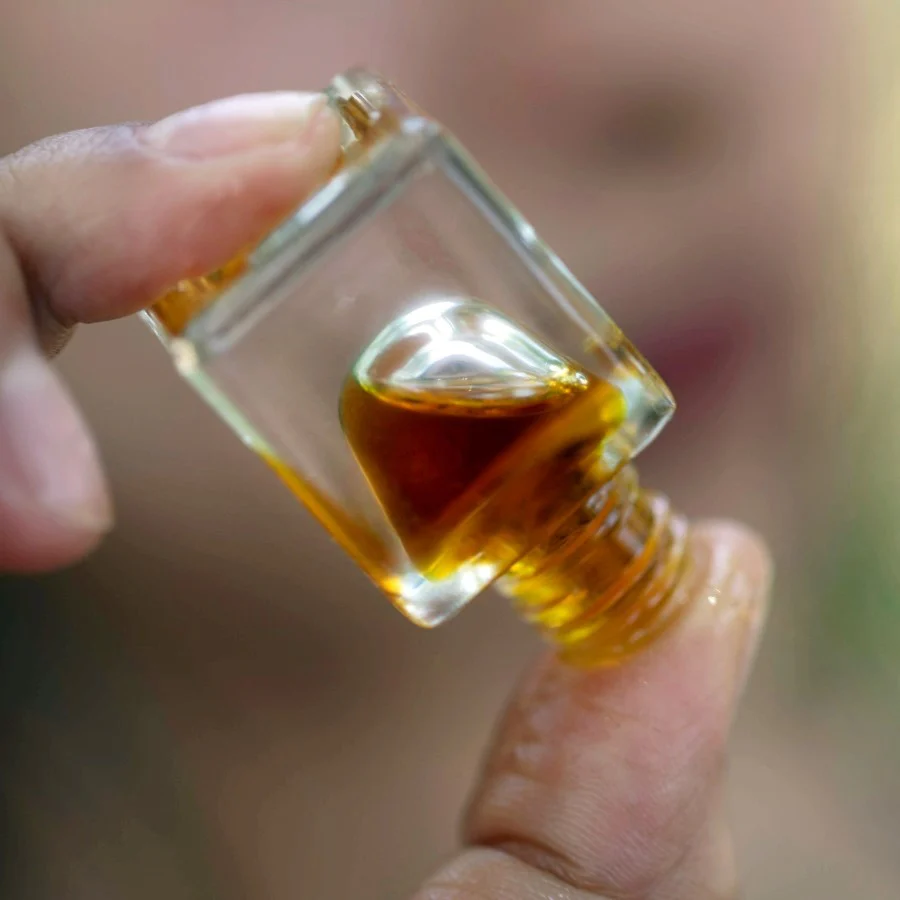
Indonesian Patchouli Aroma Profile
Indonesian patchouli — particularly Sulawesi origin — is considered the global benchmark aroma profile for patchouli essential oil.
When fragrance briefs call for 'patchouli', this is the profile they mean:
- Opening (top note): Fresh, slightly woody-herbaceous — the norpatchoulenol fraction creates an initial brightness before the heavier base compounds emerge
- Heart: Rich, earthy, dark, musky — the dominant patchoulol fraction fully expressed. Deep, complex, slightly sweet undertones
- Drydown (base): Warm, sweet-earthy, slightly balsamic — extraordinary persistence. Indonesian patchouli can project on skin for 12–24 hours
- Overall impression: Multi-layered, complex, evolving — experienced differently at 30 minutes, 2 hours, and 6 hours after application
Indian Patchouli Aroma Profile
Indian patchouli has a distinctly different character — not inferior in all contexts, but meaningfully different:
- Opening: More camphoraceous than Indonesian — a slightly medicinal, herbal quality in the top note
- Heart: Earthy, slightly musty — less sweet complexity than Indonesian. The earthy dominance is more linear and less evolving
- Drydown: Earthy persistence — good longevity but less aroma evolution than Indonesian
- Overall impression: Simpler, more linear, more medicinal-earthy. Not the 'classic patchouli' of fine fragrance tradition, but appropriate for specific applications
Practical Aroma Applications
- Indonesian preferred for: Fine fragrance (all families), luxury cosmetics requiring 'premium patchouli' positioning, sophisticated soap with complex fragrance story, niche perfumery where the full complexity of patchouli is the point
- Indian acceptable for: Ayurvedic and traditional medicine preparations where camphorous character is acceptable or desirable, budget personal care where patchouli aroma is a minor note rather than a hero ingredient, incense where the simpler character blends adequately, domestic Indian market products
| A Note from the Perfumer's Perspective Professional perfumers consistently specify Indonesian origin in their briefs — and most often Sulawesi sub-origin — because the depth and complexity of the aroma creates fragrance building blocks that Indian patchouli cannot replicate. Indian patchouli's slightly camphorous character can work against certain fragrance directions, particularly in floral, fruity-floral, and clean compositions where patchouli's role is to add depth without herbal medicinal notes. |
Which Patchouli Oil for Which Application? A Buyer’s Decision Guide
| Application | Recommended Origin | Grade | Reasoning |
| Fine fragrance (luxury) | Indonesian — Sulawesi | Dark or MD | Benchmark aroma complexity; superior fixative performance |
| Niche/indie perfumery | Indonesian — Aceh or Sulawesi | MD preferred | Highest patchoulol; cleanest version of premium Indonesian profile |
| Chypre / Oriental composition | Indonesian — Sulawesi | Dark | Maximum depth and earthiness — defines this fragrance family |
| Mass market fragrance | Indonesian (standard) or Indian | Dark | Indonesian standard grade preferred; Indian acceptable for budget briefs |
| Premium skincare (facial) | Indonesian | Light or MD | Colour-neutral; higher patchoulol for better functional activity |
| Budget personal care | Indonesian standard or Indian | Dark | Indian acceptable for cost-sensitive applications where patchouli is minor note |
| Soap manufacturing (premium) | Indonesian | Dark or Light | Indonesian aroma profile adds premium positioning; Light for white soap |
| Ayurvedic preparations | Indian acceptable | Standard | Indian patchouli's slightly camphorous character is traditional in Ayurvedic context |
| Anti-dandruff hair care | Indonesian — Light grade | Light | 2025 research validates Light grade specifically for scalp applications |
| Anti-ageing serum | Indonesian | MD only | Highest patchoulol; near-colourless for white/pale formulations |
Related Reading
→ Patchouli Oil in Cosmetics, Perfumes & Soaps — Application Guide
→ Pure Patchouli Oil Benefits for Skin — Complete Skincare Guide
→ Patchouli Oil for Hair Growth — Formulator's Guide
Sourcing Indonesian Patchouli Oil: What to Specify
For buyers choosing Indonesian over Indian patchouli — or evaluating both — here is what to include in your purchase order for the best result:
- Grade: Specify explicitly — Dark, Light (Iron-Free), or MD. Do not leave unstated
- Origin: 'Sulawesi' for maximum complexity; 'Aceh/Sumatra' for slightly cleaner profile; 'Indonesia' if origin sub-specification is not required
- Minimum patchoulol %: State 'patchoulol ≥30%' for Sulawesi premium; '≥29%' for standard Indonesian; '≥32%' for MD grade
- COA + GCMS: Batch-specific — patchoulol %, β-caryophyllene %, specific gravity, refractive index, optical rotation
- Halal certificate (MUI): Required for Middle East, Malaysian, and Muslim-market products — only Indonesian manufacturers can provide MUI Halal
For complete sourcing guide: How to Source Essential Oils from Indonesia — Complete Importer's Guide. For what GEO offers: What Is Patchouli Oil Used For — Complete Guide.
| Request Indonesian Patchouli Oil Samples — Compare Grades & Origins Contact Global Essential Oil to request a patchouli grade sample kit — Dark, Light (Iron-Free), and MD from our current Sulawesi and Aceh stock — with batch-specific COA (patchoulol %), GCMS report, and Halal certificate. Compare against your current Indian patchouli supply before making your next sourcing decision. We respond within 1 business day. → Contact Global Essential Oil — Request Indonesian Patchouli Sample & Pricing |
Or visit our Patchouli Essential Oil product page for full specifications, or our Essential Oils from Indonesia hub.
Is Indonesian patchouli oil better than Indian patchouli oil?
For most fragrance and cosmetic applications, Indonesian patchouli oil is generally preferred due to its higher patchoulol content, richer aroma profile, and stronger fixative properties. However, Indian patchouli can still be suitable for budget-conscious formulations and certain traditional applications.
What is the patchoulol content difference between Indonesian and Indian patchouli?
Indonesian patchouli oil typically contains 29–35% patchoulol, while Indian patchouli usually ranges from 27–32%. This difference contributes to the richer aroma and stronger performance often associated with Indonesian-origin oil.
Why does Indonesian patchouli have higher patchoulol content?
Higher patchoulol levels are influenced by growing conditions, including soil composition, altitude, and climate. Indonesian patchouli is commonly cultivated in volcanic regions that support the development of desirable aromatic compounds.
Can I substitute Indian patchouli for Indonesian patchouli in a fragrance formula?
Yes, but the final fragrance may differ. Indonesian patchouli generally offers a deeper and more complex aroma, while Indian patchouli can have a slightly sharper character. Testing both oils in your formulation is recommended before large-scale production.
What is Sulawesi patchouli and why is it considered premium?
Sulawesi is one of Indonesia's leading patchouli-producing regions and is known for consistently high patchoulol content and a rich earthy aroma. These characteristics make Sulawesi-origin patchouli highly valued in the fragrance industry.
Does the grade (Dark, Light, MD) differ between Indonesian and Indian patchouli?
Yes. Indonesian patchouli oil is available in multiple grades, including Dark, Light (Iron-Free), and Molecular Distilled (MD). Indian patchouli is typically sold as a standard commercial grade with fewer processing variations.
Is all Indonesian patchouli oil the same quality?
No. Quality can vary depending on origin, cultivation practices, distillation methods, and storage conditions. Sulawesi and Aceh are among the most recognized producing regions, but batch-specific testing is still important.
Where can I buy Indonesian patchouli oil directly from a manufacturer?
You can source Indonesian patchouli oil from reputable manufacturers that provide batch-specific COA and GC-MS documentation. When evaluating suppliers, look for transparent sourcing, quality certifications, and traceable production practices.