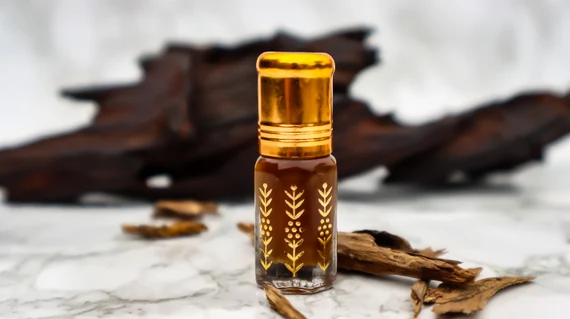
Agarwood oil — known as oud in the Arabic world and gaharu in Southeast Asia — is one of the rarest, most complex, and most historically revered aromatic substances in human history.
Commands prices that regularly exceed gold by weight. Appears in religious texts from ancient China, India, and the Middle East. And has been the subject of increasing scientific investigation for its genuine therapeutic properties that support its traditional reputation.
This guide covers the evidence-based benefits and applications of agarwood oil in aromatherapy — from anxiety relief, sleep support, and meditation to skincare and fine fragrance — with compound data, practical application examples, and safety guidance.
We also cover the important sustainability context of Indonesian agarwood, the primary global source, and what it means for responsible sourcing.
As an Indonesian manufacturer of both Aquilaria agarwood oil and Aetoxylon agarwood oil from Kalimantan and Sumatra, we write from direct production and sourcing experience — not as distributors or wellness bloggers.
| Quick Summary: Agarwood Oil Benefits for Aromatherapy Agarwood oil is used for: (1) anxiety relief and emotional calming; (2) sleep support and insomnia; (3) meditation and spiritual practice; (4) mood enhancement and antidepressant effects; (5) skin care — anti-ageing, antimicrobial; (6) aphrodisiac and sensory experience; (7) fine fragrance — luxury base note; (8) traditional medicine across Ayurveda, TCM, and Islamic medicine. Read on for the science and practical guidance behind each benefit. |
What Is Agarwood Oil? Formation, Species & Why It Is So Rare
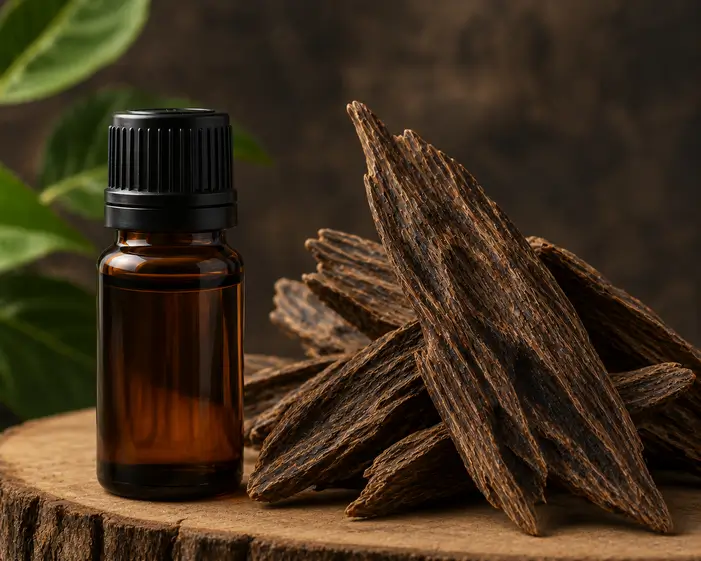
Agarwood oil is not extracted from a healthy tree — it is the product of a remarkable biological defence response.
When Aquilaria or Gyrinops trees are injured or infected by a specific mould (Phialophora parasitica or related species), they produce a dark, dense, aromatic resin in the heartwood as a pathological response.
It is this resin-saturated heartwood — called agarwood or oud wood — that is steam-distilled to produce agarwood essential oil.
Not every Aquilaria tree produces this resin — only approximately 7–10% of wild trees are naturally infected, which explains agarwood's extraordinary rarity and price.
Cultivated agarwood plantations use inoculation techniques to artificially trigger resin production at scale — this is the primary source of commercial agarwood today, and the approach used in Indonesian sustainable production.
Key Species from Indonesia
- Aquilaria malaccensis: The most commercially important species globally. CITES Appendix II listed. Found across Kalimantan, Sumatra, and Java. Produces oil with the classic dark, smoky, resinous oud profile prized in Middle Eastern and Western niche perfumery
- Aquilaria crassna: Common in Kalimantan. Slightly sweeter, less smoky than malaccensis. Used in both aromatherapy and fine fragrance
- Aetoxylon sympetalum: A related agarwood-producing species from Kalimantan — produces an oil with a distinctly different, slightly greener-woody character. Available as Aetoxylon agarwood oil from Global Essential Oil
CITES Status and Sustainability
All commercially traded Aquilaria species are listed under CITES Appendix II — meaning international trade requires official documentation confirming the oil originates from legal, sustainable sources. Wild harvesting of Aquilaria trees is now severely restricted to protect wild populations.
| ⚠️ Always verify CITES compliance when sourcing agarwood When purchasing agarwood oil in bulk for commercial use, always request CITES export documentation and verify that the supplier can confirm the oil originates from legally cultivated, not wild-harvested, trees. Indonesian suppliers with legitimate operations will have CITES permits as a standard document. See our quality verification guide: Understanding COA & GCMS Reports. |
What Makes Agarwood Oil Therapeutically Active? The Chemistry
Agarwood oil is one of the most chemically complex essential oils known — containing over 150 identified compounds.
Unlike most essential oils dominated by one or two primary compounds, agarwood's therapeutic and aromatic profile is the result of a complex interplay of chromones, sesquiterpenes, and oxygenated derivatives unique to the pathological resin-formation process.
Chromones — The Signature Compounds
Chromones (benzopyrones) are the signature compounds of agarwood that no other essential oil contains. They are formed specifically during the resin-producing pathological response of Aquilaria trees. Key chromones include:
- 2-(2-Phenylethyl)chromones: The most abundant chromone class in agarwood — directly responsible for the distinctive warm, sweet, balsamic-resinous character that defines high-quality oud oil. Their presence and profile in GCMS analysis is used to authenticate genuine agarwood oil versus synthetic blends or lower-quality substitutes
- Jinkohol and related chromone derivatives: Traditional Japanese incense literature identifies these compounds as responsible for the most prized aspects of agarwood fragrance — their concentration is higher in older, more resin-saturated wood
Sesquiterpenes — The Therapeutic Fraction
The sesquiterpene fraction of agarwood oil carries the primary therapeutic activity — particularly for aromatherapy and wellness applications:
- α-Guaiene and δ-Guaiene: Anti-inflammatory sesquiterpenes — contribute to agarwood oil's calming and skin-soothing properties. Also present in patchouli and vetiver, reinforcing the therapeutic synergy of these three oils when blended
- Agarospirol: A bicyclic sesquiterpene alcohol specific to agarwood — associated with the oil's sedative and anxiolytic properties in pharmacological studies
- β-Agarofuran and related furanoid sesquiterpenes: Contribute to the distinctive 'oud' character and support the oil's antimicrobial activity
| Why Compound Data Matters for Agarwood Quality Assessment A genuine, high-quality agarwood oil should show chromones as a significant fraction in GCMS analysis — their presence confirms authentic resin-origin oil. Synthetic oud oils (increasingly common as the real product commands high prices) will show absence of chromones and an atypical sesquiterpene profile. Always request batch-specific GCMS for agarwood oil purchases. See: Understanding COA & GCMS Reports. |
Agarwood Oil Benefits in Aromatherapy: Evidence and Practice
Anxiety Relief and Emotional Calming
Agarwood oil's anxiolytic (anxiety-reducing) properties are its most researched therapeutic application.
A 2022 PMC study confirmed that inhaled agarwood extract demonstrated measurable anxiolytic effects in animal models — with the sesquiterpene fraction, particularly agarospirol, proposed as the primary active compound acting on GABAergic pathways (the same mechanism as pharmaceutical benzodiazepines, though at much lower potency).
The deep, heavy, resinous aroma of agarwood oil also activates the parasympathetic nervous system response via the olfactory-limbic pathway — the same mechanism documented for vetiver and patchouli oils — helping shift the nervous system from sympathetic (fight-or-flight) to parasympathetic (rest-and-digest) states.
Practical application: 2–3 drops in a cold diffuser for 20–30 minutes. For direct calming: 1 drop in 1 teaspoon of VCO applied to inner wrists or base of throat. Blend with 2 drops bergamot to add uplifting freshness to the grounding base.
Sleep Support and Insomnia
Agarwood's sedative properties — documented in traditional medicine across Ayurveda, TCM, and Islamic medicine — are supported by emerging pharmacological evidence.
The sesquiterpene fraction's effects on GABAergic and serotonergic pathways provide a plausible mechanism for the sleep-facilitating properties observed in traditional practice.
Practical application: 2 drops agarwood + 2 drops lavender + 1 drop vetiver in diffuser for 20 minutes before sleep. The combination creates a deeply grounding, sleep-conducive aromatic environment. Alternatively: 1 drop agarwood on a tissue placed near the pillow — the aroma will gradually diffuse throughout the night.
Meditation and Spiritual Practice
This is arguably the oldest and most cross-culturally consistent use of agarwood — its presence in religious and spiritual contexts spans thousands of years across virtually every major religious tradition:
- Islamic tradition: Oud is the most prized incense in Islamic practice — used in mosques and for personal purification. The Prophet Muhammad is recorded to have recommended burning agarwood for spiritual purification
- Buddhism: Agarwood incense is burned in temples across Japan, China, Korea, and Southeast Asia. Japanese kōdō ("the way of incense") is an entire art form centred on appreciating agarwood's subtle aromatic transformations
- Hinduism: Referenced in Sanskrit texts including the Vedas — used in temple rituals, yoga practice, and Ayurvedic medicine
- Christianity: References to 'aloe' in the Old Testament are believed by some scholars to refer to agarwood — its use as incense in early Christian religious practice is documented
Practical application for meditation: 1–2 drops in diffuser or on a charcoal incense disk 10–15 minutes before meditation practice. The aroma creates an immediate sensory shift that helps establish a meditative mindset — experienced meditators often report that consistent use of agarwood creates a conditioned response that facilitates entering meditative states more quickly over time.
Mood Enhancement and Antidepressant Effects
Agarwood oil's effects on mood go beyond simple relaxation. Traditional medicine systems consistently describe it as a "spirit lifter" — improving overall emotional tone, reducing feelings of heaviness or sadness, and promoting a sense of wellbeing.
Pharmacological investigation has identified inhibition of 5-HT (serotonin) reuptake as a potential mechanism — the same pathway targeted by SSRI antidepressants, though at fundamentally different potency levels.
Practical application: Personal inhaler with 3 drops agarwood + 2 drops bergamot — carried for use during low-mood moments. Or 2–3 drops in diffuser for general uplifting environment in home or workspace.
Skin Care Benefits
The sesquiterpene and chromone fractions of agarwood oil contribute several skin-relevant properties:
- Anti-inflammatory: α-Guaiene and related sesquiterpenes reduce skin inflammation — relevant for reactive, sensitive, and acne-prone skin
- Antimicrobial: Inhibitory activity against P. acnes and S. aureus documented in laboratory studies — supports use in acne formulations
- Antioxidant: Chromone fraction demonstrates free radical scavenging — relevant for anti-ageing applications
Practical application: 0.5–1% agarwood oil in a luxury facial serum or body oil. Its heavy, resinous character makes it best suited to night-time application in an oil or rich cream base. Blends exceptionally with patchouli MD grade and vetiver for a luxurious Indonesian-origin skincare oil.
Aphrodisiac and Sensory Experience
Agarwood oil's reputation as an aphrodisiac is one of its longest-documented traditional uses — appearing in texts from ancient India, Arabia, and China.
The mechanism likely involves the oil's complex interaction with the limbic system (the brain's emotional and instinctive processing centre) and its powerful effect on mood and physical relaxation.
The deep, warm, animalic-sweet character of oud oil has a documented cross-cultural association with intimacy and attraction.
Agarwood Oil in Traditional Medicine Systems
The therapeutic tradition of agarwood spans multiple established medical systems — each approaching its benefits from a different theoretical framework but consistently arriving at similar applications:
| Medical System | Traditional Uses of Agarwood | Active Preparation |
| Ayurveda (India) | Digestive disorders, respiratory conditions, nervous system disorders, mental clarity, joint pain, fever | Oil, decoction, incense smoke inhalation |
| Traditional Chinese Medicine (TCM) | Regulating qi, relieving pain, calming shen (spirit), digestive disorders, asthma, vomiting | Oral decoction, incense, topical application |
| Tibetan Medicine | Mental disorders, emotional imbalance, 'wind' diseases (anxiety, insomnia, tremors) | Compound formulas, incense |
| Islamic Medicine (Unani) | Strengthening heart and brain, improving memory, purification, aphrodisiac | Fumigation (incense), oil application, oral preparations |
| Japanese Kampo | Sedative effects, digestive support | Decoction; refined form in kōdō (incense ceremony) |
Agarwood Oil in Fine Fragrance: The Perfumer’s Perspective
In fine fragrance, agarwood oil occupies a position of unparalleled prestige — it is the single most expensive natural ingredient used in mainstream commercial perfumery, and the foundation of an entire fragrance family (oud/oriental) that now dominates the Middle Eastern market and has powerfully influenced Western niche and mainstream perfumery.
Agarwood as a Luxury Base Note
Agarwood functions primarily as a base note — contributing deep, resinous, sweet-smoky warmth to a composition.
Its extraordinary longevity (lasting on skin for 12–24+ hours from quality oil) makes it one of the most powerful natural fixatives available.
Major fragrance houses — including Tom Ford, Chanel, Dior, Amouage, and Creed — have launched oud-featuring compositions that have become commercial benchmarks.
Indonesian Agarwood in Modern Perfumery
Indonesian agarwood oil — particularly from Kalimantan (Borneo) — has a distinctive character: deeper, smokier, more resinous than Cambodian or Indian oud.
It is particularly prized by niche perfumers for its animalic, leathery facets that add complexity to oriental and oud compositions.
Vetiver from Garut, West Java and dark patchouli from Sulawesi are the natural blending partners for Indonesian agarwood — creating a fully Indonesian-origin luxury base accord.
Practical Blending Guide
- Patchouli (Dark grade) at 3:1 (patchouli:agarwood) — earthy-resinous oriental base. The most classic Indonesian luxury accord
- Vetiver (Garut) at 2:1 (vetiver:agarwood) — smoky-volcanic depth. Used in niche oud compositions for maximum complexity
- Rose absolute at 5:1 (rose:agarwood) — floral-oud accord. The foundation of the classic Middle Eastern oud rose fragrance genre
- Frankincense + agarwood at 1:1 — sacred incense accord for meditation products and spiritual fragrance
How to Use Agarwood Oil: Practical Guide
Aromatherapy Diffusion
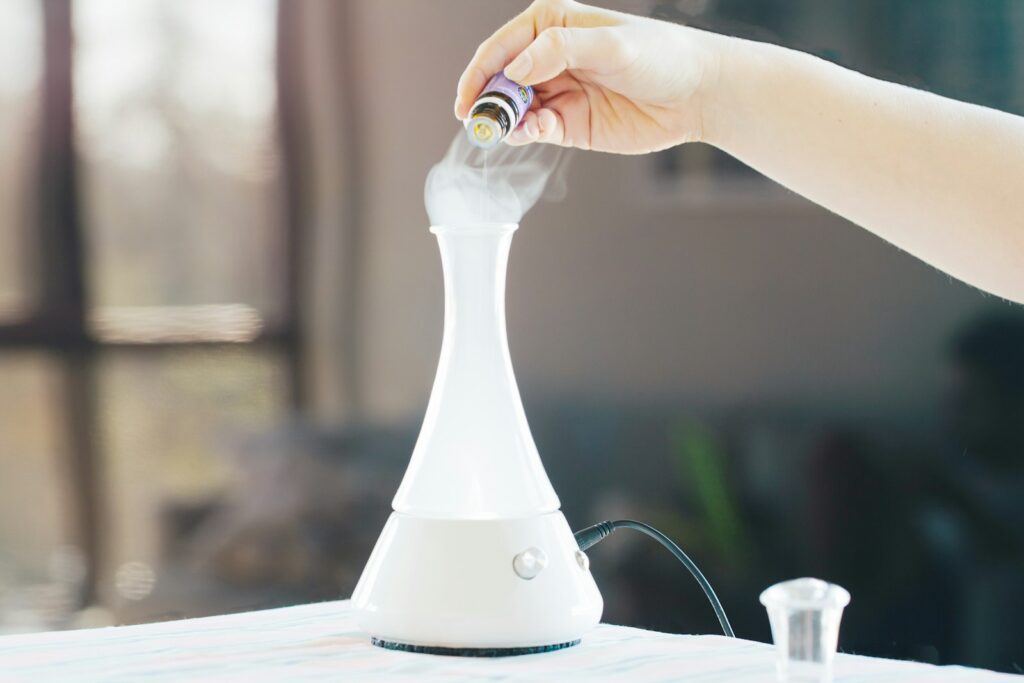
Add 1–3 drops of agarwood oil to a cold-water diffuser with 100ml water. Agarwood's heavy, complex aroma requires very small amounts — its concentration and tenacity mean that even 1–2 drops will fill a room.
Run for 15–20 minute sessions; unlike lighter oils, agarwood's aroma persists in the room long after the diffuser stops. Best times: before meditation, before sleep, or for creating a special ambience.
Personal Inhaler
2–3 drops on a personal inhaler wick — the most economical way to use agarwood oil therapeutically, preserving the expensive oil for targeted inhalation rather than diffusion.
Ideal for anxiety management during the day without exposing others to the aroma.
Topical Application
Dilute 0.5–1% in a carrier oil for skin application. Virgin Coconut Oil (VCO) is an excellent carrier — its mild scent does not compete with agarwood's complex profile.
Apply to: pulse points (inner wrist, neck) for personal fragrance; affected areas for skin care; chest and back for respiratory support during aromatherapy.
Traditional Incense / Bakhoor
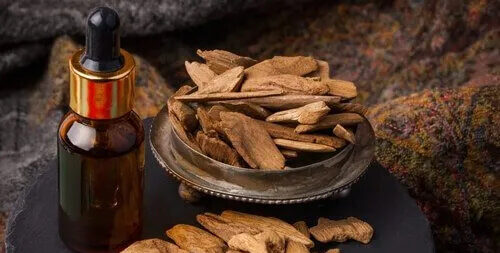
In Middle Eastern tradition, agarwood wood chips (oud/bakhoor) are burned on charcoal for fumigation of rooms, clothing, and personal spaces.
For those using agarwood oil rather than wood chips, place 2–3 drops on an incense disk or charcoal — the result is similar but more oil-efficient than burning chips.
Agarwood Oil Safety: What You Need to Know
- Always dilute for skin: Maximum 1–2% in carrier oil for leave-on application. Undiluted application can cause sensitisation — agarwood contains reactive sesquiterpene aldehydes that can irritate sensitive skin
- Patch test: Apply 1% dilution to inner arm, wait 24 hours before broader use. Agarwood allergies are uncommon but documented
- IFRA status: Agarwood oil is IFRA-approved for fragrance use — usage limits vary by product category. For leave-on cosmetics, stay within category-appropriate limits
- Pregnancy: As with all essential oils, consult a healthcare professional before using during pregnancy. Traditional systems have documented both therapeutic and contraindicated uses — professional guidance is recommended
- Quality and adulteration: Agarwood oil is one of the most frequently adulterated essential oils due to its high price. Synthetic oud, diluted oil, and oils from non-Aquilaria sources are common in the market. Always request GCMS analysis confirming chromone presence before purchasing
- Sustainability: Only purchase from suppliers who can provide CITES documentation confirming legal, cultivated origin. Wild agarwood is an endangered resource — responsible purchasing matters
Sourcing Indonesian Agarwood Oil: What Buyers Need to Know
For fragrance houses, cosmetic manufacturers, and therapeutic product brands sourcing agarwood oil in bulk, Indonesia remains the most important and accessible source of legal, documented agarwood oil:
- Aquilaria malaccensis from Kalimantan: Deep, classic Indonesian oud character — most prized for niche perfumery
- Aetoxylon sympetalum from Kalimantan: Lighter, woody-green character — more affordable, suitable for personal care and therapeutic applications
- Required documentation: CITES export permit (mandatory), batch-specific COA + GCMS (confirms chromone content), MSDS, Halal certificate if required
- MOQ: 5–50ml sample for evaluation; 500g–1kg for small bulk; 5kg+ for industrial/fragrance applications
For complete supplier verification and sourcing guidance from Indonesia, see: How to Source Essential Oils from Indonesia. For the full range of Indonesian agarwood and other essential oils, see: Essential Oils from Indonesia — Complete List.
| Request Indonesian Agarwood Oil Sample Contact Global Essential Oil to request an Aquilaria or Aetoxylon agarwood oil sample from our current Kalimantan stock — with batch-specific COA, GCMS (chromone content), CITES documentation, and Halal certificate. We respond within 1 business day. → Contact Global Essential Oil — Request Agarwood Oil Sample Now |
Or visit our product pages: Aquilaria Agarwood Essential Oil · Aetoxylon Agarwood Essential Oil.