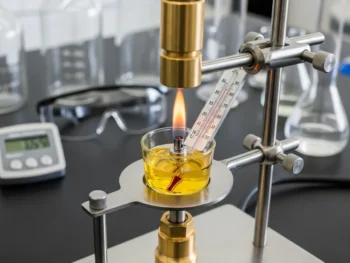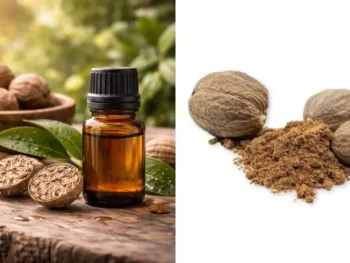
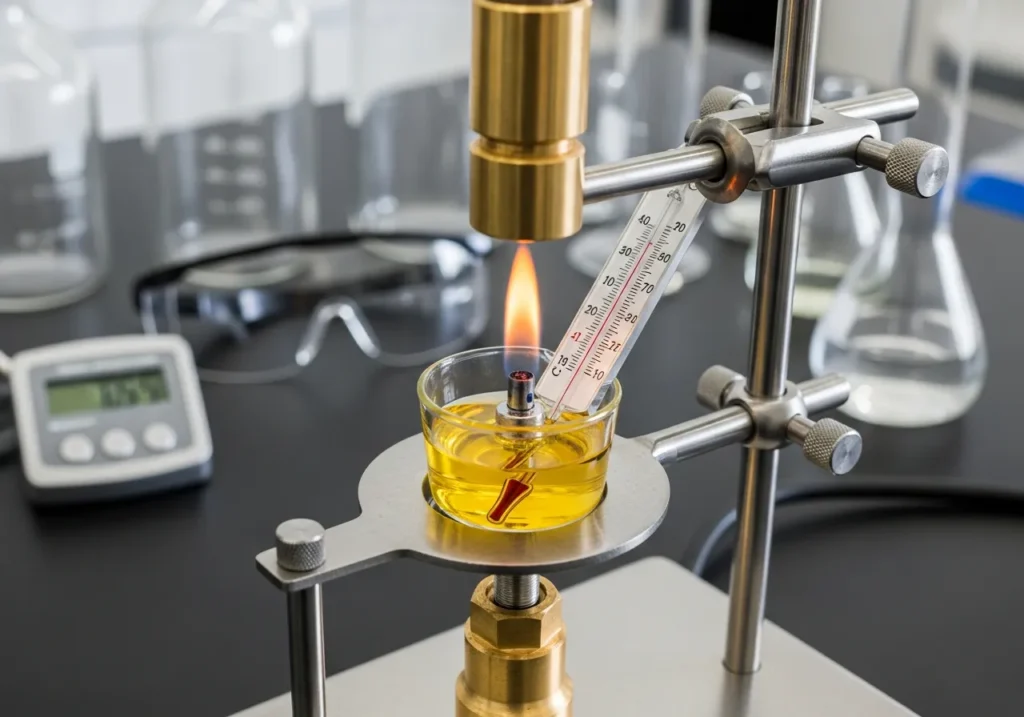
The essential oil flash point is the lowest temperature at which an oil releases enough vapor to form an ignitable mixture with air under specified test conditions.
It matters when handling concentrated oils, reviewing safety documents, storing materials and arranging transport.
It is not the temperature at which an oil automatically catches fire, evaporates completely or loses its fragrance.
This guide includes an essential oil flash point chart in Celsius and Fahrenheit, explains why values vary, and helps candle makers, formulators and bulk buyers interpret the information without mistaking a reference number for a safety limit.
What Is the Flash Point of an Essential Oil?
Flash point describes the ignition hazard of vapors above a liquid when an ignition source is present.
A brief flash under a standardized test does not necessarily mean the liquid will continue burning.
Vapors may also be present below the reported flash point, so it should never be treated as a guarantee of safe handling.
See the OSHA physical hazard criteria for the regulatory definition.
Are All Essential Oils Flammable?
Many essential oils can burn, but not every oil meets the same regulatory definition of a flammable liquid. A citrus oil and a heavier woody oil can have very different flash points.
Even a high-flash-point oil may present fire, skin, aspiration or environmental hazards. Review the specific Safety Data Sheet (SDS), rather than assuming that a natural ingredient is harmless.
Flash Point vs. Fire Point, Boiling Point and Autoignition Temperature
| Property | What it describes |
| Flash point | Threshold for ignition of vapor with an external source under defined test conditions. |
| Fire point | Temperature at which burning continues under a specified test. |
| Boiling point | Temperature at which a liquid boils at a specified pressure; mixtures can have a boiling range. |
| Autoignition temperature | Temperature at which ignition occurs without an external ignition source under defined conditions. |
Evaporation is different from all four. Aromatic constituents can evaporate at room temperature; there is no single temperature at which the scent of an essential oil suddenly disappears.
In a laboratory test: liquid releases vapor → vapor mixes with air → an ignition source may cause a brief flash. This is a conceptual explanation, not a testing procedure.
Essential Oil Flash Point Chart (°C and °F)

Use this reference chart to compare examples of supplier-reported flash points. These are not Global Essential Oil specifications or universal values.
The listed botanical identity is included where the cited source identifies it. Fahrenheit figures are rounded to the nearest degree; “>” means a lower bound, not an exact result.
| Oil / material | °C | °F | Reported source |
| Nutmeg (Indonesian) Myristica fragrans | 43 | 109 | Robertet TDS; closed cup |
| Orange (supplier example) | 45 | 113 | HBNO |
| Lemon (supplier example) | 48 | 118 | HBNO |
| Eucalyptus globulus | 50 | 122 | HBNO |
| Tea tree (supplier example) | 64 | 147 | HBNO |
| Lavender (supplier example) | 75 | 167 | HBNO |
| Java citronella Cymbopogon winterianus | 75 | 167 | Zayat Aroma MSDS |
| Lemongrass (supplier example) | 79 | 174 | HBNO |
| Citronella (supplier example) | 85 | 185 | HBNO |
| Clove bud Syzygium aromaticum | >100 | >212 | Trade Essential Oils |
| Patchouli (dark grade) | 100 | 212 | HBNO |
| Patchouli (double distilled) Pogostemon cablin | 114.5 | 238 | Eden Botanicals TDS |
| Vetiver (supplier example) | 130 | 266 | HBNO |
Source note: Robertet technical data sheet (product 00021270, revision 21 October 2024); Eden Botanicals technical data sheet (SKU 761); Zayat Aroma MSDS for Citronella of Java; HBNO supplier guide and Trade Essential Oils reference list.
Test methods were not stated for every listed number. Always obtain current product-specific documentation for safety decisions.
Which Essential Oils Have Low and High Flash Points?
The chart shows that nutmeg and some citrus oils can have lower reported values than patchouli, clove bud or vetiver.
This is useful for preliminary hazard screening, not for choosing the strongest fragrance or declaring a material safe.
The exact material matters: a dark patchouli grade should not automatically be assigned the result from a double-distilled grade.
Why Flash Point Values Differ Between Suppliers
Essential oils are complex mixtures. Botanical species, extraction and rectification processes, composition, additives and test methods can affect the result.
For example, the two citronella entries above are not necessarily the same botanical type or grade, and the two patchouli examples describe different grades.
A value copied from a chart cannot establish the flash point of an unidentified oil. Ask the supplier to confirm the species, grade, available test method and current SDS.
How Is Essential Oil Flash Point Measured?
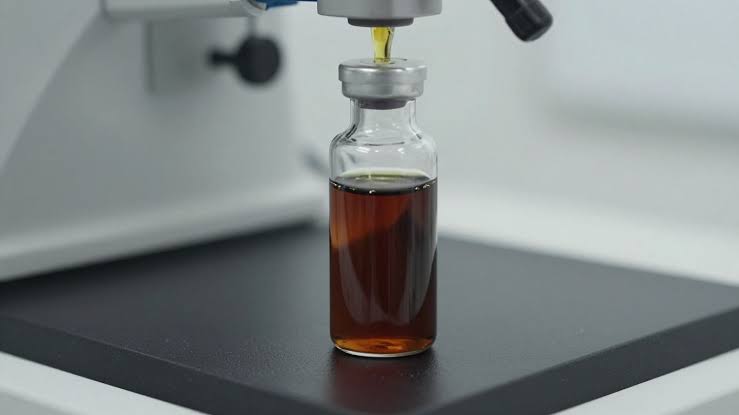
Qualified laboratories use standardized apparatus to measure whether vapor above a sample can ignite under controlled conditions.
The result depends on the method used, so the method should accompany the number when available.
Flash point testing involves intentionally exposing vapor to an ignition source and is not a home experiment.
Closed-Cup vs. Open-Cup Testing
Closed-cup methods limit vapor escape from the test vessel; open-cup methods allow greater exchange with the surrounding air.
Closed-cup results are often lower, but there is no universal conversion between the two. Methods such as ASTM D56 and ASTM D93 are recognized in the US hazard and transport frameworks for relevant liquids.
A laboratory should select the method required for the material and intended regulatory use.
Can You Calculate the Flash Point of an Essential Oil Blend?
A weighted average of ingredient flash points is not a dependable blend flash point. Vapor composition and interactions between ingredients can make the result differ substantially from that calculation.
The same issue applies when an essential oil is combined with ethanol, a carrier oil or another solvent.
For a new commercial mixture, obtain appropriate hazard assessment and testing or a validated determination permitted by the applicable rules.
Do not classify a blend using a simple average or the chart above.
Why Does Essential Oil Flash Point Matter?
Fire Safety and Handling
Flash point helps identify conditions where ignitable vapor may be a concern.
Keep materials away from ignition sources, follow the SDS for ventilation, personal protection and handling precautions, and use appropriate equipment for the assessed hazard.
Do not warm concentrated oil over an open flame or attempt to confirm its flash point yourself.
For workplaces, include transfers, spills and cleaning operations in the site risk assessment.
Storage and Warehouse Safety
Use the supplier’s recommended storage conditions, compatible sealed containers and suitable segregation for the assessed hazards.
Local fire codes and the quantity stored can affect warehouse requirements.
Flash point is only one part of the assessment: oxidation, light exposure, container integrity and storage history also matter.
Our guide to essential oil storage stability explains how buyers can manage quality during storage.
Transportation and Dangerous Goods Classification
The flash point can influence transport classification, packaging, labeling and carrier acceptance. However, one value does not determine every requirement.
Some materials may be regulated for other hazards even when their flash point is relatively high. Confirm the actual classification rather than assuming every essential oil can be shipped in the same way.
Essential Oil Flash Point in Candle Making
Candle makers often ask whether a low-flash-point oil can be used in warm wax. The distinction is between the hazard properties of the concentrated ingredient and the processing or burn performance of the complete candle formula.
Can You Add Essential Oils to Wax Above Their Flash Point?
Exceeding the oil’s flash point does not by itself cause ignition, but it does not make the process safe either.
Do not use the chart as a wax-mixing temperature guide or permission to exceed a material’s handling limits.
Follow the wax and fragrance suppliers’ instructions and the safety requirements for the specific materials and process.
CandleScience’s flash point explanation distinguishes ignition hazard from wax incorporation; its product-specific mixing guidance is not a universal essential oil recipe.
Does Flash Point Affect Scent Throw?
Flash point is not a direct measure of how strongly a candle smells.
Cold throw and hot throw depend on the oil’s aroma profile, its compatibility with the wax, fragrance concentration, wick and vessel design, and the way the candle is made and burned.
A low-flash-point oil does not simply disappear when it reaches the listed temperature. Evaluate actual scent performance separately from hazard properties.
Does a Higher Flash Point Mean a Safer Candle?
No. Finished candle safety depends on the entire formulation and burn behavior. A high-flash-point ingredient can still contribute to an unsuitable candle.
Gel wax may have its own fragrance compatibility and flash point requirements; follow the gel manufacturer’s instructions.
Commercial makers should conduct appropriate burn and safety tests before selling a formula.
For ingredient selection and testing considerations, see our guide to choosing essential oils for candle making.
Does Flash Point Matter in Soap, Cosmetics and Perfumery?
Yes, particularly when handling concentrated aromatic materials and flammable solvents.
However, flash point does not establish thermal stability, fragrance retention, skin safety or an appropriate usage concentration.
A diluted perfume may have very different hazard properties from its original oil, especially if it contains alcohol.
Formulators should evaluate ingredient compatibility, process conditions and finished-product safety separately.
For skin-contact products, review applicable fragrance restrictions, allergen information and safety assessments for the intended use.
An oil with a high flash point is not automatically suitable at a high concentration.
Where to Find Flash Point on an Essential Oil SDS
The most useful starting point is the SDS for the exact material you intend to purchase or use. In the commonly used 16-section format, flash point is normally listed under Section 9.
Other sections provide important context, as shown in OSHA’s SDS requirements.
| SDS section | What to review |
| 1 — Identification | Product name, supplier, identity and recommended use. |
| 2 — Hazard identification | Hazard classes, warnings and precautionary statements. |
| 5 — Fire-fighting measures | Material-specific emergency response information. |
| 7 — Handling and storage | Precautions, storage conditions and incompatible materials. |
| 9 — Physical and chemical properties | Flash point, units and test method if provided. |
| 14 — Transport information | Transport classification and related details, if provided. |
How to Interpret SDS Section 9
Check whether the result is an exact value, a range, a lower bound or an unavailable result. For example, “>100°C” does not mean the flash point equals 100°C.
If the field is blank or marked unavailable, ask for clarification; do not treat missing data as proof that an oil is nonflammable. Confirm the revision date and product identity before relying on the document.
Flash Point in an SDS vs. COA
A Certificate of Analysis (COA) records agreed quality results for a product or lot. Some COAs include flash point, while others do not.
An SDS communicates hazards and recommended precautions; it might describe a product grade rather than a specific batch.
Neither document replaces the other. For additional quality parameters, read our guide to essential oil COA and GC-MS reports.
What to Do When Supplier Flash Point Values Differ
Compare the botanical identity, grade, composition, units, test method and document dates.
If uncertainty remains, ask the suppliers to explain the difference and provide appropriate supporting evidence.
If the difference affects hazard classification or a purchasing requirement, obtain a qualified review before accepting the material.
Essential Oil Flash Point and International Shipping
What Does Class 3 Flammable Liquid Mean?
Under the US transport rules in 49 CFR 173.120, Class 3 generally includes liquids with flash points at or below 60°C (140°F), subject to exceptions and other provisions, including certain heated shipments.
US workplace labeling is a separate system: OSHA’s flammable-liquid categories extend through 93°C (199.4°F) under specified criteria. A transport Class 3 designation is not the same thing as OSHA Category 3.
For example, the 43°C nutmeg reference in the chart calls for close classification review, while the 100°C dark patchouli example illustrates why not every essential oil falls within the usual 60°C transport threshold. These examples are not shipment classifications for GEO products.
Why Shipping Requirements Depend on the Specific Oil and Shipment
Air, sea and road transport may have different requirements. Packaging, quantity, destination, carrier policy, other hazard classes and the specific material also affect what is permitted.
Section 14 of an SDS is helpful when provided, but it is not mandatory under the US OSHA SDS rule; a qualified dangerous goods professional may need to confirm the classification independently.
For commercial shipments, confirm the applicable current rules, transport classification, packaging and paperwork with the supplier and freight partner before booking.
See our essential oil export documents guide for the wider documentation checklist.
What Bulk Essential Oil Buyers Should Check Before Ordering
Procurement and QA teams can prevent avoidable delays by collecting safety and product data before approving a purchase order. Request the following for the exact oil and grade being evaluated:
- Botanical identity, extraction method, grade and intended application.
- Current SDS, including hazard information, flash point and test method where available.
- Relevant COA, specification sheet and GC-MS report where available.
- Packaging type, quantity, compatibility and storage requirements.
- Transport classification and shipment-specific documentation, confirmed with the responsible logistics team.
- Representative sample availability and any application-specific compliance information.
Global Essential Oil supplies Indonesian aromatic ingredients including patchouli essential oil, nutmeg essential oil and citronella essential oil.
If you are evaluating materials for a fragrance, cosmetic or other manufacturing application, contact our export team to discuss your intended use, available SDS and quality documentation, packaging, sample requests and bulk requirements.
The reference values above are not specifications for these products.
Final Thoughts
The essential oil flash point is a useful hazard parameter, not a universal temperature limit for evaporation, fragrance performance or candle making.
A reference chart helps compare materials, but safe handling, formulation and shipping decisions require current product-specific documentation and assessment.
For buyers sourcing Indonesian oils, Global Essential Oil welcomes inquiries about specifications, available safety documents, samples and bulk supply.
Frequently Asked Questions
What is the flash point of essential oils?
It is the temperature at which a liquid produces sufficient vapor for an ignitable mixture under specified test conditions. Each oil or blend has its own result.
Are all essential oils flammable?
Many can burn, but not all meet the same regulatory flammability definitions. Check the specific SDS for hazard classification and precautions.
Which essential oils have the highest flash points?
Supplier examples for vetiver, patchouli and clove bud often show higher values than citrus or nutmeg oils. There is no universal ranking across all species, grades and test methods.
What happens when essential oils exceed their flash point?
Ignitable vapor may be generated under relevant conditions. An ignition source can present a fire hazard, but exceeding the flash point does not mean automatic combustion.
Can essential oils be added to wax above their flash point?
Flash point alone cannot answer that question safely. Use the specific wax and oil instructions, process risk assessment and finished-product tests; never use a generic chart as mixing guidance.
Is flash point the same as evaporation temperature?
No. Essential oil constituents can evaporate below their flash point. Flash point describes ignition hazard, not the point at which aroma is lost.
Does diluting essential oil change its flash point?
It can. The diluent and the behavior of the complete mixture matter. Do not assume dilution always raises the flash point or removes the fire hazard.
Where can I find the flash point of a specific essential oil?
Start with Section 9 of the latest SDS for the exact oil and grade. Ask for clarification or supporting test data if the result or method is missing.