
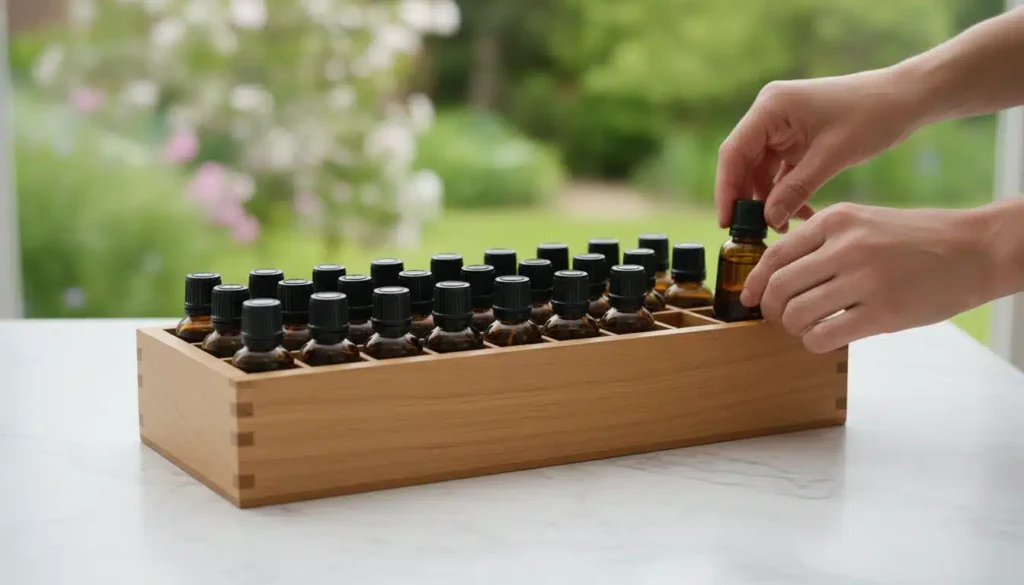
Your team approved an essential oil, received the bulk shipment, completed incoming quality control, and released the material into warehouse stock.
Several months later, part of the batch is still unused.
The drum may have been opened repeatedly, the remaining volume may be much lower than when it arrived, and production now wants to use the same batch again.
The practical question is no longer simply, “What is the shelf life of this essential oil?”
It is: does the material still meet the quality criteria your business originally approved, and is additional review or retesting justified before the next production use?
Essential oils are complex mixtures of volatile compounds.
A widely cited review of essential oil stability identifies temperature, light, and oxygen availability as major factors that can influence chemical integrity during storage.
More recent stability research also shows that storage behavior varies by oil composition, container, temperature, light exposure, and oxygen availability.
That means a date printed on a document cannot replace an assessment of the actual batch and its storage history.
What Does “Stability” Mean for an Essential Oil?

For a B2B buyer, stability is more useful when defined as the ability of a material to remain within agreed quality criteria during a defined storage period and under defined conditions.
A recent 2026 review of essential oil stability studies similarly frames stability around maintaining fundamental quality parameters throughout the declared storage period.
Those quality criteria may include more than chemical composition.
Depending on the oil and its intended application, a stored batch may also need to remain acceptable in terms of sensory profile, physical characteristics, identity, and formulation performance.
- Chemical stability: the relevant constituent profile remains within the accepted specification.
- Sensory stability: aroma and other organoleptic characteristics remain consistent with the approved reference.
- Physical stability: appearance and relevant physical parameters remain acceptable.
- Application stability: the material continues to perform as expected in the buyer’s formulation or production process.
This is why “the oil still smells normal” and “the original COA was acceptable” are useful observations, but neither one alone proves that a stored batch remains suitable for every future use.
Shelf Life, Retest Date and Batch Release Are Not the Same Thing
These terms are often mixed together in purchasing and warehouse discussions, but they answer different questions.
| Term | What It Tells You | What It Does Not Automatically Decide |
| Shelf life | The supplier’s or manufacturer’s expected period of acceptable stability under defined storage conditions. | Whether a specific stored batch is automatically suitable for the buyer’s next production run. |
| Retest / review date | A point at which the material should be re-evaluated under the applicable quality system or supplier guidance. | A universal industry deadline that applies identically to every essential oil. |
| Expiry date | A defined end point used in some product or quality systems. | That every essential oil uses the same expiry convention. |
| Production release | The buyer’s QA/QC decision to permit the actual batch for use. | That the batch can remain released forever regardless of later storage conditions. |
There is no single universal retest period that can be applied to all essential oils and all industries.
The correct review interval depends on the material, supplier information, storage conditions, buyer specification, intended use, and the company’s own quality system.
What Causes Essential Oils to Change During Bulk Storage?

Oxygen and Headspace
Oxidation is one of the best-documented pathways of essential oil degradation.
Oxygen exposure can increase when a drum is repeatedly opened, poorly resealed, decanted frequently, or left with a large amount of headspace as inventory is consumed.
A 2025 review discussing essential oil degradation during storage notes that oxygen access, temperature, compound structure, and chemical composition all influence oxidation behavior.
The same review also emphasizes that reducing headspace alone does not guarantee complete protection because dissolved oxygen and oil-specific chemistry still matter.
For a warehouse or production team, the practical lesson is not “zero headspace equals zero oxidation.”
It is to reduce unnecessary oxygen exposure, maintain effective closure, document repeated opening, and treat a heavily used or poorly handled drum differently from a sealed reserve container.
Temperature and Temperature Fluctuation
Higher storage temperatures generally accelerate chemical reactions.
Temperature fluctuation can also complicate stability because the oil may experience repeated changes during transport, warehousing, transfer, or seasonal conditions.
A 2023 GC-MS stability study of four essential oils stored under different temperatures, light conditions, container types, and oxygen availability found that chemical changes were strongly dependent on both storage conditions and the oil being studied.
This is one reason B2B buyers should avoid applying one universal storage temperature or one universal shelf-life assumption to every essential oil.
Light Exposure
Light can promote photochemical and oxidative changes, particularly in more light-sensitive constituents.
Bulk drums are often opaque, but light exposure can still become relevant during sampling, decanting, laboratory storage, or when smaller working containers are used.
Repeated Opening and Decanting
A bulk drum that is opened once and then stored under controlled conditions is not the same risk scenario as a drum opened every week for production withdrawal.
Each handling event can introduce air, increase opportunities for contamination, disturb closure integrity, and make the material’s storage history more complex.
For this reason, first-open date, transfer history, remaining volume, and handling frequency can be as useful to QA/QC as the original receipt date when deciding whether a batch should be re-evaluated.
Container and Closure Integrity
Storage stability also depends on whether the container remains appropriate for the material.
Damaged closures, leakage, incompatible contact materials, repeated transfer through unsuitable equipment, or contamination during handling can create quality problems that have little to do with the original supplier COA.
Why Some Essential Oils Are More Storage-Sensitive Than Others

Essential oils do not age in the same way because they do not have the same chemical composition.
The relative abundance of monoterpenes, sesquiterpenes, aldehydes, alcohols, esters, phenols, and other constituents can change how an oil responds to oxygen, heat, light, and time.
The practical implication is simple: a buyer should not build a warehouse rule around broad statements such as “all citrus-like oils last X years” or “heavy oils never oxidize.”
Instead, storage and retesting decisions should follow the actual material specification and risk profile.
Monoterpene-Rich Oils
Many monoterpene-rich profiles can be relatively sensitive to oxidation and volatilization.
For these oils, changes in lighter constituents may affect both aroma and chemical fingerprint even when the material still looks visually normal.
Aldehyde-Rich Oils
Aldehyde-rich oils may require attention to the specific marker compounds defined in the buyer’s specification.
For example, a citronella or lemongrass buyer may care about different key constituents and different acceptance limits even though both materials belong to the broader Cymbopogon group.
Heavier Sesquiterpene-Rich Oils
Heavier profiles can behave differently from highly volatile monoterpene-rich oils, but “slower change” should not be interpreted as “no change.”
Patchouli is a useful example: controlled ageing can intentionally alter aroma character in perfumery, but intentional ageing under defined conditions is not the same as uncontrolled warehouse degradation.
If grade or ageing character matters to your formulation, see our Patchouli Oil Grades Explained guide rather than treating all stored patchouli oil as one category.
What Changes Can Signal Possible Oxidation or Storage Degradation?
A storage-related change is a trigger to investigate, not automatically a reason to reject the batch.
The right decision depends on whether the observed change is expected for that oil and whether the material still meets the agreed specification.
| Signal | What It May Indicate | Automatic Rejection? |
| Aroma shift / off-note | Oxidation, volatilization, contamination, or natural ageing | No — investigate against reference and specification |
| Color change | Chemical change, ageing, contamination, or oil-specific variation | Depends on the oil and agreed limits |
| Unexpected turbidity or sediment | Contamination, temperature effect, precipitation, or compositional change | Investigate before use |
| Viscosity change | Possible oxidation, polymerization, temperature effect, or contamination | Investigate |
| Specific gravity / refractive index shift | Possible change in physical or compositional profile | Compare with specification and method |
| GC / GC-MS profile shift | Chemical composition has changed relative to reference | Evaluate against acceptance criteria and application |
A study evaluating quality parameters during essential oil storage used multiple analytical approaches to monitor alterations under accelerated storage conditions, reinforcing the idea that no single observation should be treated as a complete stability assessment.
When Should a B2B Buyer Consider Retesting an Essential Oil?
Retesting should be trigger-based and risk-based, not automatic simply because a calendar date has changed. Common triggers include the following.
The Supplier Review or Retest Point Has Been Reached
If the supplier specification, quality agreement, or internal procedure defines a review or retest point, that requirement should be followed before continued use.
The Drum Has Been Opened Repeatedly
Repeated opening increases the importance of reviewing handling history, remaining volume, closure integrity, sensory consistency, and any application-specific quality parameters.
Storage Conditions Deviated From the Defined Conditions
A known temperature excursion, prolonged exposure to uncontrolled warehouse conditions, light exposure, damaged packaging, or uncertain storage history may justify placing the batch on hold while QA/QC determines the appropriate investigation.
The Container Is Mostly Empty
A partially depleted drum usually has more headspace than a full drum. That does not prove the oil has oxidized, but it changes the exposure scenario and may justify a higher level of review when combined with long storage or repeated opening.
Aroma, Color or Appearance Has Changed
Unexpected sensory or visual change should trigger investigation. It should not be dismissed because the original COA was acceptable, and it should not automatically be labeled “oxidation” without additional evidence.
The Oil Is Going Into a Sensitive or High-Value Formulation
A batch used in a premium fragrance, tightly controlled cosmetic formula, flavor system, or customer-specific specification may justify stronger confirmation than the same material used in a lower-risk application.
Testing depth should follow the consequence of failure as well as the probability of change.
There Has Been a Long Production Gap
If a batch was approved long ago and then remained unused for an extended period, the decision to return it to production should consider the current material condition, not only the historical release record.
What Should Be Retested?
Retesting does not mean repeating every available laboratory test. A better approach is to increase verification in layers according to the material, storage history, and risk.
Level 1: Documentation and Storage-History Review
- Confirm batch / lot identity and current container identification.
- Review receipt date, first-open date, and handling or transfer history where recorded.
- Review supplier storage recommendations and any internal storage log.
- Check the original specification, COA, and prior release results.
- Confirm whether the intended application or customer specification has changed.
Level 2: Organoleptic and Physical Screening
- Appearance and color against the approved or retained reference.
- Odor / aroma profile using the company’s controlled sensory method.
- Specific gravity, refractive index, optical rotation, or other physical parameters where they are part of the agreed specification.
- Any oil-specific observation defined in the internal QC method.
Level 3: Analytical Confirmation
GC or GC-MS may be appropriate when chemical-profile confirmation is important, especially after a significant storage concern, for high-value materials, or when the specification requires it.
Other stability indicators should only be used when they are scientifically appropriate and validated for the oil or quality system involved.
For guidance on interpreting batch documentation and chromatographic results, use our Essential Oil COA & GC-MS Guide rather than treating a chromatogram as a simple pass/fail document.
Level 4: Application Performance Check
Analytical conformity and real-world performance are related but not identical.
A fragrance house may compare the stored oil in a blotter or reference accord.
A cosmetic manufacturer may run a formulation check. A flavor or home-care manufacturer may assess the parameter that is critical to its own finished product.
If the oil is analytically acceptable but no longer performs like the approved reference, the buyer still needs a documented disposition decision.
Does an Old COA Still Apply to a Stored Essential Oil?
A COA is a record of results for a particular batch at the time and under the conditions represented by that testing.
It remains important for identity, traceability, and comparison, but it is not a live measurement of the material months later.
After prolonged storage, repeated opening, repacking, or a known storage excursion, buyers should distinguish between historical batch evidence and current material condition.
The older COA can still be the reference point, but QA/QC may decide that additional current evidence is needed before the batch is used again.
How to Reduce Oxidation Risk in Bulk Essential Oil Storage
Minimize Unnecessary Oxygen Exposure
Keep containers properly closed and avoid unnecessary opening.
Where a company uses smaller working containers or inert-gas practices, those controls should be validated for the specific material, packaging system, and quality procedure rather than copied from a generic internet recommendation.
Control and Stabilize Storage Conditions
Follow the supplier’s current storage recommendation and the company’s validated warehouse conditions.
Avoid assuming that one temperature range is ideal for every essential oil.
The important point is to control the condition and avoid avoidable heat or large fluctuations.
Protect Working Stock From Light
Even when master drums are opaque, smaller sampling or working containers should be appropriate for the material and protected from unnecessary light exposure.
Use Compatible Containers and Controlled Transfer Practices
Container compatibility, clean transfer equipment, secure closure, labeling, and traceability should be part of the storage system.
A technically good oil can still become a poor production material if it is mishandled after receipt.
Record the First-Open Date and Important Handling Events
For long-term warehouse stock, a first-open date can be more informative than purchase date alone.
Recording major transfers, repacking, storage deviations, or repeated sampling gives QA/QC a more defensible basis for deciding when additional testing is justified.
Master Drum vs Working Container: A Risk-Control Concept
For some operations, repeatedly opening a large master drum every time production needs a small quantity may create unnecessary handling.
A company may instead use a controlled transfer strategy in which reserve stock remains protected while a smaller quantity is placed into a compatible, properly labeled working container.
This is not a universal requirement. It should only be used when container compatibility, transfer procedure, cleaning controls, traceability, and the company’s quality system support it.
The objective is to reduce unnecessary handling and exposure without creating a new contamination or identification risk.
Retesting Does Not Mean “Test Everything Again”
| Situation | Possible Review Depth |
| Sealed batch, controlled storage, still within defined review period | Documentation review + routine checks defined by QMS |
| Opened repeatedly but no known excursion | Storage history + sensory / physical review |
| Long storage with significant headspace | Increase verification based on risk and specification |
| Known temperature or storage excursion | Hold / investigate + risk-based testing |
| Sensitive or high-value application | Application-specific confirmation may be appropriate |
| Unexpected appearance or aroma | Hold + investigate before production use |
| Significant analytical concern | GC/GC-MS or qualified external laboratory where justified |
Examples for Patchouli, Nutmeg and Citronella Oil
Patchouli Oil
Patchouli is often discussed differently from many lighter essential oils because controlled ageing can be desirable for some fragrance applications.
That does not mean any aroma or color change during warehouse storage should automatically be accepted as “good ageing.”
Buyers should still compare grade, sensory profile, agreed physical parameters, and chemical profile where required.
For current product and grade options, see our Bulk Patchouli Essential Oil from Indonesia.
Nutmeg Essential Oil
Nutmeg oil contains a complex volatile profile and should be reviewed according to the buyer’s agreed specification, storage history, and intended application.
A stored batch that has been repeatedly opened or held for a long period should not be approved only because the product name and old COA still match.
For commercial product information and batch-document requests, see our Nutmeg Oil product page.
Java Citronella Oil
For Java citronella oil, buyers may monitor the agreed chemical and physical parameters together with aroma and storage history.
A change in odor or a shift in key analytical parameters should be evaluated against the specification rather than judged from one indicator alone.
For current bulk product information, see our Citronella Essential Oil page.
Bulk Essential Oil Storage & Retesting Checklist
- Batch / lot identity is clear and traceable.
- Supplier storage instructions are available.
- Receipt date is recorded.
- First-open date is recorded when relevant.
- Container and closure condition remain acceptable.
- Storage history has been reviewed for known deviations.
- Remaining volume / headspace has been considered as part of the risk review.
- Appearance and aroma have been checked against an approved or retained reference where appropriate.
- Required physical parameters have been reviewed or retested where applicable.
- Supplier review / retest date or internal review point has been checked.
- Additional analytical testing has been triggered when justified.
- Application-specific confirmation has been completed where necessary.
- QA/QC disposition is documented before continued production use.
When Should a Stored Batch Be Put on Hold?
A stored essential oil should be put on hold when the available information is not sufficient to support continued use under the buyer’s quality system. Common triggers include:
- Unknown or unreliable storage history.
- Damaged container or closure.
- Unexpected aroma, color, turbidity, or physical appearance.
- Out-of-spec or questionable physical parameter.
- Uncertain batch identity or labeling discrepancy.
- A defined review / retest requirement has been reached and not completed.
- A significant temperature, light, contamination, or handling excursion.
- A customer-specific or application-specific requirement calls for renewed confirmation.
A hold does not automatically mean rejection. It creates time for documented investigation, confirmatory testing where justified, supplier communication, and a formal release or rejection decision.
Build Storage Stability Into the Purchasing Specification
Storage problems are easier to manage when the buyer and supplier clarify expectations before the order is placed.
Procurement and QA/QC teams should confirm the information needed to manage the material throughout its warehouse life, not only at shipment arrival.
- Recommended storage conditions.
- Shelf-life or review / retest convention used for the product.
- Packaging type and available pack sizes.
- Batch / manufacturing information.
- Batch-specific COA availability.
- GC or GC-MS availability where relevant.
- SDS / MSDS and handling information.
- Any application-specific specification or marker compounds.
- How the supplier handles questions about older stock, deviations, or retesting.
For a deeper explanation of how to structure supplier verification and purchasing requirements, see our How to Source Essential Oils from Indonesia guide.
Need Current Essential Oil Specifications or Batch Documents?
If your company is sourcing Indonesian patchouli, nutmeg, citronella, or other essential oils, request the current product information and batch documentation that apply to the material you are evaluating.
Document availability and storage recommendations can vary by product, batch, intended application, and destination market.
To discuss your required specification, packaging, sample, COA, GC/GC-MS availability, or quotation, contact the Global Essential Oil export team.
Frequently Asked Questions
Do essential oils expire or oxidize?
Essential oils can oxidize and change over time. Their usability depends on storage conditions, oil type, and whether the batch still meets the required specification.
What is the difference between shelf life and a retest date?
Shelf life is the expected period of stability under recommended conditions. A retest date is when the material should be reviewed again before continued use.
Does GC-MS need to be repeated after long storage?
Not always. GC-MS retesting is more relevant when there are storage concerns, specification requirements, or noticeable changes in the batch.
Can essential oil still be used after its stated shelf life?
Possibly, but it should not be approved based on the date alone. The batch should be reviewed according to storage history, specification, and QA/QC requirements.
Does a half-empty drum oxidize faster?
A half-empty drum has more headspace and therefore more potential oxygen exposure. However, oxidation risk also depends on the oil, temperature, sealing, and handling frequency.
Should bulk essential oils be refrigerated?
Not necessarily. Follow the supplier’s recommended storage conditions and your company’s validated storage procedure.
Can an oxidized essential oil still match its old COA?
Yes, because the COA reflects the batch when it was originally tested. Stored material may change afterward, so current condition may require additional evaluation.