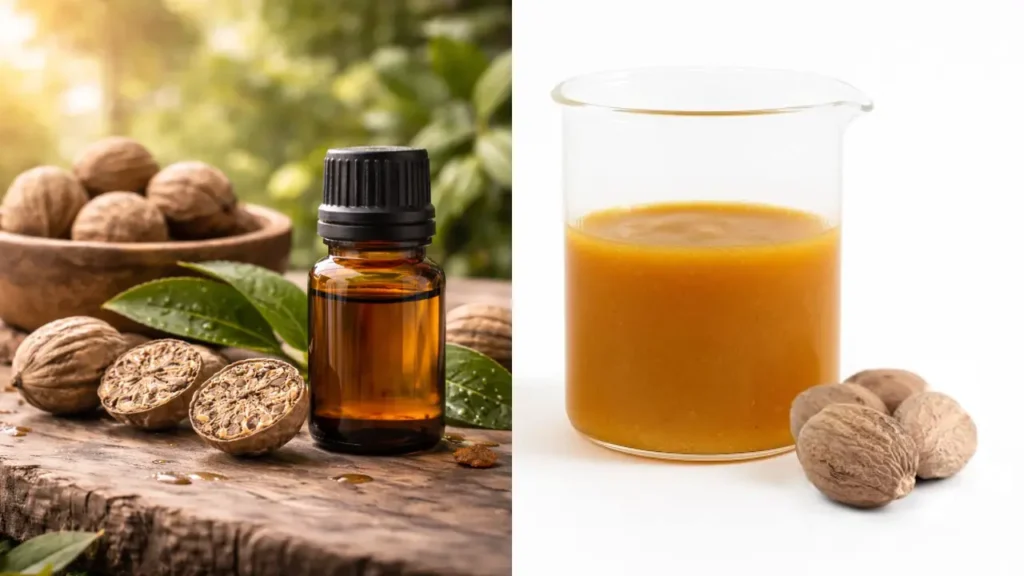
Nutmeg oil vs oleoresin is not a choice between two names for the same ingredient.
Both can start from Myristica fragrans seed, but the way they are produced changes what is captured from the spice, how the material behaves in a formulation, and what a B2B buyer should verify before approval.
Nutmeg essential oil is primarily a volatile aromatic material obtained through distillation.
Nutmeg oleoresin is an extract that contains volatile aroma compounds together with non-volatile or resinous components.
That distinction can affect aroma intensity, spice depth, persistence during processing, physical handling, quality documentation, and suitability for a specific food or flavor system.
There is no universal winner.
A beverage formulator looking for a concentrated aromatic lift may evaluate the essential oil first, while a savory or processed-food manufacturer seeking a broader spice character may decide that an oleoresin deserves evaluation.
The right choice depends on the product brief, process conditions, sensory target, regulatory requirements, and the buyer’s internal quality system.
Nutmeg Oil vs Oleoresin: Quick Comparison for B2B Buyers
Use this table as a starting point, not as a substitute for supplier specifications or formulation trials.
Commercial products can differ according to raw material, extraction conditions, standardization, and the supplier’s formulation.
| Factor | Nutmeg Essential Oil | Nutmeg Oleoresin |
| Production route | Steam or water-steam distillation | Solvent or other extraction process, followed by concentration |
| Main material captured | Primarily volatile aromatic fraction | Volatile aroma compounds plus non-volatile/resinous spice components |
| Typical sensory role | Concentrated aromatic lift and recognizable nutmeg character | Broader, fuller spice character with greater depth and persistence |
| Physical character | Fluid essential oil | More concentrated, resinous or viscous extract; commercial form can vary |
| Processing consideration | Volatile aroma can be sensitive to heat and process conditions | Non-volatile fraction can help retain broader spice character in some processed-food systems |
| Buyer documentation focus | Botanical identity, plant part, extraction, specification, COA, GC-MS where relevant, SDS | Extraction method, extract specification, carrier/diluent if any, residual-solvent requirements where relevant, sensory and food-compliance data |
| Global Essential Oil availability | Available, subject to current product and batch availability | Not currently supplied by Global Essential Oil |
What Is Nutmeg Essential Oil?
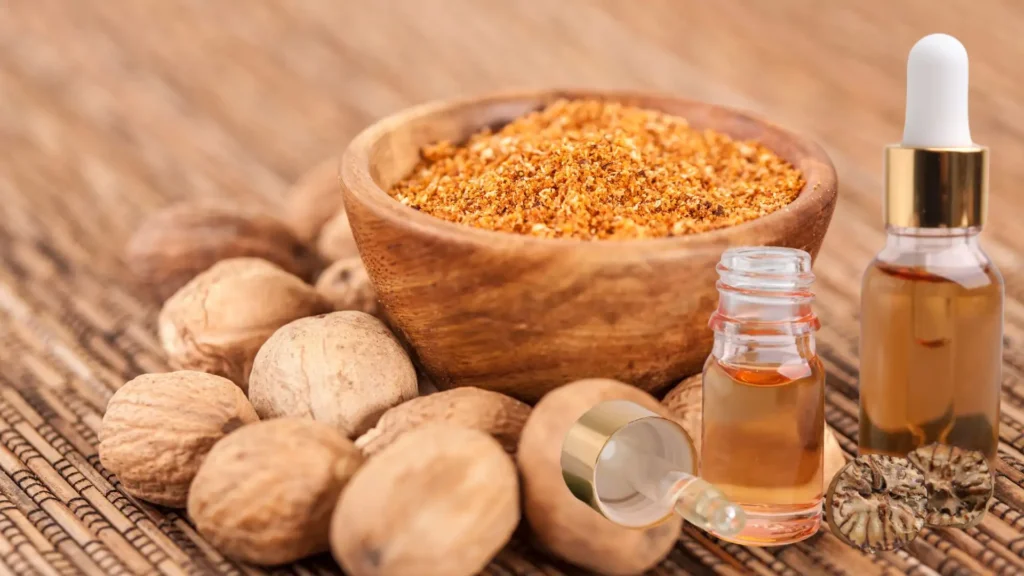
Nutmeg essential oil is the volatile oil obtained from nutmeg seed, commonly through steam or water-steam distillation.
Distillation separates volatile aromatic compounds from the plant material and produces a concentrated liquid ingredient with the warm, spicy, woody, and fresh-terpenic character associated with nutmeg.
For buyers evaluating Indonesian material, the Nutmeg Essential Oil product page provides the commercial route for current product enquiries.
This comparison article, however, focuses on deciding whether essential oil is the right ingredient format in the first place.
Because nutmeg oil is a natural distilled material, its chemical and sensory profile should not be treated as one fixed formula.
Origin, raw-material maturity, distillation conditions, storage, and batch variation can all influence the material that reaches a formulator.
What Is Nutmeg Oleoresin?

Nutmeg oleoresin is a concentrated spice extract rather than a distilled essential oil.
It contains the aromatic fraction of nutmeg together with resinous and other non-volatile constituents extracted from the spice.
This broader composition is one reason oleoresins are often considered when a formulator wants a character closer to the whole spice rather than only its volatile aroma.
A peer-reviewed study on nutmeg oleoresin extraction describes oleoresin as a mixture of essential oil and resin obtained from spice material and notes that extraction conditions can change yield, chemical composition, and sensory properties.
That matters commercially: “nutmeg oleoresin” is not automatically a single standardized sensory profile unless the supplier defines the specification.
Global Essential Oil does not currently supply nutmeg oleoresin.
Buyers whose formulation specifically requires oleoresin should source it from a supplier specializing in spice extracts and evaluate that supplier’s extraction method, standardization, food-compliance documentation, and sample performance.
How Are Nutmeg Essential Oil and Oleoresin Produced Differently?
Distillation for Nutmeg Essential Oil
In distillation, steam passes through or around prepared nutmeg material and carries volatile compounds into a condenser. The condensed oil phase is separated from water.
The process is designed around volatility: compounds that can travel with steam are preferentially recovered, while much of the non-volatile spice material remains behind.
Extraction for Nutmeg Oleoresin
Oleoresin production uses an extraction process to remove a broader set of soluble spice constituents.
Conventional processes may use food-appropriate solvents followed by filtration and solvent removal; other extraction technologies may be used by individual manufacturers.
The choice of solvent, extraction time, temperature, concentration step, and other processing variables can change the final extract.
Why Extraction Method Changes the Final Ingredient
Research from North Maluku provides a useful example.
Assagaf and colleagues compared direct maceration with a combined distillation-maceration approach and found different yields and GC-MS profiles across the essential-oil and oleoresin fractions. See the AGRITECH study from Universitas Gadjah Mada.
The important buyer takeaway is not the exact laboratory percentage; it is that processing method materially affects the composition of the ingredient.
Chemical Composition: Why the Two Materials Behave Differently
The essential oil concentrates volatile constituents, while oleoresin includes additional compounds that are not captured to the same extent by ordinary distillation. This changes more than a laboratory chromatogram.
It can affect sensory depth, physical behavior, stability expectations, and how the ingredient performs during manufacturing.
| Research example - not a commercial specification In one North Maluku study, the distilled nutmeg essential oil contained 31 identified components and showed sabinene as the largest reported component, while the directly macerated oleoresin contained a different profile with 39 identified components. The study also reported different profiles for oleoresin recovered after distillation. These results are specific to the study material and methods and should not be copied into a purchase specification for every commercial nutmeg oil or oleoresin. |
For procurement, this is why a generic statement such as “both come from nutmeg” is not enough.
The buyer needs to understand which fraction of the spice the formulation actually requires and which analytical or sensory specification will control acceptance.
Aroma and Flavor: What Difference Does a Formulator Notice?
Nutmeg Essential Oil: Aromatic Lift and Concentration
Nutmeg essential oil is useful when the formulation needs a concentrated volatile aroma.
It can deliver an immediate spicy, warm, woody, and sometimes fresh-terpenic impression without adding the broader physical extract of the spice.
In flavor systems, that can be useful where the formulation is built around highly concentrated aromatic materials or where a liquid essential-oil format fits the process better.
Nutmeg Oleoresin: Fuller Spice Character and Persistence
Oleoresin carries more of the broader extracted spice character.
Scientific literature describes oleoresins as closer to the original spice in flavor character and, in some applications, more resistant to loss during high-temperature processing than comparable essential oils because of their non-volatile constituents.
That does not make oleoresin automatically superior; it makes the ingredient different.
Why “Stronger” Does Not Automatically Mean “Better”
A more persistent or fuller spice profile can be an advantage in one product and a problem in another.
A beverage may need a clean aromatic accent rather than a heavy spice body. A savory seasoning may benefit from depth that survives processing.
The practical question is whether the ingredient produces the intended sensory result in the finished product, not which material sounds more concentrated on paper.
Which One Performs Better During Food Processing?
Processing conditions can change how nutmeg character is expressed.
Heat, holding time, evaporation, fat content, water activity, mixing sequence, and the food matrix can all influence aroma retention and flavor release.
The nutmeg oleoresin study in the Journal of Food Science and Technology notes that oleoresins tend to withstand high-temperature processing to a greater extent than comparable essential oils because of their non-volatile constituents.
That is a useful formulation clue, but it should not be turned into a universal rule.
A short heat exposure in one beverage process is not equivalent to baking, retorting, frying, or a long-cook savory system.
Essential oil may still be the better material when aromatic lift, compatibility, or a specific flavor-house design calls for it.
Buyers should validate performance under the actual manufacturing conditions that matter to their product.
Nutmeg Essential Oil vs Oleoresin by Application
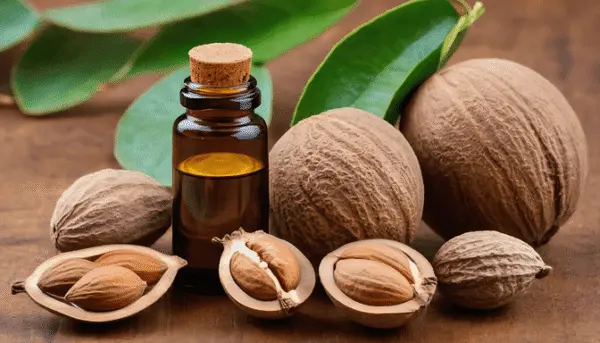
The table below is a decision aid. It deliberately uses “evaluate” rather than “always use” because the final choice depends on the formulation brief and the supplier material.
| Application | Starting Consideration | Why |
| Beverages | Nutmeg essential oil is often worth evaluating first | A concentrated aromatic format can fit beverage flavor systems where lift and clean spice aroma are the target. |
| Confectionery | Either material may be appropriate | The decision depends on whether the product needs volatile aroma, fuller spice depth, heat persistence, or a combination built by the flavorist. |
| Bakery | Oleoresin may deserve evaluation | Baking introduces heat and may benefit from a broader spice extract, but trials are still required. |
| Sauces & savory foods | Oleoresin is often relevant | A fuller spice character and persistence can be useful in complex savory matrices. |
| Processed meat & seasoning systems | Oleoresin can be relevant | Seasoning applications may value broad spice character rather than only top-note aroma. |
| Fragrance & perfumery | Nutmeg essential oil is more directly relevant | Perfumery works primarily with aromatic materials; see the dedicated Nutmeg Essential Oil for Perfumery guide. |
For fragrance-specific use, see our Nutmeg Essential Oil for Perfumery guide rather than expanding the perfumery discussion on this page.
When Nutmeg Essential Oil May Be the Better Choice
Nutmeg essential oil may be the more logical material to evaluate when the formulation brief prioritizes a concentrated volatile aroma rather than the broader extract of the spice. Typical decision signals include:
- The formula is designed around essential oils or other concentrated aromatic ingredients.
- A clean spicy aromatic lift is more important than a fuller resinous spice character.
- The application requires the material to behave as a fragrance or aroma ingredient rather than as a broader spice extract.
- The buyer already has an essential-oil specification, analytical workflow, and approved formulation pathway.
- The development team wants to evaluate nutmeg alongside other distilled natural materials in the same flavor or fragrance system.
Choosing essential oil still requires a batch-level decision.
Natural variation means the buyer should define the expected identity, sensory profile, and analytical acceptance criteria instead of approving a product only because the label says “nutmeg oil.”
When Nutmeg Oleoresin May Be the Better Choice
Nutmeg oleoresin may be more appropriate when the product brief calls for a fuller spice impression, additional non-volatile spice constituents, or flavor persistence through a demanding food process. It may deserve evaluation when:
- The finished product needs a broader whole-spice character rather than mainly volatile aroma.
- The food matrix or processing conditions make aroma retention a major development concern.
- A savory, seasoning, bakery, or processed-food system is being built around concentrated spice extracts.
- The flavor house or R&D team has specifically defined an oleoresin-based formulation.
- The buyer needs an extract specification that addresses the physical and compositional characteristics of oleoresin rather than an essential-oil specification.
| Important supply note Global Essential Oil does not currently supply Nutmeg Oleoresin. If oleoresin is the better fit for your formulation, source it from a qualified spice-extract supplier rather than substituting Nutmeg Essential Oil simply because it is available. |
What Should Food & Flavor Buyers Compare Before Choosing?
The choice becomes much easier when procurement and R&D define the decision criteria before requesting samples. At minimum, compare the following factors.
1. Intended Sensory Profile
Define whether the target is aromatic lift, warm spice depth, a whole-spice effect, persistence, or a specific balance designed by a flavorist. Avoid approving an ingredient only from a neat bottle evaluation.
2. Processing Conditions
Record the relevant heat exposure, holding time, mixing sequence, pH, fat or water phase, and any other process step that may change flavor performance.
3. Food or Beverage Matrix
A material that performs well in a dry seasoning may behave differently in a dairy beverage, sauce, confectionery filling, bakery product, or fat-rich formulation.
4. Required Ingredient Format
Check whether your internal specification, regulatory dossier, customer requirement, or formulation system calls for an essential oil, an oleoresin, or a standardized flavor preparation. The trade name should match the material actually being purchased.
5. Batch Consistency and Supplier Specification
Natural materials vary. The buyer should agree which sensory, physical, or analytical parameters control acceptance and how repeat lots will be compared with the approved reference.
6. Target-Market Requirements
Food-ingredient requirements differ by destination and finished-product category.
Confirm the applicable rules for the exact ingredient and use case rather than relying on a general statement that nutmeg is a familiar food spice.
Quality Documents Are Not Identical for Essential Oil and Oleoresin
One procurement mistake is to ask both materials for the same document package without considering how they are produced. There is overlap, but the technical questions are not identical.
| Buyer Check | Nutmeg Essential Oil | Nutmeg Oleoresin |
| Botanical identity / plant part | Confirm Myristica fragrans seed and the declared extraction route | Confirm raw material identity and the spice material used for extraction |
| Specification | Physical, sensory, and chemical parameters appropriate to nutmeg essential oil | Extract-specific physical, compositional, and sensory parameters |
| COA | Useful for checking the offered batch against the agreed specification | Useful, but should reflect the oleoresin specification rather than an essential-oil template |
| GC-MS / chromatography | Can support evaluation of volatile chemical profile where relevant | May characterize volatile fraction, but oleoresin quality is not represented by volatile GC-MS alone |
| SDS | Review for handling and hazard communication | Review the applicable safety and handling document for the supplied extract |
| Extraction / solvent information | Distillation method should be clear | Extraction method, solvent system and residual-solvent requirements may be important |
| Food compliance | Confirm suitability for intended market/use | Confirm extract, carriers/diluents if any, and intended food use for the destination market |
For a deeper explanation of essential-oil documentation, see our Essential Oil COA and GC-MS guide.
For oleoresin, the buyer should also confirm extraction-specific requirements with the supplier and the destination-market compliance team.
As a regulatory reference point, the U.S. FDA food-substance inventory entry for nutmeg oleoresin lists nutmeg oleoresin as a flavoring agent or adjuvant.
That reference should not be treated as a blanket approval for every formulation, concentration, market, or commercial product.
Why a Sample Trial Matters Before Commercial Adoption
A technical specification can tell you what the supplier intends to sell. It cannot fully predict how the material will perform in your finished product.
This is especially important when comparing two ingredient formats with different composition and physical behavior.
Run the material through the actual development process wherever practical.
Compare aroma release, spice depth, persistence after processing, interaction with the base, appearance, dispersion or solubility behavior where relevant, and the finished product after the normal hold or stability period.
For a structured approval workflow, use our Essential Oil Sample Evaluation Before Bulk Orders guide.
It covers identity, batch traceability, physical and organoleptic checks, COA/GC-MS review, formulation trials, and the transition from an approved sample to a purchase order.
Can You Substitute Nutmeg Essential Oil for Oleoresin 1:1?
No. Nutmeg essential oil and nutmeg oleoresin should not be treated as automatic 1:1 substitutes.
Their composition, concentration, physical form, sensory delivery, and processing behavior are different. A direct weight-for-weight swap can change flavor intensity, persistence, dispersion, and the overall balance of a formulation.
If a formulation must move from one format to the other, treat it as a reformulation exercise.
Define the sensory target, review the new supplier specification, run bench trials, and validate the finished product under the relevant processing and storage conditions.
Avoid universal conversion ratios unless they are supplied and validated for a specific standardized commercial ingredient.
Sourcing Nutmeg Essential Oil for Food & Flavor Applications
If your formulation decision points to Nutmeg Essential Oil, the next step is to convert the sensory requirement into a clear procurement brief.
State the intended application, required botanical identity, target specification, approximate quantity, destination, and any documentation your quality team needs to review.
Global Essential Oil supplies Indonesian Nutmeg Essential Oil for B2B buyers.
You can review the Nutmeg Essential Oil product page for the product route, or use our Nutmeg Essential Oil manufacturer and sourcing guide when your procurement team is evaluating supplier-level requirements.
We do not currently supply Nutmeg Oleoresin. If oleoresin is the technically better fit, buyers should source it from a specialist oleoresin producer.
If Nutmeg Essential Oil is the appropriate format, our team can discuss current specifications, available documentation, sample requirements, packaging, and quotation details based on the actual inquiry.
| Need Nutmeg Essential Oil for a Food or Flavor Project? Share your application, target specification, approximate quantity, and destination with our team. We can discuss the current Nutmeg Essential Oil option and the next steps for sample or bulk evaluation. Contact Global Essential Oil |
Frequently Asked Questions
What is the difference between nutmeg oil and nutmeg oleoresin?
Nutmeg essential oil is primarily the volatile aromatic fraction obtained by distillation. Nutmeg oleoresin is an extract that contains volatile aroma compounds together with non-volatile or resinous spice constituents. That difference affects sensory character, processing behavior, physical properties, and the quality checks a buyer should perform.
Is nutmeg oleoresin the same as nutmeg essential oil?
No. They can come from the same botanical raw material, but they are produced differently and are not the same commercial ingredient. Do not use the names interchangeably on specifications, purchase orders, or formulation records.
Which is better for food manufacturing?
Neither is universally better. Essential oil can be a strong choice when concentrated volatile aroma is the priority. Oleoresin may be more suitable when a fuller spice character or greater flavor persistence through processing is required. The final decision should be made in the intended food matrix.
Which is better for beverages?
Nutmeg essential oil is often worth evaluating first when a beverage formulation needs concentrated aromatic character, but the actual choice depends on the flavor system, desired sensory profile, processing method, and regulatory requirements. A flavorist may also use a standardized preparation rather than either raw material directly.
Can nutmeg essential oil replace oleoresin?
Not automatically. Switching between essential oil and oleoresin changes the ingredient format and can change flavor intensity, persistence, and processing performance. Reformulation and sensory validation are recommended rather than a universal 1:1 conversion.
Is nutmeg oleoresin more stable than nutmeg essential oil?
Oleoresin can retain broader spice character under some high-temperature processing conditions because it contains non-volatile constituents, but “more stable” is too broad as a universal claim. Stability depends on the exact commercial ingredient, matrix, packaging, process, storage conditions, and the quality attribute being measured.
Does Global Essential Oil sell nutmeg oleoresin?
No. Global Essential Oil currently supplies Nutmeg Essential Oil, not Nutmeg Oleoresin. This guide compares the two ingredient formats so buyers can choose the material that fits their formulation rather than being pushed toward an unsuitable substitute.