Fennel oil for anxiety has attracted interest in aromatherapy, but the evidence is not strong enough to describe fennel seed essential oil as a proven treatment for anxiety disorders, chronic stress, insomnia, or poor concentration.
Two recent human studies provide useful signals, yet both have important limitations and do not justify broad medical claims.
The most accurate position is that fennel seed essential oil may be evaluated as an aromatic ingredient within a complete wellness or personal-care product.
Its effects can depend on the oil composition, concentration, exposure method, massage or other accompanying interventions, user expectations, and individual sensitivity.
| Health information note This article provides general educational information and does not diagnose or treat anxiety, depression, insomnia, or another health condition. Persistent, severe, or worsening symptoms should be discussed with a qualified healthcare or mental-health professional. |
5 Key Evidence and Safety Insights
- A 2026 exploratory randomized study found a between-group difference in state anxiety after the final massage session, but changes over time within each group were not statistically significant.
- A 2022 human study reported reduced anxiety scores after four weeks of fennel essential-oil inhalation, but its young student population and waiting-list control limit generalization.
- Current research does not establish fennel essential oil as a treatment for insomnia, depression, chronic stress, memory loss, or attention problems.
- Fennel seed oil composition can vary, especially in trans-anethole, fenchone, limonene, and estragole levels; batch-specific analysis matters.
- Formulators should evaluate the complete product, intended application, exposure route, target market, documentation, and applicable regulations rather than relying on general wellness claims.
What Is Fennel Seed Essential Oil?
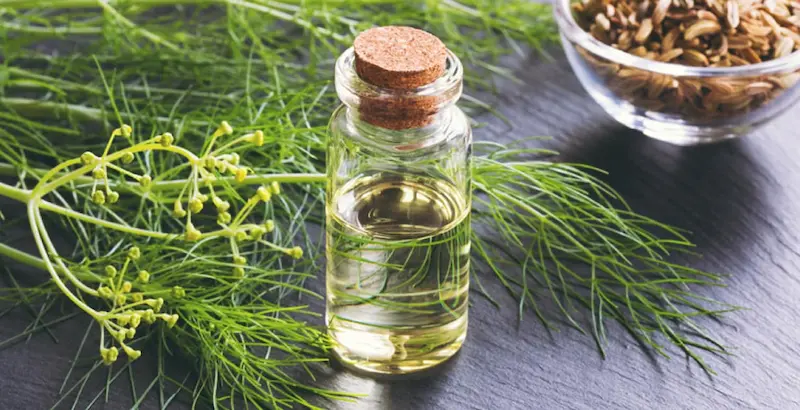
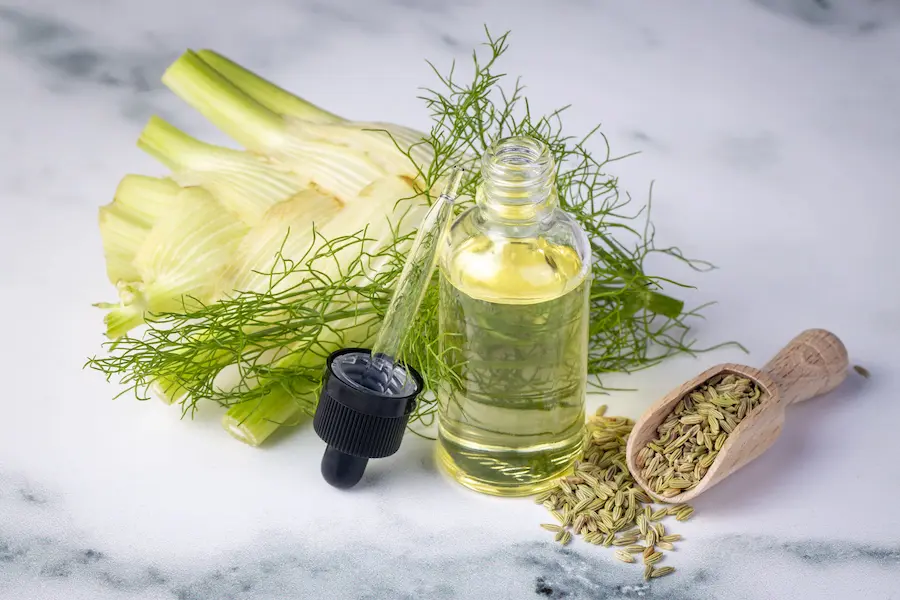
Fennel seed essential oil is a concentrated volatile oil produced from the fruits commonly called seeds of Foeniculum vulgare. It is typically obtained by steam distillation or hydrodistillation and has a sweet, anise-like aroma.
Common constituents include trans-anethole, fenchone, limonene, and estragole. Their proportions are not fixed.
Research comparing fennel oils has shown that chemical composition may vary with plant material, geographical origin, cultivation conditions, maturity, and production method.
This variability is one reason buyers should review actual batch data instead of assuming every fennel oil has the same aroma or safety profile.
Trans-anethole is often a major component of seed oil. However, the presence of a compound associated with a biological mechanism does not prove that the complete oil produces a therapeutic outcome in people.
Fennel Seeds, Extract, Essential Oil, and Trans-Anethole Are Different
Online discussions often combine several fennel materials even though their composition, concentration, and use are different.
| Material | What It Is | Why the Difference Matters |
| Whole fennel seeds | A culinary spice and traditional plant material. | Food or traditional use does not establish the effects of inhaling or applying a concentrated essential oil. |
| Fennel extract | A preparation produced with a particular solvent or extraction method. | It may include non-volatile compounds that are absent or present differently in essential oil. |
| Fennel seed essential oil | A concentrated mixture of volatile compounds obtained by distillation. | This is the primary material discussed here; batch composition and intended use still matter. |
| Trans-anethole | A major constituent in many fennel seed oils. | Research on an isolated compound is not equivalent to research on the complete oil. |
Fennel Oil for Anxiety: What Does Human Research Show?
The 2026 Exploratory Aromatherapy-Massage Study
A 2026 exploratory randomized study compared massage with sweet almond oil against aromatherapy massage using 1.6% fennel seed essential oil in sweet almond oil.
Forty participants received one session every 15 days over two months. The oil contained 78.2% trans-anethole.
After the final session, the aroma-massage group had a lower mean state-anxiety score than the massage-only group.
However, the researchers did not find statistically significant changes over time across the four assessment points within either group.
Sleep-quality and well-being patterns also favored the aroma-massage group in some descriptive results, but the mean-score differences were not statistically significant.
The study is useful because it compared fennel aroma massage with massage alone.
Its limitations include the small sample, exploratory design, combined massage-and-aroma intervention, and the lack of strong significant findings across all measurement points.
It does not establish fennel oil as an anxiety or sleep treatment.
The 2022 Human Study
A 2022 study involved 117 participants divided into a waiting-list control group, an aerial-parts essential-oil group, and a seed essential-oil group.
Participants in the intervention groups placed two drops of oil on cotton, inhaled it, and kept the cotton near the collar for 30 minutes each day for four weeks. The seed oil contained 79.2% trans-anethole.
The researchers reported reductions in anxiety scores, with a larger effect in the seed-oil group than in the aerial-parts group. The result is promising, but the trial should be interpreted carefully.
Most participants were young health-science students, the control group did not receive a placebo aroma, the intervention was conducted remotely, and expectation or other contextual effects could not be fully separated from the oil exposure.
This study supports further investigation. It does not prove that fennel essential oil treats clinical anxiety, works equally across populations, or should be used without product-specific instructions.
What Current Evidence Cannot Prove
- That fennel essential oil replaces psychotherapy, prescribed medication, or professional mental-health assessment.
- That a home diffuser, massage oil, inhaler, or personal-care formulation will reproduce a research result.
- That a stronger concentration or longer exposure creates a better mental-wellness outcome.
- That all fennel oils are equivalent in chemical composition or safety.
- That research on whole fennel, extracts, animal models, or trans-anethole alone applies directly to the complete essential oil.
Evidence at a Glance
| Evidence | What It Suggests | Main Limitation |
| Exploratory randomized study, 2026 | A difference in state anxiety appeared between groups after the final session. | Only 40 participants; combined aroma and massage; no significant change over time within groups; sleep and well-being mean differences were not significant. |
| Human experimental study, 2022 | Seed essential oil was associated with lower anxiety scores after four weeks. | Young student sample, waiting-list rather than placebo control, remote protocol, and limited generalizability. |
| Animal and compound research | Possible mechanisms involving trans-anethole and other constituents have been proposed. | Preclinical mechanisms do not establish routine human efficacy, dose, or safety. |
Does Fennel Oil Reduce Stress?

Anxiety and stress are related but not identical. The recent fennel studies measured anxiety, sleep, or well-being rather than demonstrating control of chronic stress physiology.
Claims that fennel essential oil regulates cortisol, restores hormonal balance, or reliably reduces stress are not currently supported by direct, high-quality evidence.
A user may describe an aroma as pleasant or calming, but a subjective response should not be presented as a clinical stress-management effect.
The complete setting - including massage, quiet time, expectation, ventilation, and personal aroma preference - can influence the experience.
Can Fennel Oil Improve Sleep?
The 2026 study included sleep-quality measurement, but the mean questionnaire results did not show a statistically significant benefit.
Current evidence therefore does not establish fennel seed essential oil as a treatment for insomnia or another sleep disorder.
Finished aromatherapy products may use fennel as part of a fragrance blend, but they should not be marketed as proven sleep treatments without product-specific evidence and appropriate regulatory review.
Does Fennel Oil Improve Focus or Memory?
Direct human evidence that fennel essential oil improves attention, concentration, memory, learning, or work performance is insufficient.
Research involving antioxidant activity, animal models, plant extracts, or individual compounds cannot be converted into a claim that inhaling fennel oil clears brain fog or improves productivity.
For an article about mental wellness, focus is better treated as an unanswered research question than as an established benefit.
Readers should also consider practical causes of concentration problems, including sleep, workload, medication, stress, and underlying health conditions.
How Is Fennel Oil Used in Aromatherapy Products?
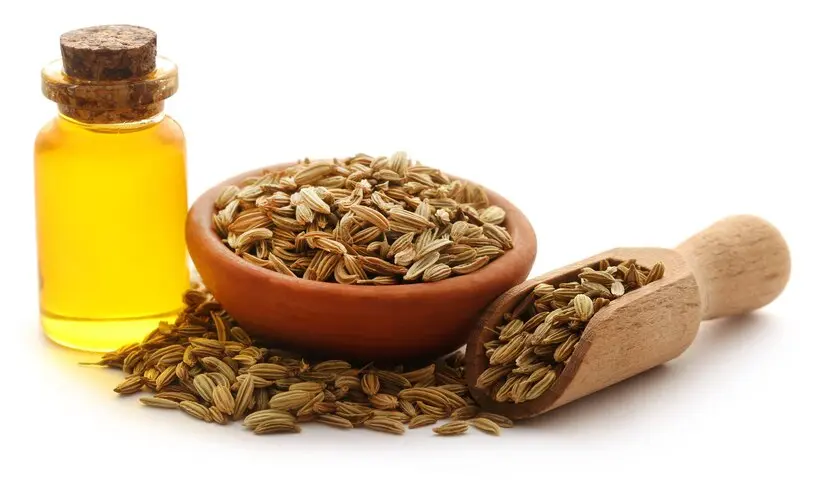
Fennel oil may be incorporated as an aromatic ingredient in diffuser products, massage oils, room fragrance, personal-care formulations, and wellness blends.
The finished-product manufacturer determines the concentration, instructions, warnings, and target user based on the complete formulation.
Concentrated essential oil should not be applied directly to the skin, and greater exposure should not be assumed to provide greater mental-wellness benefits.
Use finished products according to their labels and discontinue exposure if irritation or discomfort occurs.
Readers interested in fragrance combinations can review Global Essential Oil's guide to blending fennel seed oil for relaxation.
Keeping practical blending guidance on a separate page helps this article remain focused on evidence and safety.
Safety Considerations
Composition and Botanical Type Matter
Sweet fennel and bitter fennel materials can have different chemical profiles.
Even within the same general product category, trans-anethole, fenchone, estragole, and other constituent levels may vary.
Botanical identity, plant part, origin, and batch-specific analysis should therefore be confirmed.
Estragole Requires Careful Assessment
The European Medicines Agency has stated that estragole is a naturally occurring genotoxic carcinogen and recommends that exposure from herbal medicinal products be kept as low as practically achievable.
The EMA has also identified specific safety concerns for bitter fennel fruit oil in herbal medicinal use.
This regulatory assessment does not mean that every fennel fragrance or cosmetic product has the same risk.
It does mean that variety, composition, dose, exposure route, duration, target population, and regulatory category cannot be ignored.
Skin, Eye, and Inhalation Exposure
Follow the finished-product label, avoid direct contact with the eyes and mucous membranes, and do not apply undiluted essential oil to the skin.
Use aromatic products in an appropriately ventilated environment.
Stop use if exposure causes irritation, coughing, headache, nausea, dizziness, or breathing discomfort.
Sensitive Users and Internal Use
Pregnant or breastfeeding users, children, people with medical conditions, and those using medication should follow product restrictions and seek qualified advice where appropriate.
Concentrated fennel essential oil should not be promoted for internal use as a self-directed method of anxiety, stress, or sleep management.
A more detailed overview is available in our fennel seed oil safety guide.
Considerations for Formulators and B2B Buyers
For procurement and formulation, the key question is not simply whether fennel oil has a sweet aroma.
Buyers need to confirm whether the oil fits the intended application, specification, safety assessment, regulatory market, and finished-product claims.
1. Confirm Botanical Identity and Material
Request the botanical name, variety or type where relevant, plant part, extraction method, country of origin, and product description. Avoid using “fennel oil” as though it always identifies a single standardized chemical profile.
2. Review Batch-Specific Composition
A batch-specific COA and GC-MS report can help buyers evaluate major constituents such as trans-anethole, fenchone, limonene, and estragole. It can also support identity checks and comparison with an agreed specification.
3. Assess the Complete Finished Product
Finished-product suitability depends on total formulation, concentration, exposure route, allergens, stability, packaging, target population, labeling, and applicable rules.
A raw-material study does not validate the efficacy or safety of a final diffuser, massage oil, cosmetic, fragrance, or wellness product.
4. Request Relevant Documentation
- Product specification and botanical identity.
- Batch-specific Certificate of Analysis.
- GC-MS or other appropriate chemical-profile report.
- SDS or MSDS for handling and transport.
- Packaging, MOQ, lead time, and export-document information.
- Application-specific documents required for the target market.
Buyers evaluating Indonesian material can review the fennel essential oil manufacturer page for product and bulk-supply information.
Source Indonesian Fennel Essential Oil for B2B Applications
Global Essential Oil supplies Indonesian fennel essential oil for B2B applications.
Buyers and formulators can discuss botanical identity, intended use, product specifications, available COA, GC-MS and SDS documentation, packaging, and bulk supply requirements with the export team.
Contact Global Essential Oil to request product information or discuss a quotation.
The suitability and safety of a finished product depend on its complete formulation, concentration, exposure route, intended use, target market, and applicable regulations.
Frequently Asked Questions
Does fennel oil help with anxiety?
Two human studies have reported signals related to anxiety, but their limitations prevent fennel essential oil from being described as a proven anxiety treatment. More rigorous and larger clinical trials are needed.
Is fennel oil good for stress?
Fennel oil may be used as an aromatic ingredient, but direct evidence that it controls chronic stress or regulates cortisol is insufficient.
Does fennel oil help with sleep?
The 2026 exploratory study measured sleep quality, but the mean results did not demonstrate a statistically significant benefit. Fennel oil is not an established insomnia treatment.
Can fennel oil improve focus or memory?
There is not enough direct human evidence to conclude that fennel essential oil improves attention, concentration, learning, or memory.
Is fennel seed essential oil the same as eating fennel seeds?
No. Whole fennel seeds are a culinary plant material, while essential oil is a concentrated mixture of volatile compounds. Their dose, composition, exposure route, and safety considerations differ.
Can fennel essential oil be applied directly to the skin?
Concentrated fennel essential oil should not be applied directly to the skin. Use a finished, appropriately formulated product according to its label.