

A perfume can smell bright when first applied, softer after a while, and warmer as it settles.
Perfumers often describe this development using top, middle, and base notes.
These terms help explain which aromas are most noticeable at different stages of wearing a fragrance.
The three categories are useful, but they are not sealed layers that appear one after another.
Aromatic ingredients begin contributing together, and their relative intensity changes as a perfume evaporates.
Understanding that difference makes the fragrance pyramid far more helpful—for perfume enthusiasts and for anyone learning about natural aromatic ingredients.
What Are Top, Middle, and Base Notes in Perfume?
Top notes shape the opening impression, middle (or heart) notes express much of the fragrance’s recognizable character, and base notes add depth to the later dry-down.
The terms describe how a scent is perceived over time, rather than three separate liquids inside a bottle.
| Note category | Main role | Common scent character | Essential oil examples |
| Top / head | Opening impression | Bright, fresh, aromatic | Bergamot, lemon, peppermint |
| Middle / heart | Main scent character | Floral, herbal, warm-spicy | Lavender, geranium, nutmeg |
| Base / bottom | Depth and lingering dry-down | Woody, earthy, resinous | Patchouli, vetiver, cedarwood |
These examples are typical, not fixed classifications. One material may act in more than one role depending on its chemistry, amount, and the other ingredients in the composition.
Understanding the Fragrance Pyramid
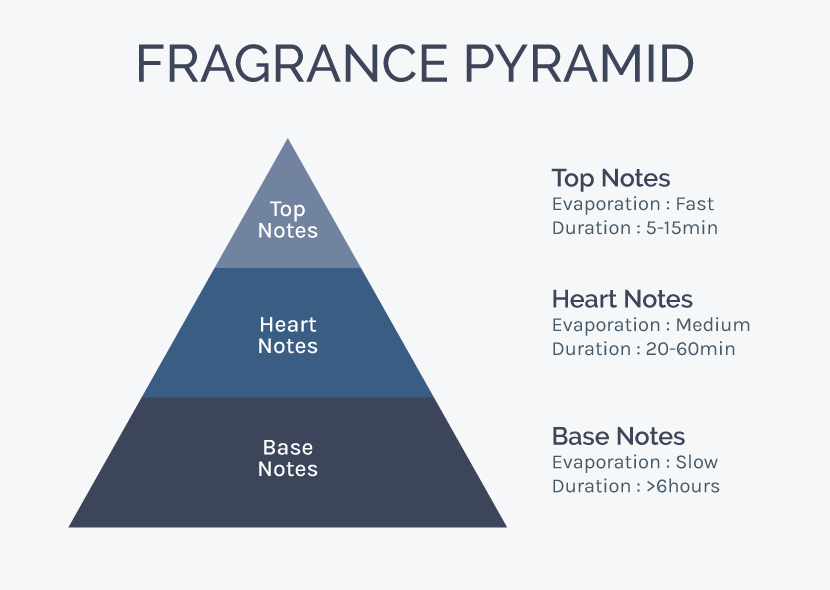
The fragrance pyramid is a simple picture of scent development: the top is the opening, the middle is the heart, and the base is the longer-lasting foundation.
It can help someone reading a perfume description imagine how its character may evolve rather than judging the fragrance only from its first spray.
The underlying idea is volatility—how readily fragrance molecules move into the air. Highly volatile components tend to make a strong early impression. Less volatile components often remain perceptible later.
But a real perfume contains many materials with overlapping evaporation patterns, and the blend changes continuously rather than switching from one layer to the next.
As natural-perfumery educators explain in Natural Perfumery Basics, these categories are subjective and may overlap. Treat the pyramid as a useful guide, not a formula requiring universal percentages or exact time limits.
The Three Types of Fragrance Notes Explained
Top Notes: The First Impression
Top notes are the scents you are most likely to notice immediately.
Citrus materials such as bergamot and lemon often create a lively, sparkling opening, while peppermint can lend a sharp, cool aromatic effect.
Their prominence commonly changes quickly as the more volatile elements dissipate.
An appealing top note can make a fragrance feel inviting at first contact. Yet an opening is not the entire story.
A perfume built only around fleeting materials may smell noticeably different after a short period, which is why perfumers consider how the opening relates to the heart and base.
Middle Notes: The Heart of a Fragrance
Middle notes, also called heart notes, often carry the theme that makes a scent recognizable after its brightest opening recedes.
Lavender and geranium can contribute herbal or floral character. Nutmeg oil may add warm, spicy nuances when it suits the intended fragrance direction.
Middle-note ingredients can help connect a fresh opening with a deeper dry-down.
They do not necessarily wait to become detectable; a floral or spicy material may already be noticeable from the first moments.
For an example of an Indonesian aromatic ingredient with a warm-spicy profile, explore the nutmeg essential oil product information.
Base Notes: The Long-Lasting Foundation
Base notes are associated with the depth and character that remain as lighter aromas fade. Earthy patchouli, smoky-woody vetiver, and different types of cedarwood are familiar examples.
These materials can give a fragrance a richer, more grounded quality, although their actual persistence depends on the whole formula.
Patchouli is especially useful as an illustration because its earthy and woody character can be present throughout a composition while becoming more noticeable in the dry-down.
To explore this ingredient more deeply, see our article on working with patchouli essential oil notes.
How Do Top, Middle, and Base Notes Work Together?

Imagine a fragrance opening with a citrus-like sparkle, becoming more floral or spicy as it settles, and leaving an earthy-woody impression later.
That change does not mean three independent fragrances have taken turns. The materials were present together, but their balance in the air—and therefore what your nose notices—has changed.
Concentration, the identity of each aroma material, interactions within the mixture, the carrier, and the testing surface all influence the result.
A powerful base-note ingredient may be detectable immediately. A middle-note material may remain noticeable well into the dry-down. Notes describe the experience rather than guaranteeing a rigid sequence.
Do All Perfumes Follow the Fragrance Pyramid?
No. Some perfumes change dramatically between the opening and the dry-down; others have a comparatively consistent, or “linear,” scent profile.
Neither approach is inherently better. A linear perfume may emphasize one recognizable impression throughout wear, whereas an evolving composition may reveal different facets over time.
Perfumer and educator Karen Gilbert also points out that the fragrance pyramid can be misleading if it suggests each group of materials evaporates separately.
This is why it is worth smelling a perfume over time instead of relying only on a note list.
Examples of Essential Oils Used in Different Fragrance Notes
Essential oils offer real examples of how natural materials can contribute to a fragrance.
The table below shows common associations, not promises that every variety or batch will behave identically.
| Typical role | Essential oil examples | What to look for |
| Top | Bergamot, lemon, peppermint | Sparkling, fresh or sharp early impressions |
| Middle | Lavender, geranium, nutmeg | Floral, herbal or warm-spicy body |
| Base | Patchouli, vetiver, cedarwood | Earthy, woody depth in the dry-down |
Indonesian patchouli and vetiver are especially relevant to perfumery discussions because of their distinctive woody and earthy qualities.
You can explore our bulk patchouli oil details and Indonesian vetiver sourcing guide if you are interested in those raw materials.
The appropriate use of any oil still depends on the intended fragrance and a review of its specification and safety requirements.
How to Identify Top, Middle, and Base Notes in a Perfume
You do not need professional equipment to begin recognizing fragrance development.
A paper scent strip, a notebook, and patient observation can help you separate your first impression from the later dry-down.
- Apply a small amount of perfume to a clean fragrance testing strip. Avoid touching the scented end or comparing many strong scents at once.
- Smell the opening soon after application. Describe the first impression in your own words: citrusy, floral, herbal, spicy, woody, or something else.
- Revisit the strip after the first impression has softened. Notice which qualities have become more apparent rather than assuming a middle note must begin at a specific minute.
- Return again during the dry-down. Look for aromas that remain recognizable when the initial brightness has diminished.
- Record what changed and what stayed consistent. Compare several fragrances across separate sessions, and allow your nose to rest between samples.
It can be useful to compare a blotter with a properly formulated finished perfume on skin, but results may differ because the surfaces and conditions are different.
Never test undiluted essential oils directly on skin as part of this exercise.
Why Fragrance Notes Matter in Perfume Formulation
For fragrance developers, a note description is a communication tool. It helps turn a broad fragrance brief—such as fresh at first, floral in the heart, and woody in the dry-down—into a more testable sensory direction. It also encourages evaluation at more than one point in a fragrance’s life.
However, choosing raw materials for a commercial product involves more than classifying notes.
Manufacturers also consider odor consistency, ingredient identity, safety for the intended application, and performance in the complete formula.
Our Indonesian essential oils for perfumery guide explores that professional ingredient-selection process in more detail. For a hands-on beginner activity instead, see how to make perfume with essential oils.
Final Thoughts
Top, middle, and base notes offer a practical language for understanding perfume, from its first impression to its lingering dry-down.
The key is to listen to the fragrance over time: notice which aromas lead, which support the center, and which remain.
The more you practice, the easier it becomes to recognize a scent’s structure without treating the fragrance pyramid as a strict rule.
If you are developing fragrances and exploring Indonesian natural aromatic ingredients, contact the Global Essential Oil team to discuss product information, sample requirements, and potential sourcing options.
Frequently Asked Questions
What is the difference between top, middle, and base notes?
Top notes are most prominent in the opening, middle notes help define the fragrance’s heart, and base notes contribute depth in the later dry-down. They overlap and do not appear as three completely separate stages.
Which perfume notes last the longest?
Base-note materials are generally associated with longer persistence, but duration varies by ingredient, formula, concentration, and testing conditions. “Base note” is not a guarantee that a fragrance will last a fixed number of hours.
Can one essential oil be both a top and middle note?
Yes. Natural aromatic materials contain many compounds and may show different facets in different formulations. Note categories are useful descriptions, not permanent labels assigned to every oil.
Do all perfumes have top, middle, and base notes?
Not every fragrance displays a pronounced three-stage evolution. Some are intentionally more linear, while others transition noticeably from opening to heart to base. The pyramid is one way to describe the experience.