Citronella oil does not remain chemically unchanged forever.
Like other essential oils, it contains volatile compounds that can be affected by oxygen, heat, light, repeated opening, contamination, and unsuitable storage conditions.
For a bulk buyer, that means shelf life should be treated as a quality-management question, not just a date printed on a specification sheet.
Published shelf-life values for citronella oil can differ between suppliers and product specifications.
Some commercial sources use a shelf life of roughly two years under recommended storage conditions, while others state three years or longer.
Those numbers are not automatically interchangeable because the material, packaging, storage assumptions, and supplier quality policies may differ.
The practical approach is therefore simple: use the supplier-stated shelf life or best-before information as one input, then combine it with the batch documentation, packaging condition, storage history, sensory observations, and your own quality-control procedures.
A well-managed batch and a poorly stored batch of the same age should not automatically be treated as equivalent.
| Quick Answer | What B2B Buyers Should Do |
| Shelf-life number | Use the supplier or batch documentation; do not assume one universal period applies to every citronella oil. |
| After opening | Track the opening date, minimize unnecessary air exposure, keep the closure secure, and review long-term headspace. |
| Storage | Keep the material protected from excessive heat, direct light, water ingress, and avoidable contamination. |
| Older stock | Re-evaluate when the batch is beyond its stated shelf life, has an uncertain storage history, or shows a meaningful change. |
| Quality evidence | A historical COA describes the tested batch at release; it does not prove that poorly stored material remains unchanged indefinitely. |
How Long Does Citronella Oil Last?
There is no single shelf-life number that should be treated as a universal rule for every citronella essential oil. Commercial specifications available in the market differ.
For example, some supplier documents state around 24 months when stored properly, while other bulk product information lists three to four years under recommended conditions.
This variation is one reason a procurement team should avoid copying a shelf-life number from a generic blog or another supplier’s product sheet into its own specification.
The more relevant question is: what shelf life applies to the exact material, package, and storage conditions being purchased?
A widely cited review of essential-oil stability notes that essential oils are susceptible to conversion and degradation reactions and identifies temperature, light, and oxygen availability as major factors affecting integrity.
For technical background, see the review Stability of Essential Oils by Turek and Stintzing.
Why Published Shelf-Life Numbers Differ
- Different botanical types and batches can have different chemical profiles.
- The stated period may be counted from production, filling, release, or opening, depending on the supplier.
- Packaging systems and closure quality differ between suppliers and order formats.
- Storage assumptions may differ, including temperature, light exposure, and how often the container is opened.
- Some suppliers use a fixed best-before period, while others allow retesting or extension under controlled quality procedures.
Buyer takeaway: ask for the current product or batch shelf-life information and the recommended storage conditions. Do not assume that a number from another citronella oil applies to the material you are buying.
Shelf Life Is Not a Sudden “Expiry Event”
Essential-oil deterioration is generally a gradual process rather than a switch that flips at midnight on a particular date. Exposure history matters.
A batch that has spent months in a tightly closed, suitable package under controlled conditions is a different quality-risk scenario from a batch that has been repeatedly opened, stored near heat, or left with a compromised closure.
For B2B use, the expiry or best-before date should therefore trigger a quality decision rather than a guess.
The buyer’s QA team should determine whether the material can still be accepted, needs additional review, or should be rejected according to the application and internal procedures.
What Happens to Citronella Oil During Storage?

Citronella oil is a mixture of volatile aromatic constituents rather than one single molecule.
Its commercial character is associated with compounds such as citronellal, citronellol, geraniol, and other constituents.
Over time, unsuitable storage can alter the balance of volatile components and the overall sensory or analytical profile.
Oxidation
Oxygen is one of the most important external factors in essential-oil stability.
Oxidative reactions can change an oil’s chemical profile and may eventually affect odor, color, or suitability for the intended specification.
This is why closure integrity and unnecessary exposure to air matter in long-term storage.
Volatile Loss
Repeated opening, imperfect sealing, and handling can allow volatile constituents to escape.
For a bulk drum that is opened many times over several months, operational handling can become part of the quality story, not just the original production date.
Light Exposure
Light can accelerate degradation reactions in essential oils. Bulk packaging is often designed to reduce direct light exposure, but warehouse practices still matter.
Avoid leaving working containers or transferred material in direct sunlight or bright heat-exposed areas.
Heat and Temperature Fluctuation
Elevated temperature can accelerate chemical change, while large temperature swings may complicate storage and handling.
The safest policy is to follow the supplier’s stated storage conditions and keep the warehouse environment as stable as practical for the material.
Moisture and Contamination
Citronella essential oil should also be protected from water ingress, dirty transfer equipment, incompatible residues, and other foreign material.
A clean package can still be compromised later if dispensing practices are poor.
For a citronella-specific example of why storage conditions matter, a study on Java citronella components notes that essential-oil constituents can undergo chemical changes during storage and handling because of volatility and exposure to heat, humidity, light, or oxygen.
Sealed vs Opened Citronella Oil: Why Headspace Matters

An unopened supplier-sealed container normally has a simpler exposure history than a drum that has been opened repeatedly.
Once a container is in use, air enters the headspace and dispensing activity can introduce additional handling risks.
As the quantity in a drum decreases, the proportion of air space inside the container can increase.
For slow-moving stock, that headspace becomes a practical consideration because the remaining oil may spend a long time in contact with the air inside the package.
This does not mean every partially used drum should automatically be transferred into a smaller container.
A transfer creates its own risks: the new container must be clean, compatible with the oil, correctly sealed, properly labeled, and traceable to the original batch.
In many facilities, the decision should involve QC, warehouse, EHS, and production teams rather than being handled informally.
How Bulk Buyers Should Store Citronella Oil After Delivery
The most useful storage controls are operational. They should be simple enough for warehouse staff to follow consistently and specific enough to preserve traceability.
- Keep the container properly closed whenever material is not being dispensed.
- Limit unnecessary opening of the main bulk container.
- Protect the package from direct sunlight, excessive heat, and avoidable temperature swings.
- Prevent water, dust, dirty tools, and foreign material from entering the container.
- Use clean, compatible pumps, hoses, funnels, or transfer equipment.
- Record the batch or lot number, received date, opened date, and relevant dispensing history.
- Keep damaged, leaking, or uncertain containers under quality hold until they are assessed.
If you are still deciding which bulk container format is appropriate before ordering, see our Bulk Essential Oil Packaging guide for container materials, closures, liners, shipping considerations, and purchase-order questions.
Should You Transfer Citronella Oil Into a Smaller Container?
Sometimes, but not automatically. A partially used bulk container may justify a smaller working package when the remaining quantity will be stored for a long period and your quality system allows the transfer.
The objective is to reduce unnecessary exposure while preserving material compatibility and traceability.
Before transferring, confirm all of the following:
- The new container material and closure are suitable for the specific citronella oil.
- The package is clean, dry, and free of residues from previous contents.
- The transfer equipment is suitable and clean.
- The new package receives the original batch/lot identity and relevant status labels.
- The transfer does not conflict with the supplier’s storage guidance or your internal QA procedure.
Do not move bulk citronella oil into an arbitrary plastic bottle, reused drum, or unverified container simply because it has less empty space.
Reducing headspace is useful only if the replacement packaging is suitable.
Which Containers Are Suitable for Storing Bulk Citronella Oil?
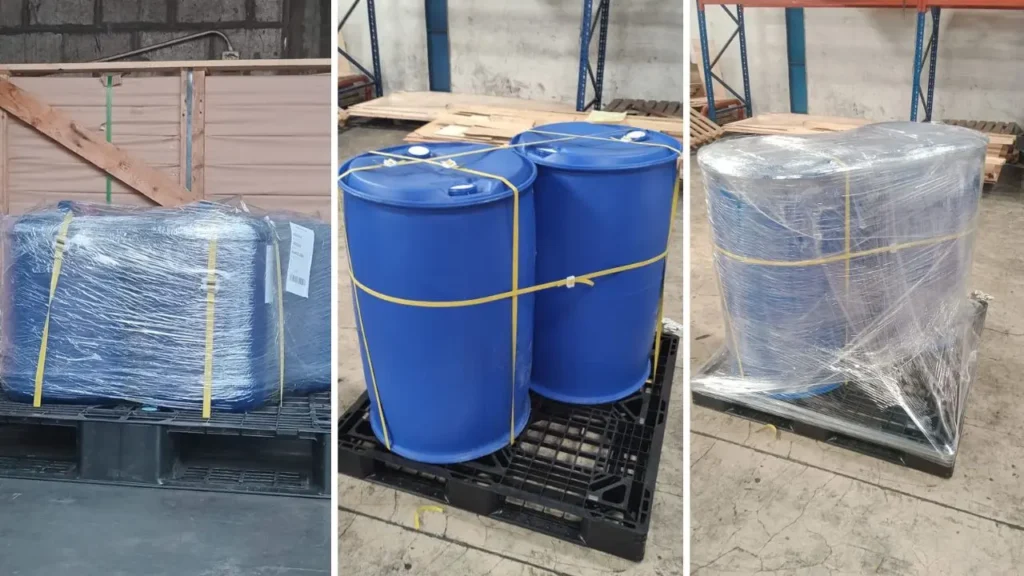
The answer depends on the specific oil, package design, storage duration, and supplier system.
Commercial citronella oil is sold in different formats, including metal drums, aluminum containers, and compatible polymer packages.
Small retained samples or laboratory quantities may use other containers.
The important point is not to declare one material universally best.
Buyers should confirm the proposed container, any internal lining, closure or gasket, net fill, and intended storage period for the exact product.
For a broader decision framework on glass, HDPE, aluminum, steel, drums, jerrycans, and high-volume containers, use the Bulk Essential Oil Packaging: B2B Container Guide.
Signs That Stored Citronella Oil Should Be Re-Evaluated
A storage warning sign does not automatically prove that a batch is unusable.
It means the material deserves review before it is released into production. Possible triggers include:
- A noticeable change in the expected citronella aroma or the appearance of an off-note.
- An unexpected color shift compared with the retained reference or receiving record.
- Haze, cloudiness, sediment, or another appearance change that is not expected for the batch.
- A damaged seal, leaking closure, dented container, or uncertain package history.
- Known exposure to abnormal heat, direct sunlight, water, or contamination.
- A long period after opening with frequent dispensing from the same container.
- An unclear storage history after warehouse transfer, third-party storage, or returned goods.
Sensory and visual checks are screening tools. They should not be treated as a substitute for analytical evaluation when the application or quality system requires more evidence.
Should You Use Citronella Oil After Its Stated Shelf Life?
There is no responsible universal answer.
A B2B buyer should not automatically approve old stock just because it still smells acceptable, and should not automatically assume every batch becomes unusable the day after a stated shelf life.
The decision should consider:
- The supplier-stated shelf life or best-before information.
- The intended finished-product application and risk level.
- How the material has been stored since receipt.
- Whether the original package and seal remained intact.
- Any sensory or visual changes.
- The buyer’s internal raw-material specification and quality policy.
- Whether re-testing is appropriate before release.
If the material is used in a regulated, high-value, or formulation-sensitive product, the buyer’s quality team may apply a more conservative decision process than for a low-risk internal trial.
The requirement should come from the actual application and quality system, not from a generic internet rule.
When Should a Stored Batch Be Retested?
Re-testing is most useful when it answers a defined quality question. It should not be performed as a ritual with no acceptance criteria. Common triggers can include:
| Possible Retest Trigger | Why It Matters |
| Beyond the supplier-stated shelf life | The batch has reached or passed the period stated in the supplier documentation and the buyer’s procedure allows extension only after review. |
| Storage excursion | The material was exposed to unusual heat, light, water, or another condition outside normal handling. |
| Packaging problem | The seal, liner, drum, or closure has been compromised or its condition is uncertain. |
| Sensory or visual change | The aroma, color, clarity, or appearance has changed enough to raise a quality question. |
| Long time after opening | The main container has been repeatedly opened or partially used over an extended period. |
| Critical application | The finished product requires tighter control of aroma, analytical profile, or raw-material consistency. |
The test plan should be tied to the agreed specification.
Depending on the situation, a buyer may review appearance and odor together with physical parameters, chromatographic data, or other agreed tests.
Not every situation requires the same test package.
For a practical explanation of specific gravity, refractive index, chromatographic profiles, and other common quality information, see our guide to reading an essential oil COA and GC-MS report.
COA vs Current Stored-Batch Condition
A Certificate of Analysis is valuable, but buyers need to understand what it proves.
A COA records test results associated with a particular batch at the time the supplier or laboratory performed the analysis.
It is historical evidence of the batch’s tested condition, not a guarantee that the material can never change afterward.
For example, if a drum was received in specification and then stored for a long period with repeated opening or poor temperature control, the original COA still documents the original test result.
It does not automatically demonstrate that the material today is chemically identical to its release condition.
This distinction is especially important when old inventory is being released into a formulation with tight aroma or analytical requirements.
Procurement may own the supplier relationship, but QA should own the decision on whether current evidence is sufficient.
How to Manage Citronella Oil Inventory in a Warehouse
Good storage is easier when inventory records are designed around the material rather than only around warehouse location. A useful system can include:
- Lot or batch number on every working and transferred container.
- Received date and supplier release or production information where available.
- Date the main container was first opened.
- Remaining quantity or dispensing records when relevant.
- Storage location and any known storage excursion.
- QC status, including hold, approved, conditional, or rejected status as applicable.
- Retained sample records when your quality system uses them.
For stock rotation, some operations use FIFO (first in, first out), while others use FEFO (first expiry or earliest best-before, first out) when shelf-life control is important.
The appropriate method depends on the company’s inventory and quality system.
Avoid combining different lots into one working container unless the procedure has been approved and traceability is preserved.
Mixing lots can make investigation, COA matching, and complaint handling much harder.
Bulk Citronella Oil Storage Checklist
| Check | Buyer Action |
| Batch identity | Match every drum or working container to the correct batch record and documentation. |
| Shelf-life information | Review the current supplier or batch-specific shelf-life / best-before information. |
| Seal and closure | Keep the package securely closed when material is not being dispensed. |
| Light and heat | Protect the oil from direct sunlight and excessive or highly variable temperatures. |
| Contamination | Keep water, dirty tools, and foreign material out of the container. |
| Headspace | Review partially empty containers that will remain in storage for an extended period. |
| Transfers | Use only clean, compatible, correctly labeled replacement containers. |
| Records | Track received date, opened date, batch identity, and relevant handling history. |
| Condition | Monitor expected aroma, color, clarity, and package condition. |
| Older inventory | Use your QA procedure to decide whether re-evaluation or retesting is needed. |
Common Citronella Oil Storage Mistakes
Leaving a Drum Partially Open
A loose or repeatedly open closure increases unnecessary exposure and raises contamination risk.
Opening the Main Container for Every Small Dispense
Frequent access can create more handling and exposure than a controlled working-container system.
Storing Near Heat or Direct Sunlight
Convenient warehouse placement is not always suitable for long-term essential-oil integrity.
Transferring Into an Unverified Container
A smaller package is not an improvement if its material, cleanliness, seal, or traceability is poor.
Mixing Old and New Lots
This can blur batch identity and complicate QC, documentation, and complaint investigation.
Assuming the COA Guarantees Indefinite Stability
The COA is an important release record, but current condition still depends on storage and handling after release.
Treating Every Online Shelf-Life Number as Universal
Commercial sources use different assumptions and policies. The relevant number is the one tied to your actual material and supplier documentation.
Storage Planning Before You Place a Bulk Order
Shelf-life management should start before the shipment arrives. Procurement teams can reduce storage risk by matching the order and packaging plan to expected consumption.
Before confirming a bulk order, ask:
- How quickly will we consume one container after it is opened?
- Will the main package be opened daily, weekly, or only a few times?
- Does the warehouse have suitable environmental and handling controls?
- Would several smaller approved containers be operationally better than one large package?
- Do we need retained samples or incoming-reference samples for long-term comparison?
- What shelf-life and storage information will be supplied with the batch?
- What is our internal action if material approaches its stated shelf life before consumption?
For the broader purchasing workflow - including bulk considerations, specification, packaging, and quotation questions - see our Bulk Citronella Oil Wholesale from Indonesia guide.
Sourcing Citronella Oil for Bulk Applications
Bulk buyers should discuss storage as part of the commercial and quality conversation before an order is finalized. The useful questions are not limited to price or quantity.
Ask which citronella type is being offered, what specification applies, what packaging is proposed, what shelf-life or best-before information is available, and which technical documents can be provided for the batch or product.
Global Essential Oil supplies Indonesian Citronella Essential Oil for B2B applications.
Buyers can review our Citronella Essential Oil product page and discuss current specifications, packaging, available documentation, sample requirements, and quotation details with our team.
Availability and documentation should be confirmed for the specific product, batch, destination, and order.
Market conditions can also affect purchasing and inventory planning. For a broader supply-side perspective, see our Citronella Oil Market: Demand, Supply & Price Drivers.
Need to discuss a bulk Citronella requirement? Contact Global Essential Oil with your intended application, approximate quantity, destination, and quality requirements so the current product and documentation options can be confirmed.
Frequently Asked Questions
How long does citronella oil last?
There is no single universal period for every batch. Commercial product information varies, and the correct shelf life should come from the supplier or batch documentation together with the stated storage conditions. Buyers should also consider how the oil has actually been stored and handled.
Does citronella essential oil expire?
Citronella oil can change over time. The practical B2B question is whether the stored batch still meets the relevant quality requirements, not whether an online article gives a universal expiry date.
How should bulk citronella oil be stored?
Keep the material in a suitable, properly closed container, protected from excessive heat, direct light, water ingress, and avoidable contamination. Follow the supplier’s storage instructions and maintain batch and opening records.
Does citronella oil go bad after opening?
Opening does not instantly make the oil unusable, but repeated exposure to air and handling can increase stability risk over time. Track the opening date, keep the closure secure, and review slow-moving partially used containers.
Can citronella oil be stored in a drum?
Yes, citronella oil is commercially supplied in bulk drums and other industrial packages. The drum material, internal lining, closure, compatibility, and intended storage duration should be confirmed for the specific product.
Should citronella oil be transferred to a smaller container after opening?
Sometimes, especially when a small remaining quantity will be stored for a long period. But the replacement package must be clean, compatible, properly sealed, labeled, and traceable. Do not transfer into an arbitrary container simply to reduce headspace.
How can you tell if citronella oil has oxidized?
A meaningful change in aroma, color, clarity, or analytical profile can justify further evaluation, but sensory signs alone do not prove the cause. When quality matters, compare the stored material with the agreed specification and use appropriate analytical review if needed.
Can citronella oil still be used after the supplier’s stated shelf life?
That decision should follow the buyer’s QA procedure. Review the stated shelf life, storage history, packaging condition, application, sensory condition, and whether re-testing is appropriate. Do not automatically approve or reject a batch based only on age.