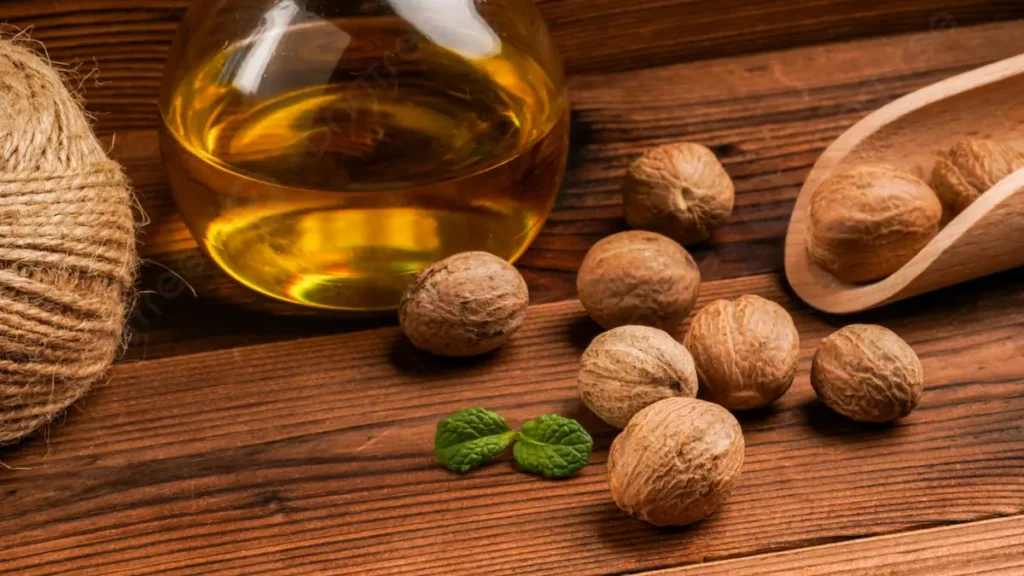
Nutmeg essential oil from Myristica fragrans is used in fragrance, flavor, personal care, and other product-development contexts because of its warm, spicy aromatic profile.
Safety, however, cannot be reduced to a single rule such as “natural means safe” or a universal dilution percentage.
A practical safety assessment depends on the actual chemical profile of the oil, the intended application, concentration, exposure route, finished-product category, and the regulatory requirements of the target market.
Nutmeg essential oil can contain constituents such as myristicin, safrole, elemicin, and methyleugenol, so formulators and B2B buyers should review batch-specific analytical documentation rather than rely only on generic descriptions of nutmeg oil.
This guide explains the main nutmeg essential oil safety considerations, what current scientific and regulatory sources can—and cannot—tell us, and what manufacturers, importers, formulators, and procurement teams should verify before approving a batch for commercial use.
Is Nutmeg Essential Oil Safe?

Nutmeg essential oil can be used in commercial formulations when its identity, composition, concentration, exposure route, and applicable product standards are properly evaluated.
It should not be treated as universally safe across all applications, and a safety statement for one use category should not automatically be transferred to another.
A 2023 European Food Safety Authority assessment of a specific nutmeg-oil feed additive identified myristicin, safrole, elemicin, and methyleugenol in the assessed material and noted skin/eye irritation and skin/respiratory sensitisation concerns for that additive.
That assessment was conducted for an animal-feed use case, so it should not be read as a universal finished-product limit for cosmetics, fragrance, food, or other applications.
It does, however, illustrate why composition and intended use matter in a professional safety review.
What Is Nutmeg Essential Oil?
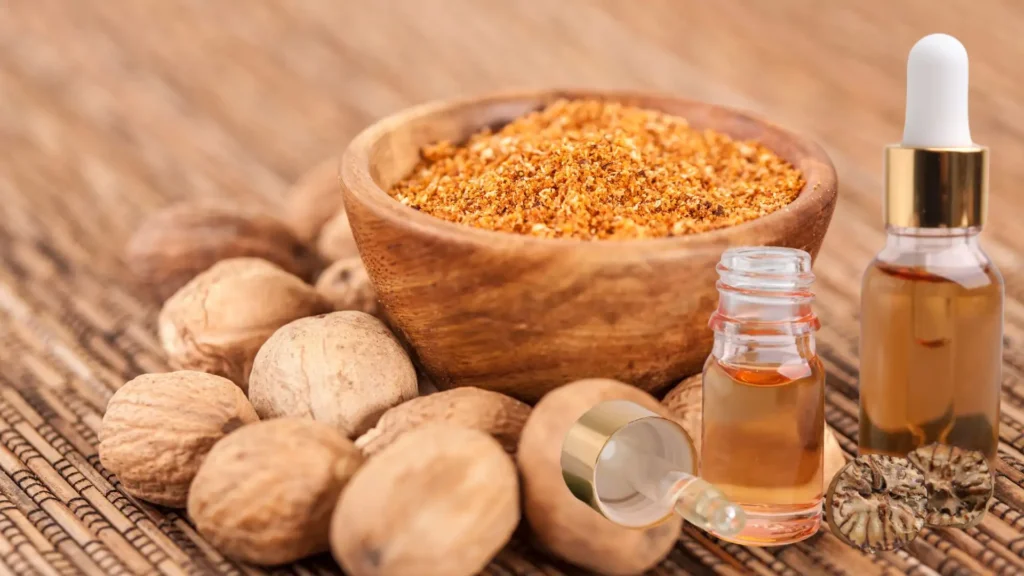
Nutmeg essential oil is a volatile oil commonly produced from the seed of Myristica fragrans by steam distillation.
Its chemical profile can vary with botanical material, origin, processing, distillation conditions, storage, and batch-to-batch variation.
A scientific review of nutmeg essential oil composition and biological activity reports major constituents that can include sabinene, eugenol, myristicin, beta-myrcene, alpha-pinene, and other volatile compounds.
Because the profile is variable, buyers should evaluate the actual batch rather than assume every nutmeg oil has the same composition or risk profile.
For current commercial product information, packaging, and available documentation, see our Nutmeg Essential Oil product page.
Why Myristicin, Safrole, Elemicin and Methyleugenol Matter
Nutmeg oil safety discussions often focus on several aromatic constituents because their presence and concentration can affect how a batch is evaluated for a particular end use.
The key point for B2B buyers is not to judge an oil by one constituent alone, but to understand the complete analytical profile and how relevant standards apply to the intended finished product.
Myristicin
Myristicin is one of the characteristic aromatic constituents associated with nutmeg.
It is frequently discussed in toxicological literature because high exposure to nutmeg or myristicin-containing materials has been associated with adverse effects.
In a commercial essential-oil context, this is a reason to verify the actual batch composition and intended exposure rather than extrapolate from culinary spice use or from concentrated experimental doses.
Safrole and Other Restricted Constituents
Safrole and other constituents may be subject to application-specific restrictions or risk-management requirements depending on the market and finished-product category.
For fragrance use, the IFRA Standards framework explains that natural complex substances such as essential oils can contribute restricted constituents to the finished product and that formulators must account for the relevant constituent limits for the intended IFRA category.
This is why a supplier statement such as “nutmeg oil is safe” is not enough for a formulation decision.
The buyer or finished-product manufacturer needs the batch data and must evaluate it against the requirements that apply to the actual product being developed.
Potential Risks and Side Effects of Nutmeg Essential Oil
The main safety concerns depend on concentration, exposure route, duration, individual susceptibility, the chemical profile of the oil, and the finished formulation.
The following categories are more useful than fixed consumer dosing rules because they can be evaluated within a professional product-development process.
Skin and Eye Irritation
Concentrated essential oils can irritate skin or eyes, and the EFSA assessment cited above identified the specific nutmeg-oil additive it evaluated as a skin and eye irritant.
For cosmetics or personal-care products, formulators should assess the complete finished formula, intended use level, leave-on versus rinse-off exposure, target consumer group, and applicable cosmetic safety requirements.
Sensitization and Respiratory Exposure
Sensitization risk cannot be evaluated from the product name alone. Material composition, exposure level, use pattern, and finished-product category all matter.
The same EFSA assessment identified skin and respiratory sensitisation concerns for the assessed additive, reinforcing the importance of controlled handling and application-specific evaluation in industrial settings.
Ingestion and High-Exposure Risk
Nutmeg and its constituents have a documented history of adverse effects at high ingestion levels.
That does not mean every commercial use of nutmeg essential oil creates the same exposure scenario, but it does mean oral or flavor-related applications should be evaluated under the regulations, specifications, and toxicological framework relevant to the target market.
A general blog article should not be used as a substitute for application-specific safety assessment.
Pregnancy, Medical Conditions and Personal Therapeutic Use
Personal medical use is outside the scope of B2B raw-material approval.
People who are pregnant, breastfeeding, taking medication, or managing a medical condition should not rely on a supplier article for individualized medical advice.
Commercial formulators should instead follow the safety and regulatory requirements that apply to their product category and market.
Safety Requirements Differ by Application
Fragrance and Perfumery
Fragrance safety should be assessed at the finished-product level.
Natural essential oils can contain constituents that are restricted under the IFRA Standards, so the relevant IFRA category, finished-product concentration, and contribution from all fragrance materials should be considered together.
If your team is developing a fragrance application, our Nutmeg Essential Oil for Perfumery guide provides the sourcing and aroma context, while the final safety decision remains formulation-specific.
Cosmetics and Personal Care
For cosmetics and personal care, the finished formula—not only the raw essential oil—must be evaluated.
A buyer should confirm product identity, analytical data, intended use level, relevant allergens or restricted constituents, compatibility with the formulation, and the regulatory requirements of the destination market.
Fixed dilution advice from a general article is not a substitute for a qualified cosmetic safety assessment.
Food and Flavor Applications
Food and flavor applications have their own regulatory and exposure considerations.
Culinary use of nutmeg as a spice should not be treated as equivalent to the use of concentrated essential oil.
Buyers working in food or flavor should verify permitted use, specification, purity, dosage framework, and market-specific requirements for the intended product.
Industrial Handling and Bulk Supply
For bulk handling, the practical focus is identification, storage, exposure control, packaging integrity, transport classification where applicable, and access to the current SDS/MSDS.
Procurement and warehouse teams should use the supplier’s current safety documentation and internal handling procedures rather than generic consumer instructions.
COA vs GC-MS vs SDS: What Each Document Tells You
| Document | What It Helps You Verify | What It Does Not Prove by Itself |
| COA | Batch identity, selected physical/chemical parameters, and whether the batch matches the agreed specification. | Complete toxicological suitability for every application. |
| GC / GC-MS | Chemical profile and major/minor constituents in the tested sample. | Finished-product safety, regulatory approval, or performance in the buyer’s formulation. |
| SDS / MSDS | Hazard communication, handling, storage, exposure controls, transport and emergency information. | A batch-specific proof of composition or commercial specification. |
For a deeper explanation of analytical documents and common buyer red flags, read our Essential Oil COA and GC-MS Guide.
What B2B Buyers Should Review Before Approving a Nutmeg Oil Batch
- Botanical identity: Confirm Myristica fragrans and the plant part used.
- Extraction method: Confirm the production method used for the commercial batch.
- Batch-specific COA: Check that the lot/batch number matches the material being offered or shipped.
- GC or GC-MS profile: Review the actual chemical profile, especially where constituents relevant to the intended application need to be monitored.
- SDS/MSDS: Confirm current handling, storage, hazard communication, and transport information.
- Intended application: Define whether the material is for fragrance, cosmetics, food/flavor, home care, research, or another use.
- Target market: Review the rules that apply in the destination country and finished-product category.
- Sample evaluation: Test a representative sample in the actual formulation or technical process before approving a bulk purchase.
- Approved specification: Translate the accepted sample and analytical requirements into a written purchasing specification.
- Batch consistency: For repeat orders, compare new batches with the approved reference rather than relying on the product name alone.
Safety Is Part of Supplier Qualification, Not a Separate Step
A reliable sourcing process connects safety, quality control, documentation, and commercial approval.
A buyer should be able to request current product information, a representative sample, batch-level analytical documents, and the safety documentation needed for internal review.
If your procurement team is still evaluating suppliers, our Nutmeg Essential Oil Manufacturer Indonesia guide covers broader supplier verification, sourcing, quality, and ordering considerations.
This safety article should remain the deeper reference for hazard and application-specific review rather than duplicating the entire supplier-selection process.
Best Practices for Safer Handling of Nutmeg Essential Oil
The safest practical approach is to treat nutmeg essential oil as a concentrated raw material that requires controlled handling, documentation, and application-specific evaluation.
For professional use, the following practices are more defensible than universal consumer dosing advice:
- Use the current SDS/MSDS and internal workplace procedures for storage, handling, personal protective equipment, spills, and emergency response.
- Keep the material in suitable, properly labeled packaging and follow supplier storage recommendations.
- Avoid assuming that a specification or safety conclusion from one batch automatically applies to another batch without review.
- Do not rely on aroma, color, or the product name alone to judge identity or safety.
- For formulated products, assess the final concentration and total contribution of relevant constituents from all raw materials.
- Document sample approval and translate the approved criteria into the purchase order or raw-material specification.
- Re-evaluate when the supplier, origin, processing route, grade, or chemical profile changes materially.
What This Safety Guide Does Not Mean
Scientific or regulatory evidence about a constituent, a specific nutmeg-oil sample, or one application does not automatically prove that every nutmeg essential oil is unsafe—or safe—across all uses.
It also does not establish a universal topical dilution, oral dose, fragrance limit, or food-use level.
The practical conclusion for B2B users is narrower: identify the actual material, review the actual batch, understand the intended exposure, and apply the requirements that govern the finished product in the target market.
Need Nutmeg Oil Specifications, COA, GC-MS or Safety Documentation?
If your company is evaluating Indonesian nutmeg essential oil for fragrance, cosmetics, flavor, personal care, or another manufacturing application, start with the current Nutmeg Essential Oil product page for commercial product information.
For a specific sourcing requirement, contact our export team and share your intended application, target specification, approximate quantity, destination market, and document requirements.
Our team can discuss the current product option, sample evaluation, available batch documentation, packaging, and quotation based on the actual inquiry.
Frequently Asked Questions
Is nutmeg essential oil toxic?
Nutmeg essential oil should not be described as universally toxic or universally safe without context. Risk depends on the material’s composition, concentration, exposure route, duration, and intended application. Nutmeg oil can contain constituents such as myristicin and safrole that may be relevant to toxicological or regulatory review, so professional users should evaluate batch data and application-specific requirements
What compounds are most important in a nutmeg oil safety review?
The complete chemical profile matters, but safety discussions frequently consider constituents such as myristicin, safrole, elemicin, and methyleugenol alongside the broader terpene profile. The relevant parameters depend on the intended application and market.
Is a COA enough to prove that nutmeg oil is safe?
No. A COA can confirm selected batch parameters and whether the material matches an agreed specification, but it does not by itself establish finished-product safety. Buyers may also need GC/GC-MS data, SDS information, formulation-level assessment, and market-specific regulatory review.
Why should buyers request GC-MS data for nutmeg oil?
GC-MS data can help confirm the chemical profile of a tested sample and identify major and minor volatile constituents. It is useful for quality and identity review, but it should be interpreted together with the specification, COA, SDS, and the requirements of the intended application.
Does IFRA set one universal limit for nutmeg essential oil?
No single universal statement should be assumed for every finished product. IFRA requirements are category- and constituent-dependent. Natural complex substances such as essential oils can contribute restricted constituents to a formula, so formulators need to evaluate the relevant IFRA category and the contribution of those constituents in the finished product.