Of all the natural materials in a perfumer's palette, few carry the weight — literal and figurative — of vetiver. Vetiver oil appears in over 6,000 named fragrances on Fragrantica alone, from Chanel N°5 (1921) to contemporary niche releases. It has anchored chypres, defined fougères, grounded ambers, and given masculine fragrance its signature earthiness for over a century. And yet, for many formulators — particularly those newer to working with naturals — vetiver remains one of the most misunderstood and underutilised ingredients in their toolkit.
This guide is written for perfumers, fragrance formulators, and cosmetic product developers who want a complete, technically grounded understanding of vetiver oil uses in perfumery: what it smells like and why, how it functions in a composition, the critical differences between origins (particularly Indonesian vs Haitian), recommended usage rates across fragrance categories, the best blending partners, and how to evaluate and source verified Indonesian vetiver oil for your formulations.
Related Reading
→ Indonesian Vetiver Oil — Product Specifications & Sample Request
→ How to Source Vetiver Oil from Indonesia: Supplier Guide
What Is Vetiver Oil? The Chemistry Behind the Complexity
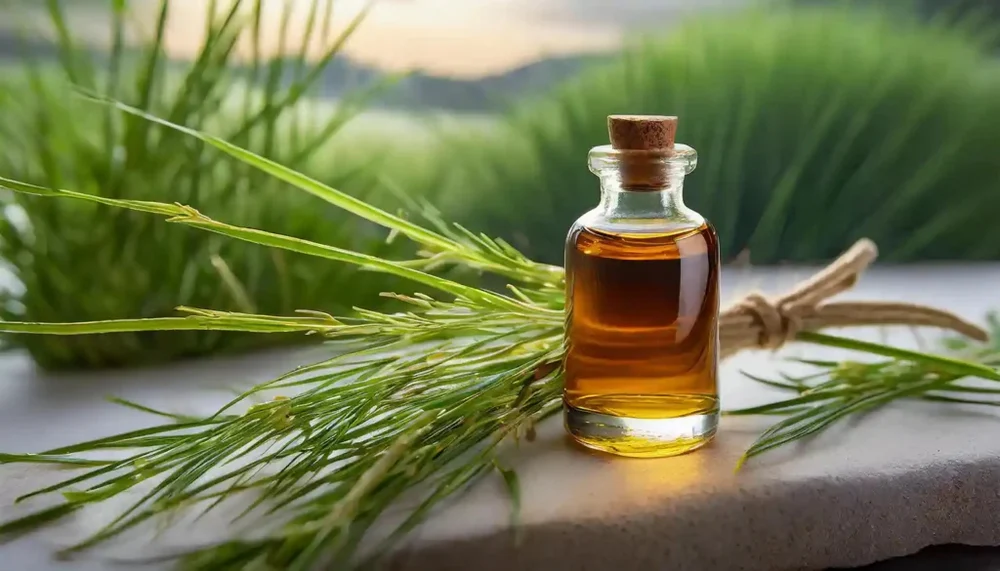
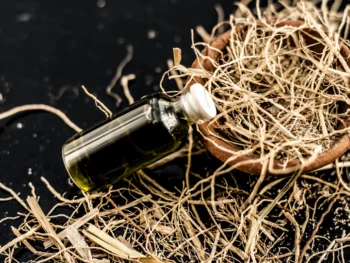
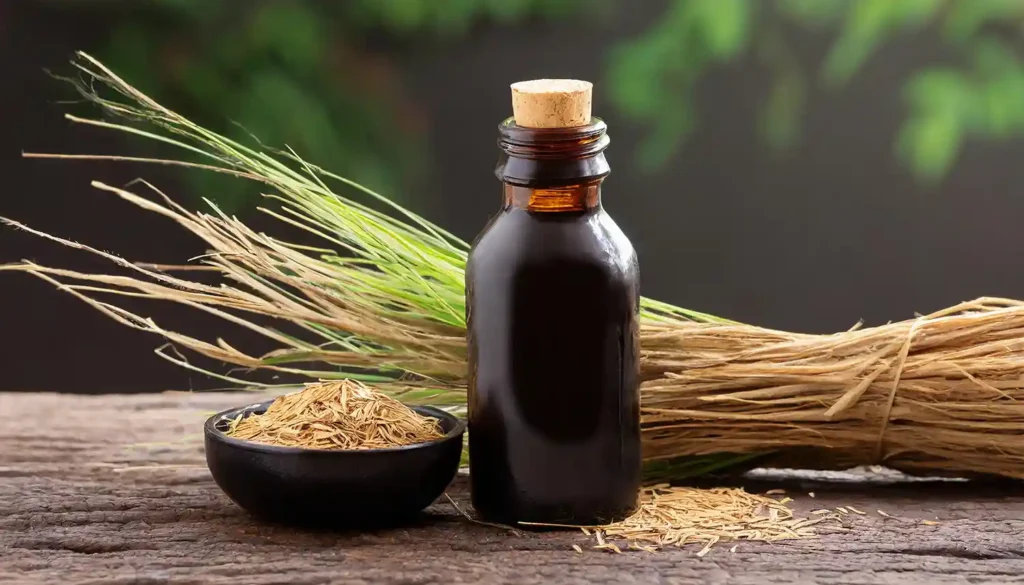
Vetiver oil is steam-distilled from the dried roots of Chrysopogon zizanioides (formerly Vetiveria zizanoides) — a perennial tropical grass whose roots grow downward up to 4 metres into the soil. Unlike most aromatic plants where the oil is in the leaves or flowers, vetiver's entire olfactory character is locked in its root system, which must develop for 15–18 months before harvest. The result of distilling these roots is one of the most chemically complex essential oils known to perfumery — containing over 100 identified compounds, the majority of which are sesquiterpenes and sesquiterpene alcohols. This complexity is precisely why vetiver cannot be fully replicated by a single synthetic molecule, and why natural vetiver remains irreplaceable in fine fragrance despite the availability of synthetic alternatives like vetiveryl acetate.
Key Aroma Compounds in Indonesian Vetiver Oil
- Khusimol (vetiver alcohol): 40–55% — primary odorant; earthy, woody, slightly rooty character
- Isovalencenol: contributes sweet, slightly floral facets
- Vetiverol: general term for vetiver sesquiterpene alcohols — fixative and tenacity contributor
- β-Vetivenene & khusimene: sesquiterpene hydrocarbons; smoky, dry, resinous character
- Vetivone (α and β): contribute the distinctive 'orris-like' and slightly medicinal nuance found in some vetiver origins
The ratio between these compounds varies significantly by origin, which is why Haitian, Indonesian, and Indian vetiver smell distinctly different despite coming from the same plant species.
In perfumery classification, vetiver is universally categorised as a base note — one of the most tenacious in the naturals palette. Its low volatility and high molecular weight mean it lingers on skin for 6–12+ hours after application, making it one of the most effective natural fixatives available to perfumers.
Indonesian Vetiver vs Haitian Vetiver: What Every Perfumer Needs to Know

The origin question is the single most important variable in vetiver selection. Indonesian vetiver from Garut, West Java, and Haitian vetiver from the Artibonite valley are the two most commercially significant origins — and they are meaningfully different both chemically and olfactorily. Choosing between them is a formulation decision, not simply a budget decision.
| Characteristic | Indonesian (Garut, Java) | Haitian (Artibonite) | Indian (Rajasthan) |
| Primary Aroma Character | Smoky, earthy, resinous, oud-like, leathery | Clean, green, woody, slightly floral, humid | Dry, woody, slightly harsh, medicinal |
| Khusimol Content | ~40–55% | ~55–65% | ~35–50% |
| Smokiness Level | High — volcanic soil contribution | Low to medium | Low |
| Green/Floral Facets | Minimal | Prominent | Minimal |
| Complexity | High — over 100 compounds | Very high — benchmark for fine fragrance | Medium |
| Fixative Tenacity | Excellent | Excellent | Good |
| Price Tier | Most accessible | Most expensive | Mid-range |
| Best Fragrance Families | Oriental, amber, woody, leather, oud accords | Chypre, fougère, fresh woody, fine fragrance | Industrial fragrance, personal care |
| Natural Perfumery Use | Increasing — oud-inspired, masculine, resinous | Dominant choice for classic fine fragrance | Less common in premium formulations |
The case for Indonesian vetiver in contemporary perfumery: While Haitian vetiver has historically been considered the benchmark for fine fragrance, the perfumery landscape is shifting. The rise of oud-inspired, leathery, and smoky Oriental fragrance — driven by Middle Eastern perfume culture crossing into Western markets — has created new demand for exactly the character that Garut vetiver naturally delivers. Indonesian vetiver's sulfurous, smoky, almost tarry opening that gradually reveals earthy-woody depth is increasingly specified by perfumers creating niche masculine fragrances, oriental accords, and incense-inspired compositions where Haitian vetiver's cleaner profile would be less appropriate.
Javanese Vetiver — Confirmed by Research
The distinctly smokier and more leathery profile of Indonesian/Javanese vetiver compared to Haitian is not subjective — it is chemically documented. Research confirms that the Garut growing region's volcanic soil rich in sulfur compounds directly influences the sesquiterpene composition of the roots during their 15–18 month development, producing a distinctly different compound ratio than vetiver grown in Haitian limestone-rich soil. This is why 'Indonesian vetiver' and 'Haitian vetiver' cannot be used interchangeably in a formulation — they are functionally different materials.
The Primary Vetiver Oil Uses in Perfumery
Vetiver as a Base Note Fixative
Vetiver's most important functional role in perfumery is as a fixative — a material that anchors lighter, more volatile notes and extends the overall longevity and olfactory evolution of a fragrance. A citrus top note without a fixative evaporates within 30 minutes. The same citrus note anchored with vetiver will project for hours, evolving as the base gradually comes forward.
This fixative property comes from vetiver's high molecular weight sesquiterpene alcohols — particularly khusimol and vetiverol — which bind to skin proteins and fabric fibres, slowing evaporation of the more volatile compounds in the composition. The practical result: 1–3% vetiver in a concentrate can meaningfully extend the longevity of an entire fragrance formula.
Vetiver as a Structural Odorant
Beyond its fixative function, vetiver contributes its own distinctive olfactory character to a composition. Unlike some fixatives that are 'invisible' (barely perceived but functionally essential), vetiver is an active odorant — its earthy, smoky, woody character is a recognisable component of the overall fragrance profile. This dual role — fixative AND odorant — makes vetiver unusually versatile: it can be used in trace amounts purely for fixation, or at higher concentrations where it becomes a defining character note.
Vetiver as a Modifier and Blender
Vetiver has a remarkable ability to link disparate elements in a composition — softening harsh synthetic molecules, smoothing transitions between top and heart notes, and adding naturalness to compositions that rely heavily on synthetics. Perfumers describe this quality as vetiver's 'soil-like' characteristic: it is the olfactory equivalent of earth that connects roots to air, grounding the abstraction of a fragrance in something real and organic.
Usage Rates: How Much Vetiver to Use in Different Fragrance Applications
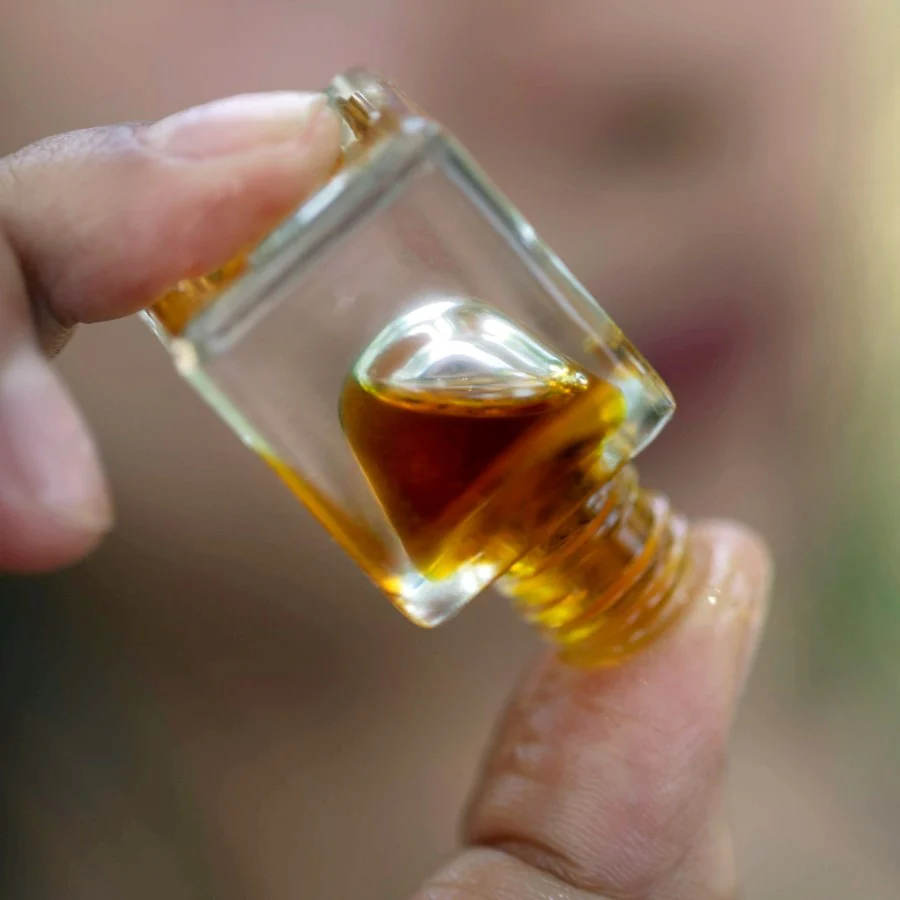
Vetiver's potency means that dosage decisions matter significantly — too little and its fixative benefit is lost; too much and it can overwhelm lighter notes. The following table provides evidence-based starting points for Indonesian vetiver oil across different fragrance and cosmetic applications:
| Application | Recommended Usage Range | Role at This Level | Practical Note |
| Fine fragrance concentrate (EDP/EDT) | 1 – 10% | Fixative + active base note | Vintage Guerlain Vetiver used up to 30%; modern fine fragrance typically 3–8% |
| Masculine fougère or chypre | 5 – 10% | Defining base character | Indonesian vetiver preferred for its smoky masculinity |
| Oriental / amber accord | 3 – 8% | Earthy depth and fixation | Pairs exceptionally with agarwood and patchouli dark |
| Fresh / citrus composition | 1 – 3% | Fixative only — minimal character contribution | Keeps citrus top notes longer without dominating |
| Oud-inspired accord | 4 – 10% | Oud-like smoky character contribution | Indonesian vetiver's sulfurous opening mimics oud character |
| Natural / botanical perfumery | 3 – 8% | IFRA-compliant natural fixative | Specify Garut origin for consistent profile across batches |
| Cosmetic leave-on (lotion, cream) | 0.1 – 0.5% | Fragrance only — IFRA compliance critical | Check IFRA 51st Amendment limits for skin leave-on category |
| Soap (rinse-off) | 0.5 – 1.5% | Fragrance + mild fixation | Vetiver is reasonably stable in alkaline soap environment |
| Candle / home fragrance | 2 – 5% | Earthy, grounding room scent | Indonesian vetiver's smokiness works well in candle format |
| Reed diffuser | 3 – 8% | Long-lasting base note diffusion | High molecular weight = excellent sustained release |
| Men's grooming (beard oil, aftershave) | 1 – 3% | Signature masculine note | Blend with patchouli light and lemongrass for balanced accord |
IFRA Compliance for Leave-On Applications
Vetiver oil is an IFRA-approved ingredient under the 51st Amendment, but usage limits vary significantly by product category. Leave-on skin products (body lotion, face cream, serum) have the strictest limits. Rinse-off products (shampoo, shower gel) have more permissive limits. Fragrance (non-skin) categories like candles and diffusers have the most permissive limits. Always verify current IFRA limits for your specific product category before finalising concentration — limits are updated periodically and vary by version of the standard.
Fragrance Families Where Indonesian Vetiver Excels
Oriental & Amber Compositions
Indonesian vetiver's smoky, resinous, oud-adjacent character makes it a natural choice in oriental and amber fragrance families. The oil's sulfurous opening note — which some perfumers describe as 'smoky wood' or 'leather and earth' — adds a layer of complexity to amber bases that Haitian vetiver's cleaner profile cannot deliver. In oriental compositions, Indonesian vetiver pairs powerfully with: agarwood (oud) oil, benzoin resinoid, labdanum absolute, and patchouli dark grade.
Fougère & Masculine Woody Compositions
Fougère — the fragrance family that defines most mainstream masculine fragrance (lavender + oakmoss + coumarin structure) — has always relied on vetiver as a base note grounding element. Indonesian vetiver works particularly well in modern woody fougères and aromatic masculine compositions where a smokier, more textured base is desired compared to the classical fougère. Notable contemporary accords in this style: vetiver + cedarwood + bergamot + lavender, with Indonesian vetiver anchoring the entire structure.
Oud & Middle Eastern Accords
This is arguably where Indonesian vetiver has its greatest contemporary opportunity. The global expansion of oud-inspired fragrance — from niche Western perfumery to mainstream launches — has created demand for ingredients that carry oud-adjacent character at more accessible price points. Garut vetiver's smoky, leathery, sulfurous opening is one of the closest natural approximations of oud character available in the essential oil palette. When blended with authentic Indonesian agarwood oil, the result is an exceptionally rich base accord that can define an entire fragrance concept.
Chypre Compositions
The classic chypre structure (bergamot + labdanum + oakmoss, with vetiver as base) has historically used Haitian vetiver for its green, earthy facets. Indonesian vetiver can be used in chypres where a darker, more leathery interpretation is desired — sometimes combined with a small percentage of Haitian vetiver to preserve some green facet while adding Indonesian smokiness.
Blending Guide: Indonesian Vetiver with Key Fragrance Partners
The following blending guide is designed for perfumers working with Indonesian vetiver oil from Global Essential Oil. All blending partners listed are available from GEO, enabling single-supplier sourcing with unified documentation.
| Partner Oil | Ratio (Vetiver:Partner) | Accord Type | Olfactory Result | GEO Product Link |
| Patchouli Dark | 1:2 | Earth & shadow base accord | Deep, smoky, musky — classic oriental base | patchouli-essential-oil-manufacturer |
| Patchouli Light (Iron-Free) | 1:3 | Modern woody-earthy | Cleaner than dark blend — suited for contemporary masculine | patchouli-essential-oil-manufacturer |
| Agarwood / Oud Oil | 1:4 | Luxury oud accord | Ultra-premium Indonesian oud-inspired base | agarwood-aetoxylon-oil |
| Lemongrass Oil | 1:8 | Fresh-earthy contrast | Citrus brightness cuts vetiver heaviness — fresh masculine opening | lemongrass-essential-oil |
| Citronella Oil | 1:6 | Natural & functional | Adds green freshness; useful in natural outdoor/repellent fragrance | citronella-essential-oil |
| VCO (carrier) | 5% vetiver in VCO | Skin-safe diluted product | Perfect carrier for beard oil, body oil, massage application | virgin-coconut-oil-manufacturing |
Advanced Blending Notes from Indonesian Vetiver’s Character
- Opening note management: Indonesian vetiver's smoky opening can be intense — if you want to soften it for the top/heart transition, add a small percentage of iso E super or ambroxide alongside it to smooth the opening while preserving the depth in drydown.
- Dilution before blending: For first-time formulators working with vetiver, dilute to 10% in dipropylene glycol (DPG) or ethanol before evaluating — undiluted vetiver can be overwhelming and difficult to evaluate accurately at full strength.
- Temperature sensitivity: Indonesian vetiver is viscous, particularly in cooler environments. Warm gently (40°C water bath) before measuring — do not microwave or apply direct heat which can damage aroma compounds.
- Natural vs vetiveryl acetate: If you need a lighter, brighter vetiver character (as used in Tom Ford Grey Vetiver style compositions), consider combining natural Indonesian vetiver (for depth and naturalness) with vetiveryl acetate (for brightness and transparency) at approximately 3:1 ratio.
Related Reading
→ Patchouli Oil Grades — Dark, Light & MD: Choosing the Right Grade for Blending
→ Lemongrass Essential Oil for Cosmetics & Fragrance — Formulator's Guide
→ Agarwood Essential Oil — Indonesian Oud for Luxury Fragrance
Evaluating Vetiver Oil Quality: What Perfumers Should Assess
Organoleptic Evaluation
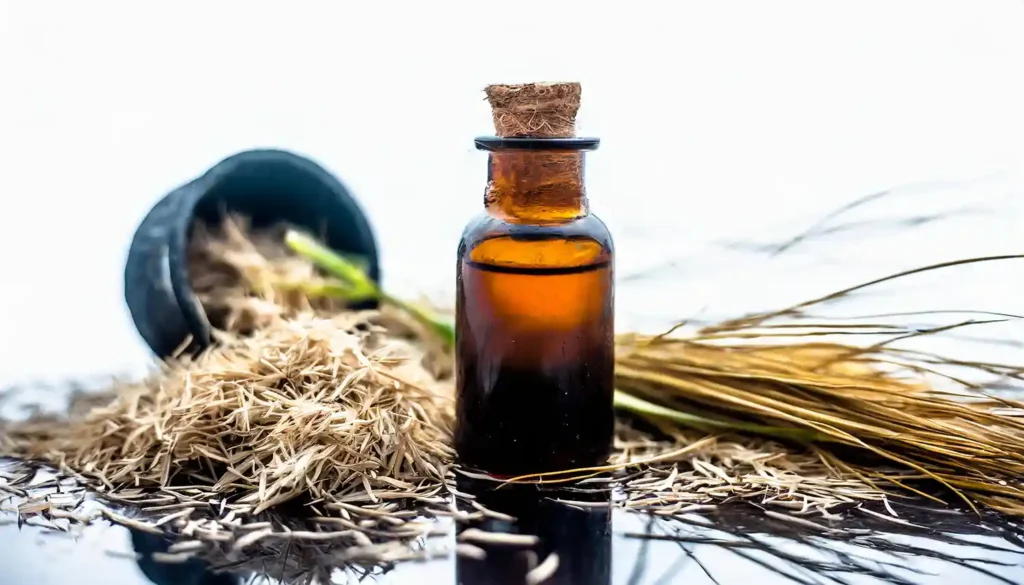
Before any analytical testing, perform a systematic sensory evaluation of your vetiver sample:
- Undiluted evaluation (on strip): Note the opening character — is it smoky, clean, or burnt? Indonesian vetiver should open with earthy-smoky character, not a harsh 'burnt rubber' note which indicates over-pressured distillation.
- 10% dilution in DPG (on strip): Assess the mid-profile — do the sesquiterpene complexity and characteristic vetiver earthiness emerge? Is the profile consistent with the origin specification?
- On skin (1% in ethanol): Evaluate longevity and skin evolution. After 6 hours, vetiver should still be clearly perceptible — this is the fixative quality test.
- Drydown at 24 hours: Authentic high-quality vetiver leaves a persistent, clean earthy-woody residue. If nothing remains at 24 hours, the oil may be adulterated or of lower grade.
Analytical Verification
For B2B purchasing decisions, always request and verify the following from your supplier — a process detailed comprehensively in our COA & GCMS guide:
- Specific gravity (0.988–1.025): Most reliable single physical parameter for purity verification — deviation indicates adulteration or incorrect species
- Optical rotation (+15° to +30°): Confirms the chiral compound profile characteristic of genuine vetiver — synthetic additions typically distort this
- Refractive index (1.519–1.530): Quick optical purity check measurable with a basic refractometer
- GCMS compound profile: Request full GCMS report — khusimol, isovalencenol, vetiselinenol, and β-vetivenene should be present in the expected ratios for Indonesian origin. Absence of key compounds or presence of unexpected synthetics are red flags
- Khusimol percentage: For Indonesian vetiver, expect 40–55%. Significantly higher (65%+) in a sample labelled as Indonesian vetiver may indicate Haitian vetiver being passed off at lower price
Sourcing Indonesian Vetiver Oil for Perfumery from Global Essential Oil
For perfumers and fragrance formulators requiring consistent, documented Indonesian vetiver oil, Global Essential Oil offers Garut-origin vetiver with full perfumery-grade documentation:
| Requirement | What GEO Provides |
| Origin specificity | Garut Regency, West Java — sub-district specification available on request |
| Processing options | Standard steam distilled & rectified (reduced burnt note) — CO₂ on inquiry |
| Batch-specific COA | Every shipment accompanied by COA with specific gravity, refractive index, optical rotation, colour |
| GCMS report | Full compound profile provided — khusimol %, sesquiterpene breakdown, adulteration-free confirmation |
| IFRA documentation | IFRA compliance information available per product category |
| Halal certification | MUI Halal certified — verifiable at halalmui.org |
| Sample availability | 50–200ml evaluation samples with full documentation — no bulk commitment required |
| Minimum bulk order | From 25kg (1 jerrycan) for trial orders; 180kg drum for standard bulk |
| Blending partners available | Patchouli (Dark/Light/MD), agarwood, lemongrass, citronella, VCO — single documentation set |
| Lead time | 2–4 weeks from confirmed order to FOB shipment (subject to stock) |
If you're working on a new fragrance project and want to evaluate Indonesian vetiver alongside other GEO base notes, we recommend requesting our base note sample kit, which can include vetiver, patchouli dark, patchouli light, and agarwood together, all with COA and GCMS, for comprehensive side-by-side evaluation. Contact our team to arrange this.
Related Reading
→ How to Source Vetiver Oil from Indonesia — Complete Supplier Verification Guide
→ Full Indonesian Essential Oil Range for Fragrance & Cosmetics
→ Sourcing Essential Oils from Indonesia — Importer's Master Guide
Final Thoughts: Why Indonesian Vetiver Deserves a Place in Your Palette
Vetiver is not a background ingredient — it is one of perfumery's foundational materials, present in more fragrance formulations than almost any other natural. And within the vetiver category, Indonesian vetiver from Garut occupies a distinct position: more complex and character-driven than its 'clean' Haitian counterpart, more affordable for applications where budget matters, and uniquely positioned for the growing demand for smoky, oud-adjacent, oriental fragrance compositions in both Western niche and Middle Eastern-influenced markets.
When exploring new vetiver oil uses in perfumery, we encourage formulators to evaluate Indonesian vetiver as a deliberate creative choice — rather than simply a budget substitute for Haitian — we'd encourage an evaluation with open expectations. The oil tells a different story: volcanic, ancient, rooted in a different terroir. That story can be the foundation of something genuinely distinctive in your next composition.
| Request an Indonesian Vetiver Oil Sample for Evaluation Contact our team to request a Garut vetiver sample — standard steam distilled or rectified — with full COA, GCMS report, and IFRA reference documentation. We can also arrange a base note sample kit including vetiver, patchouli, and agarwood for side-by-side evaluation. Respond within 1 business day. → Contact Global Essential Oil — Request Vetiver Sample for Perfumery Evaluation |
Go directly to our Indonesian Vetiver Oil product page for full specifications, or browse all Indonesian essential oils for your next formulation project.