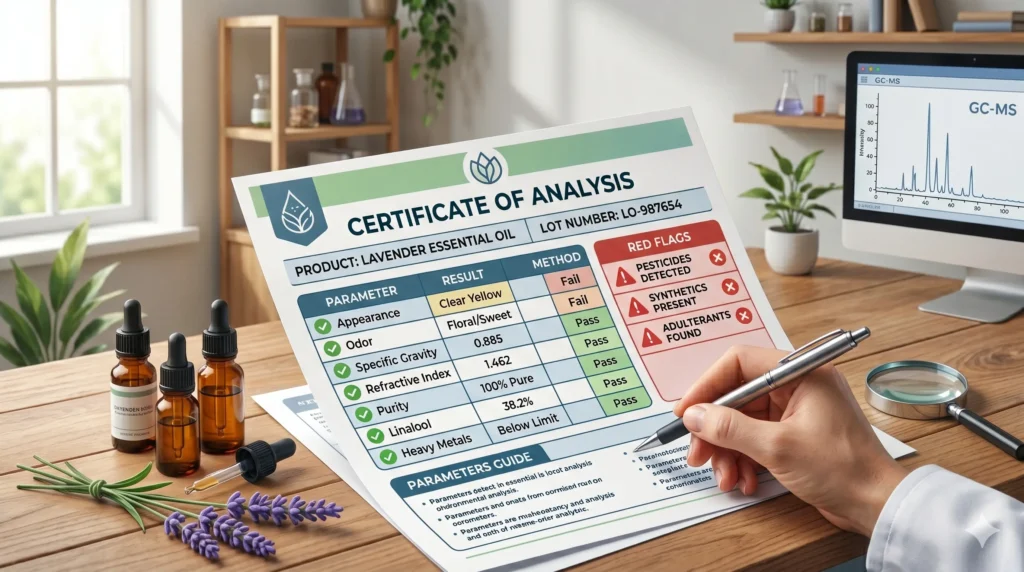
| What Is an Essential Oil COA (Certificate of Analysis)? An essential oil Certificate of Analysis (COA) is a batch-specific quality document issued by the manufacturer or an independent laboratory that reports the analytical test results for a specific batch of essential oil. It confirms that the oil meets agreed quality specifications by listing measured values for key parameters — including specific gravity, refractive index, optical rotation, and active compound content — alongside the accepted specification range for each. A COA is the primary quality assurance document in bulk essential oil trading. A valid essential oil COA must include: (1) product name and botanical species, (2) a unique batch/lot number, (3) production date and expiry date, (4) tested parameter values with specification ranges, (5) test methods used, (6) laboratory name and accreditation status, and (7) authorised signature and date of analysis. |
Every bulk shipment comes with an essential oil COA report — but not everyone receiving one knows how to read it properly.
For procurement managers, cosmetic formulators, quality control teams, and essential oil importers, the ability to critically evaluate a COA is one of the most important skills in the supply chain — it is the difference between accepting a genuine, specification-compliant batch and unknowingly approving adulterated or off-specification oil that will fail your formulation or your regulatory requirements.
This guide explains every parameter on a typical essential oil COA — what it measures, why it matters, what range to expect for common oils, and critically, how to spot a COA that has been falsified or represents poor quality.
We include real parameter examples from Indonesian essential oils that GEO produces — patchouli, clove, lemongrass — because abstract explanations are less useful than seeing what the numbers actually look like.
Related Reading
→ Patchouli Essential Oil — Product Page & COA Specifications
→ Clove Essential Oil — Product Page & COA Specifications
The 8 Essential Sections of a Valid Essential Oil COA

A complete, legitimate essential oil COA contains eight sections. Missing any of the following is a warning sign:
| Section | What It Should Contain | Why It Matters |
| 1. Product Identification | Full product name + botanical species (Latin name) + plant part distilled | Confirms you are receiving the correct oil from the correct species |
| 2. Batch/Lot Number | Unique alphanumeric code specific to this production batch | Enables traceability — without it, the COA cannot be linked to the physical product |
| 3. Production Date & Expiry | Manufacturing date and best-before or expiry date | Confirms freshness; allows shelf-life verification; aligns with harvest season expectations |
| 4. Supplier/Manufacturer Details | Company name, address, contact — must match the actual seller | Verifies document authenticity — should be consistent with all other trade documents |
| 5. Physical Parameters | Specific gravity, refractive index, optical rotation, colour, appearance | Primary physical authentication tests — confirm the oil is within genuine species range |
| 6. Chemical/Compound Parameters | GC analysis results (% of key compounds) or full GCMS profile | Confirms active compound content (patchoulol %, citral %, eugenol %) and detects adulteration |
| 7. Test Methods | ISO, AOAC, or other standardised method references for each test | Allows verification of testing protocol — vague methods cannot be audited |
| 8. Laboratory & Signature | Lab name, accreditation (ISO 17025 preferred), analyst signature, analysis date | Confirms independent testing; ISO 17025 accreditation = quality-controlled analytical process |
Physical Parameters: What Each One Measures and How to Read It

Specific Gravity (Relative Density)
| What is specific gravity on an essential oil COA? Specific gravity on an essential oil COA is the ratio of the oil's density to the density of water at the same temperature (usually 20°C or 25°C). It is measured using a pycnometer or digital densitometer. A value of 0.950 means the oil is 95% as dense as water. Specific gravity is one of the fastest ways to detect dilution or adulteration — if a batch is diluted with a lighter carrier oil, the specific gravity will fall below the authentic range. |
How to read it: Compare the reported value against the accepted specification range for that species. If the value is outside the range — particularly if it is lower than the minimum — suspect dilution or incorrect species. Values that are exactly at the specification limit on every batch suggest the COA may be fabricated.
Real examples from Indonesian essential oils:
| Oil | Specification Range | What Deviation Means |
| Patchouli (Dark grade) | 0.952 – 0.975 | Below 0.952: possible dilution with lighter oils. Above 0.975: possible heavy adulterant |
| Clove Bud Oil | 1.041 – 1.054 | Clove oil is denser than water — this confirms high eugenol content. Below range: possible dilution or wrong species |
| Lemongrass Oil | 0.869 – 0.894 | Below 0.869: possible dilution. Above 0.894: possible synthetic citral addition |
| Vetiver (Garut) | 0.986 – 1.013 | High density reflects heavy sesquiterpene content. Below range: possible dilution |
| Citronella (Java) | 0.880 – 0.910 | Below range: possible dilution. Citronella is less dense than clove — easy to spot if labels are swapped |
Refractive Index
| What is refractive index on an essential oil COA? Refractive index on an essential oil COA measures how much the oil bends (refracts) a beam of light, determined using a refractometer at 20°C. It is expressed as a dimensionless number between approximately 1.400 and 1.600 for most essential oils. Refractive index is a rapid, low-cost authentication test that detects adulteration, dilution, and incorrect species — it is one of the first parameters QC labs check. |
How to read it: Any value outside the species-specific range is cause for investigation. Note that refractive index is temperature-sensitive — the measurement temperature must be specified (usually 20°C). A COA that does not specify measurement temperature is technically incomplete.
| Oil | RI Specification (20°C) | Notes |
| Patchouli (all grades) | 1.507 – 1.515 | One of the higher RI values among EOs — reflects high sesquiterpene content |
| Clove Bud Oil | 1.528 – 1.537 | High RI reflects high eugenol concentration |
| Lemongrass Oil | 1.483 – 1.489 | Citral-dominant oils have characteristic RI range |
| Vetiver (Garut) | 1.519 – 1.533 | High RI — very heavy sesquiterpene content |
| Citronella (Java) | 1.466 – 1.476 | Lower RI than clove — confirms different active compound profile |
Optical Rotation
| What is optical rotation on an essential oil COA? Optical rotation on an essential oil COA measures how much the oil rotates plane-polarised light, measured using a polarimeter at 20°C. It is expressed in degrees as a positive (+) or negative (−) value. Optical rotation arises from chiral molecules — molecules that exist in mirror-image forms that rotate light in opposite directions. Many key essential oil compounds are chiral, making optical rotation a powerful tool for detecting synthetic substitutes, which may have different chirality from the natural compound. |
Why this matters for adulteration detection: This is one of the most powerful parameters for detecting synthetic adulteration.
Natural linalool, citronellal, menthol, and many other essential oil compounds are produced with specific chirality (handedness) by the plant's enzyme systems.
Synthetic versions are often racemic (50:50 mixture of both chiral forms), which produces a different optical rotation value than the natural compound.
A synthetic-adulterated oil will often show an optical rotation outside the natural range — or close to zero if fully racemic.
| Oil | Optical Rotation Specification | What Deviation Indicates |
| Patchouli | (−) 48° to (−) 65° | Strongly laevorotatory (negative). Less negative than −48°: possible adulteration or wrong oil |
| Clove Bud Oil | (−) 1.5° to (+) 1.5° | Near-zero — clove oil is essentially optically neutral |
| Lemongrass Oil | (−) 1° to (−) 5° | Slightly laevorotatory. Outside range: possible adulteration with synthetic citral (different chirality) |
| Vetiver (Garut) | (+) 10° to (+) 30° | Dextrorotatory (positive) — reflects specific sesquiterpene alcohol profile |
| Citronella (Java) | (−) 5° to (−) 20° | Laevorotatory — citronellal is the primary chiral contributor |
Chemical Parameters: Reading GC and GCMS Data

GC Analysis (Gas Chromatography) — The Key Quality Test
| What is GC analysis on an essential oil COA? GC analysis (Gas Chromatography) on an essential oil COA is an analytical test that separates and quantifies the individual chemical compounds in the oil. It produces a percentage breakdown of the oil's composition — showing how much of each compound is present. The most important number for buyers is typically the key active compound percentage: patchoulol % for patchouli, citral % for lemongrass, eugenol % for clove, 1,8-cineole % for cajuput/eucalyptus. GC analysis is required for quality verification of any bulk essential oil purchase. |
GC-FID vs GC-MS: GC-FID (Flame Ionisation Detection) is the quantitative method — it measures how much of each compound is present. GC-MS (Mass Spectrometry) additionally identifies compounds by their mass spectrum.
For commercial COAs, GC-FID provides the % compound data; GCMS provides both identification and quantification and is the gold standard for adulteration detection.
European buyers increasingly require GC-FID specifically because of its superior quantitative precision.
Key Compound Values — Real Examples
| Essential Oil | Primary Compound | Spec Range | What It Confirms |
| Patchouli (Indonesian) | Patchoulol (patchouli alcohol) | ≥ 29% (Dark/Light); ≥ 32% (MD) | Primary quality indicator — lower than 29%: possible adulteration, wrong origin, or poor harvest |
| Patchouli (Indonesian) | β-Caryophyllene | 5 – 12% | Confirms genuine Pogostemon cablin profile |
| Clove Bud Oil | Eugenol | 75 – 85% | Primary active — below 75%: wrong type (may be leaf instead of bud) or adulterated |
| Clove Leaf Oil | Eugenol | 70 – 78% | Leaf oil has lower eugenol than bud — must match the declared type |
| Lemongrass Oil (C. citratus) | Citral (geranial + neral) | 70 – 80% | Aroma and activity driver — below 70%: post-harvest quality loss or adulteration |
| Lemongrass Oil (C. flexuosus) | Citral (geranial + neral) | 75 – 85% | Higher citral than C. citratus — species identity confirmation |
| Citronella (Java, C. winterianus) | Citronellal | 32 – 45% | Primary repellent active — below 32%: Ceylon type or adulterated |
| Cajuput (Melaleuca cajuputi) | 1,8-Cineole (eucalyptol) | 50 – 65% | Therapeutic active — below 50%: quality concern or adulteration |
| Vetiver (Garut) | Khusimol (vetiver alcohol) | 5 – 14% | Primary quality indicator — confirms genuine Garut sesquiterpene profile |
| Eugenol USP | Eugenol | ≥ 99.0% | Pharmaceutical isolate — any result below 99.0% fails USP specification |
Reading a GCMS Report
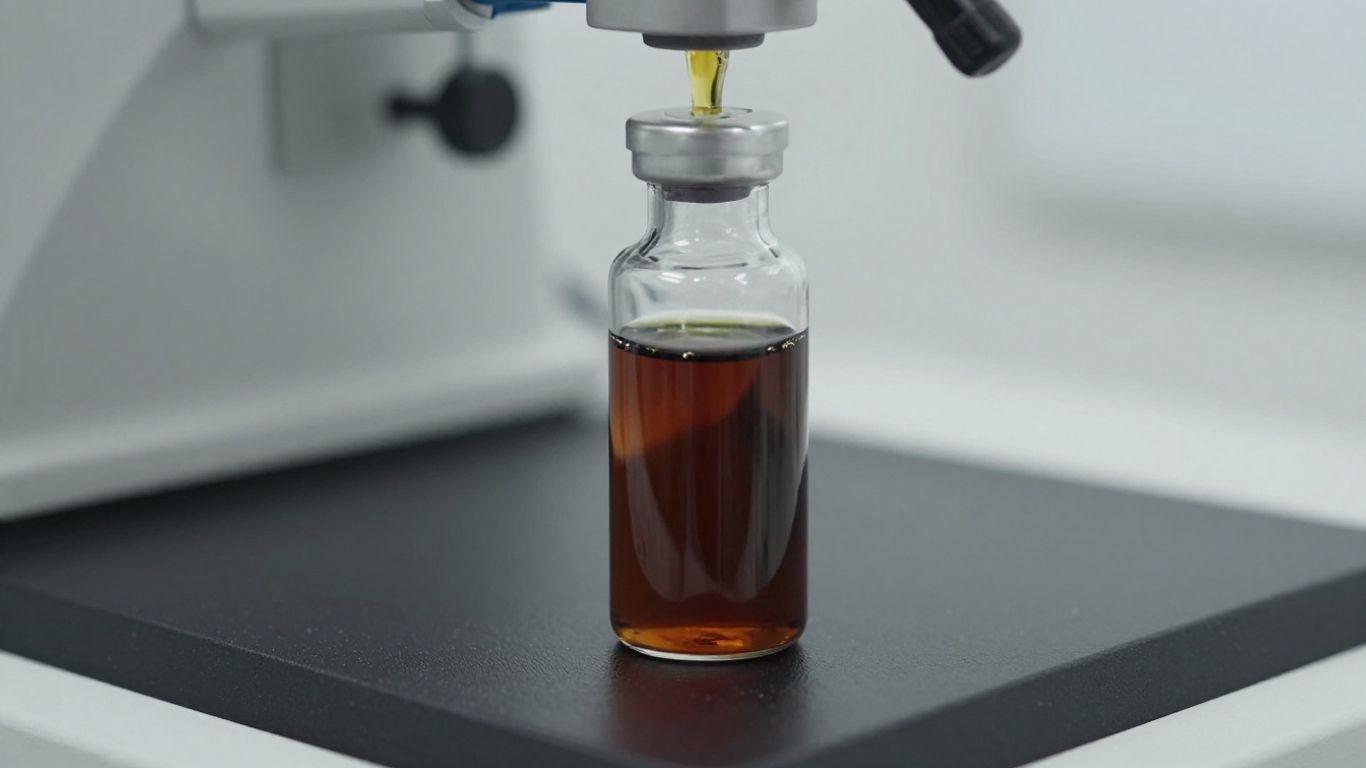
A GCMS (Gas Chromatography-Mass Spectrometry) report provides a full compound fingerprint of the oil — listing every identified compound with its retention time, percentage, and mass spectrum identification.
This is more detailed than a standard GC COA and is the most powerful tool for adulteration detection. Here is how to read it:
- Check the major compound profile matches the expected species: For patchouli, the profile should be dominated by sesquiterpenes: patchoulol, β-caryophyllene, α-guaiene, bulnesene. Presence of unusual peaks or absence of expected minor compounds suggests adulteration
- Look for the presence of norpatchoulenol (patchouli): This trace compound is the marker of genuine Pogostemon cablin oil — its absence can indicate adulteration with synthetic patchoulol blended into a terpene carrier
- Check geranial:neral ratio (lemongrass): Authentic lemongrass citral should show approximately 60:40 geranial:neral. An unusual ratio may indicate synthetic citral addition
- Look for synthetic marker compounds: Certain synthetic aroma chemicals leave characteristic GC peaks (e.g., synthetic eugenol has different trace impurity profile than natural eugenol from clove oil). An experienced GC analyst can identify these
- Confirm species-specific minor compounds are present: Each genuine essential oil has a characteristic profile of minor compounds at <1% concentration that are difficult to replicate in adulterated blends
Additional COA Parameters Worth Knowing
Flash Point
Flash point is the lowest temperature at which the oil produces enough vapour to ignite in air.
It is primarily relevant for shipping and storage classification — it determines the Dangerous Goods class for transport. All essential oils are classified as DG Class 3 Flammable Liquids.
Flash point appears on both COA and MSDS/SDS. Values range from approximately 42°C (lemongrass) to 112°C (eugenol).
Colour and Appearance
Colour and appearance are the simplest and fastest authenticity check — experienced buyers can often identify obvious quality problems by eye before any instrument testing.
Standards are usually described as: 'colourless to pale yellow', 'pale yellow to amber', 'dark amber to brown'. For patchouli specifically, Dark grade is deep amber; Light (Iron-Free) is pale gold; MD is near-colourless.
Any unexpected colour — such as cloudy appearance, green tint, or unusually dark colour in a supposedly Light grade — signals a quality problem. See: Patchouli Oil Grades Explained.
Organoleptic Testing (Odour Assessment)
Organoleptic testing — assessment by a trained nose — remains an irreplaceable quality test despite all the instrumentation available.
GC analysis can detect compound percentages but cannot fully capture the gestalt of an oil's aroma quality.
An experienced evaluator can detect: off-notes indicating oxidation or contamination, absence of expected top notes suggesting poor distillation or storage, and the distinctive character differences between species or origins (Sulawesi vs Aceh patchouli, Java vs Ceylon citronella).
Heavy Metals and Pesticide Residues
For applications in food, pharmaceutical, or cosmetics for sensitive markets, the COA should also include heavy metals testing (lead, arsenic, cadmium, mercury — typically by ICP-MS) and pesticide residue testing (particularly for organic-claiming oils).
These tests are not always included in standard Indonesian commercial COAs but are increasingly required by European buyers.
Essential Oil COA Red Flags: 10 Signs of a Problematic Document
This is the section that experienced QC professionals use as their mental checklist. Any of the following should trigger further investigation before approving a batch:
- Every parameter result is exactly at the specification limit: Real analytical results show natural variation. If specific gravity is specified as '0.952–0.975' and the result is '0.952' on every single batch, the results are almost certainly adjusted to pass specification rather than measured
- No batch/lot number, or a generic/recycled batch number: A COA without a unique, traceable batch number is worthless for traceability. Generic numbers like '2025/001' shared across multiple deliveries are a serious red flag
- Supplier's own in-house lab as the only testing source: Supplier self-testing creates an obvious conflict of interest. For high-value or high-risk purchases, require independent ISO 17025-accredited laboratory testing, or third-party split-sample verification
- No botanical species name specified: 'Patchouli oil' without 'Pogostemon cablin (Blanco) Benth.' is not a specification — it could be any number of plants with patchouli-like aroma. Always require the full Latin binomial and plant part
- Optical rotation value near zero for a strongly chiral oil: Patchouli with optical rotation near 0° (should be −48° to −65°) indicates either wrong species or adulteration with synthetic patchoulol (which is often racemic)
- Key compound % significantly below expected range: Patchoulol below 25%, citral below 65%, eugenol below 70% — these suggest adulteration, wrong species, poor-quality raw material, or incorrect post-harvest handling
- Analysis date far from production date: A COA dated months before the stated production date — or with a 2024 analysis date on a 2026 production batch — is obviously inconsistent. The analysis should be close to the production date
- Laboratory cannot be verified or is not accredited: If you cannot find the listed laboratory online or verify its ISO 17025 accreditation for analytical chemistry, treat the document with extreme scepticism
- No GC data for an oil where active compound content is the key specification: A patchouli COA without patchoulol % is meaningless. A clove oil COA without eugenol % is meaningless. Physical parameters alone are insufficient for essential oil quality verification
- Batch number does not match the physical packaging: Always cross-reference the COA batch number with the batch number on the physical drum or container. Mismatch means the COA does not represent the product you received
| 🚨 The Most Common Adulteration Scenarios in Indonesian Essential Oils Patchouli: Blending cheaper Java-origin oil into premium Sulawesi-origin oil; adding synthetic patchoulol to diluted oil; using C. heyneanus instead of C. cablin. Clove: Substituting stem oil for the declared leaf or bud oil (eugenol content will be different); adding synthetic eugenol to diluted genuine oil. Lemongrass: Adding synthetic citral (which shifts geranial:neral ratio); blending with cheaper citronella oil (citronellal appears in GCMS). Vetiver: Blending cheaper origins into Garut-declared oil; adding synthetic vetiver aroma chemicals that show unusual GCMS peaks. |
COA vs GCMS Report: When Do You Need Both?
Buyers frequently ask: is a COA enough, or do I also need a GCMS report? The answer depends on your application and risk tolerance:
| Situation | COA Alone Sufficient? | When to Request GCMS |
| First order from a new supplier | No — insufficient | Always request GCMS on first order to establish baseline compound profile |
| Regular order from established supplier | Usually yes | If any physical parameters are at the edge of specification or aroma seems off |
| High-value or pharmaceutical application | No | Always require GCMS for pharmaceutical-grade documentation |
| Premium origin claim (e.g., Sulawesi patchouli) | No | GCMS confirms species and origin-specific minor compound profile |
| Organic or natural certification claim | No | GCMS can detect synthetic compound markers |
| EU/UK cosmetic product CPSR | No | Safety assessor typically requires GCMS for leave-on product assessment |
| Standard bulk commodity order | Possibly | If supplier relationship is established and parameters are clean |
At Global Essential Oil, we provide both batch-specific COA and GCMS report as standard documentation with every order — not as an optional extra.
This reflects our position that verified documentation is not a luxury for the buyer but a baseline expectation of legitimate B2B trade.
The Complete Essential Oil COA Report Verification Checklist
Use this checklist before approving any essential oil batch for production or formulation use:
| Checkpoint | Check | Status |
| Product identification | Full botanical name (Latin binomial) + plant part + grade | ☐ |
| Batch/lot number | Unique, specific — matches physical product packaging | ☐ |
| Production date | Aligns with expected harvest season; expiry date makes sense | ☐ |
| Specific gravity | Within species-specific range for declared oil type | ☐ |
| Refractive index | Within species-specific range; measurement temperature stated | ☐ |
| Optical rotation | Within species-specific range; correct sign (positive/negative) | ☐ |
| Key compound % (GC) | Patchoulol ≥29% / Eugenol ≥75% / Citral ≥70% (as applicable) | ☐ |
| GCMS compound profile | Major and minor compounds consistent with genuine species | ☐ |
| Batch number consistency | COA batch number matches drum/container labelling | ☐ |
| Laboratory verification | Lab name verifiable; ISO 17025 accreditation preferred | ☐ |
| Organoleptic check | Aroma consistent with expected oil character and quality | ☐ |
| Halal certificate | MUI certificate if required for your market (verifiable at halalmui.org) | ☐ |
Final Thoughts: A Good COA Is Not Optional — It Is Baseline
In professional essential oil trading, a batch-specific COA with GC data is the minimum acceptable documentation for any bulk purchase.
The parameters detailed in this guide — specific gravity, refractive index, optical rotation, compound percentages — are not bureaucratic requirements.
They are practical tools that protect you from receiving oil that will underperform in your formulation, fail your regulatory requirements, or damage your product quality.
At Global Essential Oil, we provide batch-specific COA and GCMS report as standard documentation with every order.
If you are evaluating a current supplier's COA documentation practices against the standards described in this guide, or would like to compare our documentation against what you currently receive, our team is happy to share sample COA and GCMS documentation before you place any order.
| Request a Sample COA & GCMS Report from Global Essential Oil Contact our team to receive a sample batch COA and GCMS report for any Indonesian essential oil in our range — patchouli, clove, lemongrass, vetiver, citronella, cajuput, or others. See exactly what documentation you will receive with every order before committing to a bulk purchase. We respond within 1 business day. → Contact Global Essential Oil — Request Sample COA & GCMS Documentation |
For sourcing verification beyond the COA: How to Source Essential Oils from Indonesia — Complete Buyer's Guide.
For sustainable sourcing principles: Sustainable Essential Oil Sourcing — A Practical Guide.
Frequently Asked Questions
What does COA mean in essential oils?
COA stands for Certificate of Analysis. It is a batch-specific document that reports the quality test results of an essential oil, helping buyers verify that the product meets the required specifications and standards.
What are the most important parameters on an essential oil COA?
The most important parameters typically include key compound content, specific gravity, refractive index, optical rotation, and batch number. Together, these values help verify quality, authenticity, and traceability.
How do I know if an essential oil COA is fake?
Warning signs include missing batch numbers, unverifiable laboratories, inconsistent dates, or results that appear identical across multiple batches. Buyers can further verify authenticity through third-party laboratory testing.
What is the difference between a COA and a GC-MS report?
A COA provides a summary of key quality specifications for a batch of oil, while a GC-MS report offers a detailed chemical profile showing the individual compounds present. GC-MS reports are generally used for deeper quality verification and adulteration detection.
What should I look for in a patchouli oil COA?
The most important parameter is patchoulol content, along with specific gravity, refractive index, optical rotation, and a unique batch number. Buyers should also verify the botanical name and oil grade listed on the document.
Does every essential oil batch need its own COA?
Yes. A valid COA should be batch-specific and correspond to the exact lot being supplied. Generic or reused COAs do not provide reliable confirmation of product quality.
What is optical rotation and why does it matter for essential oil quality?
Optical rotation measures how an essential oil interacts with polarized light. It is commonly used to help verify authenticity and identify potential adulteration, especially in high-value essential oils.
How often should I request a GC-MS report from my essential oil supplier?
A GC-MS report is recommended when working with a new supplier, purchasing high-value oils, or conducting periodic quality verification. Many buyers request GC-MS documentation on a routine basis to support supplier qualification programs.