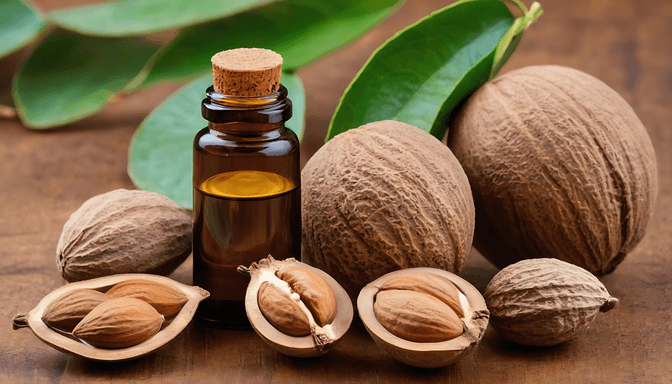
| ⚠️ Important Distinction: Essential Oil vs Oral Consumption This article discusses nutmeg essential oil — the steam-distilled aromatic oil used in aromatherapy, topical formulations, and research studies via inhalation or controlled extract application. This is entirely different from consuming ground nutmeg spice or seeds in large quantities, which is a well-documented cause of toxicity (rapid heartbeat, nausea, agitation, hallucinations) when abused at high oral doses. The neuroprotective research discussed below relates to essential oil compounds at studied concentrations, not high-dose oral nutmeg consumption. This article is not medical advice — consult a healthcare professional regarding any therapeutic use. |
| What does research show about nutmeg oil and brain health? Current research on nutmeg (Myristica fragrans) essential oil suggests several neuroprotective and antioxidant properties, primarily from preclinical (animal and cell-based) studies: (1) antioxidant activity — nutmeg oil compounds scavenge free radicals and reduce oxidative stress relevant to neuronal damage; (2) memory and cognitive support in animal models — studies have shown nutmeg extract can protect against scopolamine-induced memory impairment in rodents; (3) anti-inflammatory effects relevant to neuroprotection. Importantly, robust human clinical trials remain limited — most evidence comes from animal and laboratory studies, and findings should be considered preliminary rather than established medical fact. |
Nutmeg (Myristica fragrans) has been used in traditional medicine systems across Indonesia, India, and the Middle East for centuries — valued not only as a culinary spice but for its purported calming and restorative properties.
In recent years, scientific interest in nutmeg's pharmacological properties has grown considerably, with researchers investigating the essential oil's antioxidant, anti-inflammatory, and neuroprotective potential through preclinical studies.
This article summarises the current state of research on nutmeg essential oil's effects on brain health and oxidative stress protection — distinguishing established findings from preliminary research, and providing important safety context.
We write as Global Essential Oil, an Indonesian manufacturer of nutmeg essential oil.
Nutmeg Essential Oil: Key Compounds Relevant to Neuroprotection

Nutmeg essential oil's composition is dominated by monoterpene hydrocarbons — typically comprising 80–90% of the oil — alongside a smaller fraction of aromatic ethers:
| Compound Class | Key Compounds | Approx. % of Oil | Relevance to Neuroprotection |
| Monoterpene hydrocarbons | Sabinene, α-pinene, β-pinene, terpinen-4-ol | 60 – 80% | Documented antioxidant and anti-inflammatory activity; primary contributors to free radical scavenging |
| Oxygenated terpenes | Linalool, geraniol, terpineol | 5 – 15% | Anti-inflammatory effects relevant to neuroinflammation protection |
| Aromatic ethers | Myristicin, elemicin, safrole, eugenol | 15 – 20% | Implicated in neurochemical interactions (MAO enzyme activity) at studied concentrations; myristicin specifically researched for cholinergic and antioxidant effects |
What Preclinical Research Has Found

Antioxidant Activity and Oxidative Stress Protection
Multiple studies have confirmed that nutmeg essential oil and its extracts demonstrate strong free radical scavenging capacity in laboratory assays.
Oxidative stress — the accumulation of free radicals that damage cellular structures — is a recognised contributor to neuronal injury and age-related cognitive decline.
Nutmeg's phenolic content (reported at approximately 293 mg GAE/g in some analyses) and compounds like myristicin and eugenol contribute to measurable antioxidant capacity, with eugenol specifically shown to inhibit lipid peroxidation effectively in comparative testing.
Memory and Learning in Animal Models
Several rodent studies have investigated nutmeg extract's effects on memory function.
In one notable study design, nutmeg extract protected against scopolamine-induced memory impairment in rats — scopolamine is a compound commonly used in research to chemically induce memory deficits as a model for studying potential protective compounds.
The nutmeg extract's neuroprotective effect in this model was comparable to a reference antioxidant compound (N-acetylcysteine), with researchers attributing the effect to combined antioxidant, anti-inflammatory, and anti-apoptotic (cell-death-preventing) mechanisms.
Separately, low-dose nutmeg extract administration has been associated with enhanced learning and memory performance in rodent studies, an effect researchers have attributed to procholinergic activity (supporting acetylcholine signalling, a neurotransmitter system important for memory) combined with antioxidant action.
Anti-Inflammatory Mechanisms
Neuroinflammation is increasingly recognised as a contributing factor in cognitive decline and neurodegenerative processes.
Nutmeg compounds have demonstrated activity in modulating inflammatory signalling pathways — including PI3K/Akt/mTOR, MAPK, and NF-κB pathways — in preclinical research, supporting the broader category of anti-inflammatory mechanisms relevant to neuroprotection.
Important Limitation: The Human Evidence Gap
| What the research does NOT yet show It is important to be clear about the limits of current evidence: the majority of nutmeg neuroprotective research has been conducted in animal models, cell cultures, or chemical assays — not in controlled human clinical trials. While preclinical findings are scientifically meaningful and provide a foundation for further research, they do not yet establish that nutmeg essential oil treats or prevents any human cognitive condition. Claims that nutmeg oil 'boosts brain function' or 'increases serotonin' in humans go beyond what current peer-reviewed evidence supports. Readers interested in cognitive health should consult healthcare professionals rather than relying on preliminary animal research for treatment decisions. |
Traditional Use Context
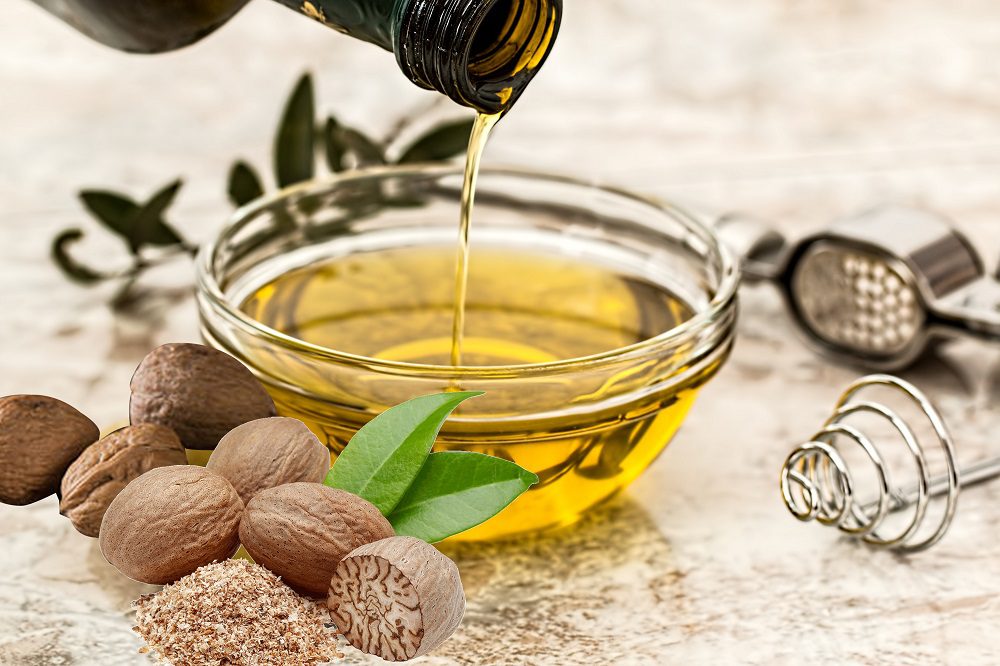
Nutmeg's use in traditional medicine systems provides historical context for current scientific interest, though traditional use alone does not constitute clinical evidence.
In Ayurvedic medicine, nutmeg has been used for digestive support and as a mild sedative. In Traditional Chinese Medicine, it appears in formulations for digestive and calming purposes.
In Indonesian traditional practice — particularly in the Banda Islands and Maluku, the historic origin of nutmeg cultivation — the spice has been valued for both culinary and medicinal applications for centuries, predating its introduction to European markets during the spice trade era.
Safety Considerations
- Essential oil vs whole spice: This article concerns essential oil research, not consumption of nutmeg powder or seeds. Always distinguish between the two when researching safety information
- Dilution required for topical use: Nutmeg essential oil should always be diluted before any skin application — typically 1–2% in a carrier oil
- Avoid internal use without guidance: Essential oils should not be ingested without guidance from a qualified healthcare practitioner
- Pregnancy: Nutmeg oil is generally advised against during pregnancy — consult a healthcare professional
- Not a treatment: This article summarises research findings; it does not constitute medical advice or a treatment recommendation for any cognitive condition
Looking Ahead: Where the Research Stands
Nutmeg essential oil's antioxidant and anti-inflammatory properties are reasonably well-supported by laboratory and animal research, positioning it as a genuinely interesting subject for continued neuroprotective research.
However, the gap between preclinical findings and validated human clinical evidence remains significant — a gap that is typical for many natural compound research areas and should inform how this research is interpreted by readers.
As research continues, particularly any movement toward human clinical trials, the evidence base will become clearer.
Related Reading
→ Nutmeg Essential Oil — Product Specifications from Indonesia
→ How to Read an Essential Oil COA Report
| Source Indonesian Nutmeg Essential Oil Global Essential Oil supplies nutmeg essential oil sourced from Indonesia's historic Banda Islands growing region, with batch-specific COA and GCMS documentation. Contact us to request a sample. → Contact Global Essential Oil — Request Nutmeg Oil Sample |
Frequently Asked Questions
Does nutmeg oil affect the brain?
Preclinical studies suggest that compounds in nutmeg oil may have antioxidant and neuroprotective properties. However, evidence from human clinical studies remains limited, so its effects on brain function are not yet fully established.
Does nutmeg increase serotonin?
Some laboratory studies indicate that certain nutmeg compounds may interact with pathways related to serotonin regulation. However, there is currently insufficient clinical evidence to confirm that nutmeg oil reliably increases serotonin levels in humans.
Is nutmeg oil the same as nutmeg toxicity from eating too much nutmeg?
No. Nutmeg toxicity is associated with consuming excessive amounts of nutmeg spice or seeds, while nutmeg essential oil refers to a concentrated extract used in aromatherapy and research settings. The two are not the same and should not be confused.
What compounds in nutmeg oil are studied for brain health?
Researchers commonly study compounds such as myristicin, eugenol, sabinene, α-pinene, and terpinen-4-ol. These compounds are of interest because of their antioxidant and anti-inflammatory properties.
Is nutmeg essential oil safe to use?
When used appropriately in aromatherapy or diluted topical applications, nutmeg essential oil is generally considered safe for most adults. It should not be ingested without professional guidance and should always be used according to safety recommendations.
Where does the best quality nutmeg oil come from?
Indonesia is widely recognized as one of the world's leading sources of high-quality nutmeg oil. The Maluku Islands, including the historic Banda Islands, are particularly known for their long tradition of nutmeg cultivation and production.