
Lemongrass essential oil — with its sharp, intensely fresh citrus aroma — is one of the most widely used essential oils in cosmetics, personal care, fragrance, and food flavouring.
But how is it actually extracted from the long, fibrous grass that produces it?
And why does the extraction method significantly affect the oil's citral content, aroma quality, and commercial value?
This guide explains the lemongrass oil extraction process comprehensively — from plant selection and harvest timing to the distillation process itself, the parameters that determine oil quality, and what buyers should understand about how extraction decisions affect the citral % they receive.
As an Indonesian manufacturer of lemongrass essential oil from West Java, we write from direct production experience.
| Quick Summary: How Lemongrass Oil Is Extracted Lemongrass oil is extracted primarily by steam distillation of fresh or slightly wilted leaves of Cymbopogon citratus or C. flexuosus. The process takes 1.5–3 hours at temperatures of 60–100°C. Oil yield is typically 0.2–0.4% of fresh leaf weight — meaning 250–500 kg of plant material is required to produce 1 kg of oil. The primary quality indicator is citral content (70–85%), which determines both the aroma intensity and the oil's commercial value. |
Understanding Lemongrass: The Plant Behind the Oil
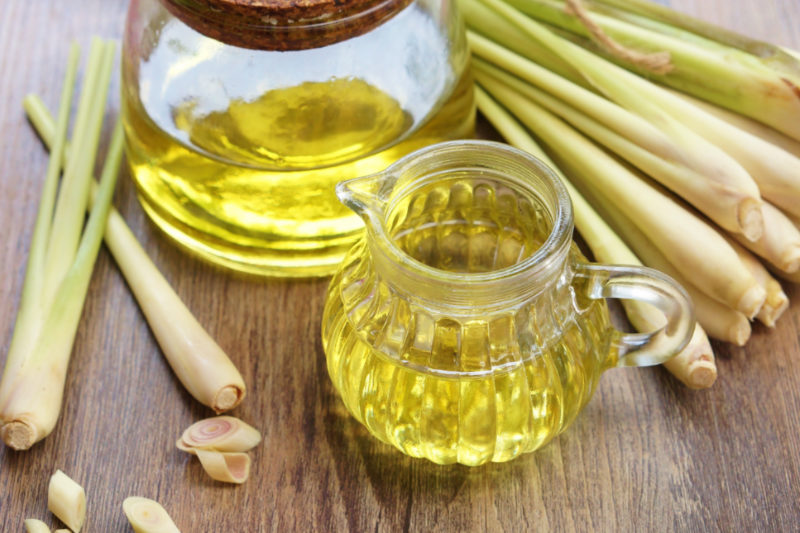
Before examining extraction, it is essential to understand what is being extracted — because lemongrass is not one species. Two distinct species of the Cymbopogon genus are commercially cultivated for essential oil production:
| Species | Common Name | Primary Origin | Citral Content | Key Application |
| Cymbopogon citratus | West Indian Lemongrass | Indonesia, India, Central America, Africa | 70 – 80% citral | Personal care, cosmetics, food flavour, aromatherapy — widely available |
| Cymbopogon flexuosus | East Indian / Cochin Lemongrass | India (Kerala, Karnataka), Nepal, Indonesia | 75 – 85% citral (higher) | Premium fragrance, food flavour industry, high-citral applications |
Indonesia's lemongrass production is primarily C. citratus — cultivated in West Java, Central Java, and Sumatra. The C. citratus species is a robust, high-yielding grass that grows to 1–2 metres in height. Unlike many aromatic plants, lemongrass does not produce flowers or seeds in commercial cultivation — it is propagated from stem divisions and harvested by cutting the leaves at approximately 20–30cm above ground level, allowing the plant to regrow for repeat harvests.
Where the Oil Is Located in the Plant
The essential oil in lemongrass is located in secretory cavities within the leaf epidermis — visible as tiny oil glands when a leaf is held up to the light.
The oil concentration is highest in the upper leaf blades, lower in the stems and sheaths.
This is why commercial distillation uses leaf material, not the whole plant — and why harvest technique (cutting to include maximum leaf blade while leaving the stem base for regrowth) affects both yield and oil quality.
Pre-Distillation: Harvest Timing and Plant Preparation
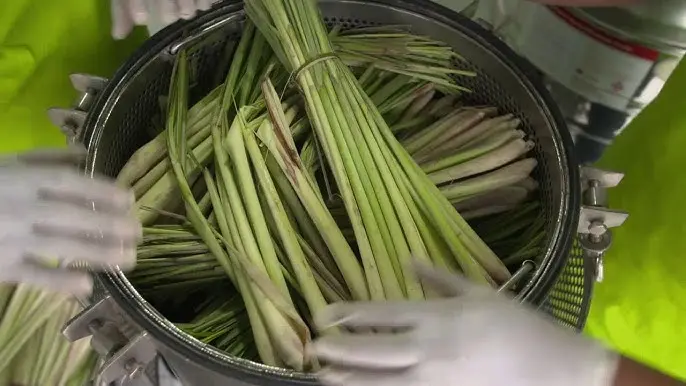
Optimal Harvest Timing
Harvest timing is the single most important factor affecting citral content in lemongrass oil — and it is entirely determined before distillation begins. Research and commercial production data consistently confirm:
- Best harvest stage: Just before flowering — when the plant reaches approximately 70–90 days of growth after planting or last harvest. At this stage, citral accumulation in the leaf glands reaches its peak
- Time of day: Morning harvest (after dew has dried, before peak afternoon heat) preserves more volatile citral compounds than midday or afternoon harvest. Heat accelerates evaporation of the lighter aromatic fractions from cut leaves
- Seasonal variation: In Indonesian production, the dry season harvest (May–October) typically yields higher citral content than wet season harvest — excess moisture in the plant tissue dilutes oil concentration
- Over-mature plant: After flowering, citral content drops significantly as the plant's metabolic energy shifts from aromatic compound accumulation to seed production. Over-mature lemongrass produces lower-quality oil regardless of distillation quality
Post-Harvest Wilting
Unlike some aromatic plants that are distilled fresh, lemongrass benefits from a brief wilting period of 4–12 hours after harvest before distillation. This partial drying:
- Reduces water content in the leaf tissue, improving steam penetration during distillation
- Allows partial cell wall breakdown that makes the oil glands more accessible to steam
- Does not improve quality if extended beyond 12–24 hours — prolonged wilting causes oxidation of citral and aroma degradation
Particle Size and Loading
Commercial lemongrass distillation loads whole or slightly chopped leaves into the still.
Finer particle size increases surface area for steam contact and can improve oil yield — but over-chopping also releases more water-soluble compounds into the hydrosol rather than the oil phase.
In Indonesian commercial practice, lemongrass is typically loaded whole or cut into 10–20cm sections.
Primary Extraction Method: Steam Distillation of Lemongrass
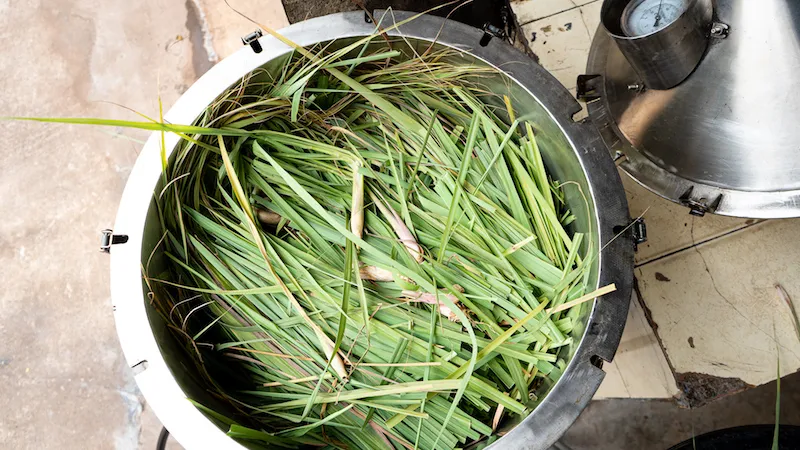
Steam distillation accounts for over 95% of commercial lemongrass oil production globally, including all production at Global Essential Oil.
It is the optimal method for lemongrass because citral and the associated aromatic compounds are thermally stable enough to survive distillation temperatures and sufficiently volatile to be carried effectively by steam.
The Steam Distillation Process for Lemongrass — Step-by-Step
- Load the still: Wilted lemongrass leaves are packed into the distillation vessel. For commercial stills of 500–2,000 litre capacity (typical in Indonesian production), a single batch may use 200–800 kg of fresh/wilted plant material
- Generate steam: An external boiler generates steam at 15–20 PSI pressure and approximately 100–105°C. This steam is piped into the base of the still and rises upward through the packed lemongrass
- Cell rupture and vaporisation: Steam heat ruptures the essential oil secretory cavities in the leaf epidermis, releasing the citral-dominant oil. The volatile compounds vaporise and mix with the steam
- Vapour transport to condenser: The steam-and-oil-vapour mixture travels through a connecting pipe to the condenser — a coiled tube submerged in cold water. The temperature drop condenses both steam and oil vapour back to liquid form
- Oil-water separation: The condensed liquid flows into a Florentine separator (also called a receiving vessel or essencier). Lemongrass oil is slightly less dense than water and forms a layer that floats on the surface, from where it is decanted. The water layer (lemongrass hydrosol) is drained separately
- Quality testing: Each batch is tested for specific gravity, refractive index, and citral % by GC analysis before being approved for storage or shipment
Key Parameters for Lemongrass Steam Distillation
| Parameter | Optimal Range | Effect of Going Outside Range |
| Steam Temperature | 95 – 105°C at the still | Too low: incomplete extraction, low yield. Too high: thermal degradation of citral, altered aroma profile |
| Steam Pressure | 15 – 20 PSI | Too low: slow extraction, poor yield. Too high: elevated temperature, risk of citral degradation |
| Distillation Duration | 1.5 – 3 hours | Under: incomplete extraction. Over: yield of heavier, lower-value compounds; no quality benefit after main fraction collected |
| Plant Material Loading | Moderate — no over-packing | Overpacked: steam channels, poor penetration, low yield. Under-packed: inefficient distillation, excess steam loss |
| Condenser Water Temperature | Below 25°C | Too warm: incomplete condensation, vapour loss, reduced yield |
| Pre-wilt Duration | 4 – 12 hours | Under: excess water in tissue, diluted steam. Over: citral oxidation, quality loss |
Other Lemongrass Extraction Methods: Comparison
Hydrodistillation
In hydrodistillation, lemongrass is submerged directly in water in the still, and the water is heated to boiling.
This is common in academic research settings (the Clevenger apparatus used in most published lemongrass research is a hydrodistillation setup) and in small-scale artisanal production. Advantages: simpler equipment, no external boiler required. Disadvantages: some water-soluble aromatic compounds dissolve in the boiling water, slightly reducing oil yield and altering composition vs direct steam distillation.
Solvent Extraction
Solvent extraction using hexane or ethanol can extract a broader range of aromatic compounds from lemongrass — including heat-sensitive compounds that are altered or lost in steam distillation.
The result is a 'concrete' or 'absolute' rather than a pure essential oil. Solvent extraction is rarely used for lemongrass commercially because: (1) steam distillation already captures most commercially valuable citral fraction effectively; (2) solvent residue is a concern for food and cosmetic applications; (3) cost is higher than distillation at scale.
CO2 Supercritical Extraction
CO2 extraction at supercritical conditions produces a fuller-spectrum lemongrass extract that preserves heat-sensitive compounds.
The resulting oil has a more complex, 'greener', plant-like character vs the cleaner citral-dominant profile of steam-distilled lemongrass. Used in premium food flavouring and niche cosmetic applications — but not in mainstream commercial lemongrass oil production due to high equipment cost.
| Method | Citral Preservation | Yield | Cost | Commercial Use |
| Steam Distillation (direct) | Good — moderate heat impact on trace compounds | 0.2 – 0.4% | Low — standard industrial | ★ Primary commercial method — 95%+ of production |
| Hydrodistillation | Similar to steam — water contact may extract different fractions | 0.15 – 0.35% | Low | Academic research, small artisanal production |
| Solvent Extraction | Excellent — captures heat-sensitive compounds | Higher — full spectrum | Medium | Rare — niche premium applications |
| CO2 Extraction | Best — no heat damage | Highest spectrum | Very high — specialised equipment | Premium flavour, cosmetic concentrate |
What Determines Citral Content in Extracted Lemongrass Oil?
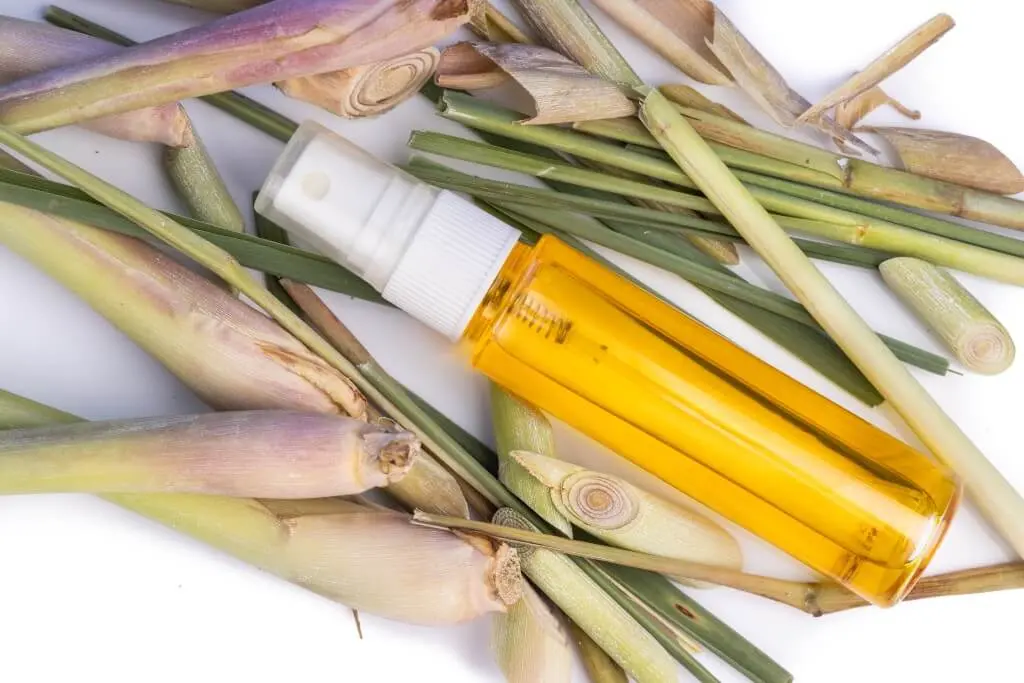
Citral — the mixture of geranial (citral A) and neral (citral B) in approximately 60:40 ratio — is the primary quality indicator for lemongrass oil and the compound responsible for its characteristic sharp lemon aroma.
Commercial lemongrass oil should contain 70–85% citral. Understanding what drives citral content helps buyers evaluate quality and understand why different batches vary:
- Species: C. flexuosus typically produces higher citral (75–85%) than C. citratus (70–80%)
- Harvest timing: Pre-flowering harvest maximises citral. Post-flowering: significant drop
- Growing region: West Java Indonesian production has specific soil and climate conditions that influence citral accumulation in the plant
- Distillation time: Shorter distillation (1.5–2 hours) preserves the lighter, citral-rich first fraction. Extended distillation beyond 3 hours begins to collect heavier terpene fractions that dilute the overall citral %
- Storage of oil: Citral oxidises over time — particularly when exposed to air, heat, or UV light. Freshly distilled lemongrass oil has higher citral % than oil stored 12–18 months under poor conditions. Always request batch-specific COA with GC data. See: Understanding COA & GCMS Reports.
| Why Citral % Matters for Your Application For food flavouring: higher citral = more intense lemon character per gram. For cosmetics and personal care: citral is a potent antimicrobial active — higher % means better functional efficacy at lower usage rates. For fragrance: citral drives the sharp, transparent lemon top note — the key fragrance contribution of lemongrass. Always specify minimum citral % (e.g., 'citral ≥72%' for C. citratus or '≥78%' for C. flexuosus) in your purchase order. |
Oil Yield and Quality Benchmarks
Expected Yield
Lemongrass oil yield is relatively low compared to some other Indonesian essential oils:
- C. citratus (West Indian): 0.20 – 0.40% of fresh leaf weight — typically 0.25–0.30% in commercial Indonesian production
- C. flexuosus (East Indian): 0.25 – 0.50% — slightly higher yield and higher citral content
- This means producing 1 kg of lemongrass oil requires 250–500 kg of fresh leaves — explaining the economics of lemongrass cultivation and distillation
Quality Specifications for Commercial Lemongrass Oil
| Parameter | C. citratus Specification | C. flexuosus Specification | Significance |
| Citral content (GC) | 70 – 80% | 75 – 85% | Primary quality/activity indicator — specify minimum on PO |
| Geranial:Neral ratio | ~60:40 | ~60:40 | Confirms authentic lemongrass — ratio is characteristic |
| Specific Gravity (20°C) | 0.869 – 0.894 | 0.870 – 0.897 | Purity and authenticity check |
| Refractive Index (20°C) | 1.483 – 1.489 | 1.484 – 1.491 | Optical confirmation of genuine lemongrass profile |
| Optical Rotation | (−) 1° to (−) 5° | (−) 3° to (−) 8° | Distinguishes from adulterated oil |
| Colour | Pale yellow to amber | Pale yellow to amber | Clear, mobile liquid — turbidity indicates contamination |
| Citronellal content | <15% (distinguishes from citronella) | <10% | Key test to confirm lemongrass vs citronella identity |
Related Reading
→ Lemongrass Essential Oil — Product Specifications from Indonesia
→ Citronella Oil vs Lemongrass Oil — Key Differences Explained
→ Lemongrass Oil Benefits for Cosmetics — Application Guide
Indonesian Lemongrass Oil: Production and Sourcing

Indonesia — particularly West Java and Central Java — is one of the world's significant producers of Cymbopogon citratus lemongrass oil.
The combination of tropical climate, fertile volcanic soils, and experienced farming communities creates favourable conditions for consistent, high-citral production.
At Global Essential Oil, our lemongrass oil is produced by steam distillation of C. citratus leaves from our West Java farming networks.
Each batch is tested for citral % by GC analysis before release, and every order is accompanied by a batch-specific COA confirming citral content, specific gravity, and refractive index.
- Citral content verified: Batch COA confirms citral % — not a generic document
- GCMS available: Full compound fingerprint on request — geranial/neral ratio confirms authentic Indonesian C. citratus
- Halal certified (MUI): Verifiable at halalmui.org
- Companion products: Citronella oil (same Cymbopogon genus, Java type) available for multi-oil orders with single documentation set
For complete Indonesian sourcing guide: How to Source Essential Oils from Indonesia.
For steam distillation process of all Indonesian oils: Essential Oil Steam Distillation Process — Complete Guide.
| Request Indonesian Lemongrass Oil Sample with Citral % COA Contact Global Essential Oil to request a Cymbopogon citratus lemongrass oil sample from our current West Java stock — with batch-specific COA (citral %), GCMS report, MSDS, and Halal certificate. We respond within 1 business day. → Contact Global Essential Oil — Request Lemongrass Oil Sample |
Or visit our Lemongrass Essential Oil product page for full specifications, or explore the complete Indonesian essential oil range.
Frequently Asked Questions
How is lemongrass oil extracted?
Lemongrass oil is primarily extracted through steam distillation of fresh or partially dried lemongrass leaves. During the process, steam carries the aromatic compounds from the plant material, which are then condensed and separated into essential oil and hydrosol.
What is the citral content of lemongrass oil and why does it matter?
Commercial lemongrass oil typically contains 70–85% citral. This compound is responsible for the oil's characteristic lemon aroma and contributes to its value in flavor, fragrance, and personal care applications.
How long does lemongrass oil distillation take?
Commercial steam distillation of lemongrass usually takes between 1.5 and 3 hours. The exact duration depends on factors such as equipment design, plant material quality, and desired oil composition.
Does harvest timing affect lemongrass oil quality?
Yes. Harvest timing can significantly influence oil yield and citral content. Lemongrass harvested at the optimal growth stage generally produces higher-quality oil with a stronger aroma profile.
What is the difference between lemongrass oil extraction and citronella oil extraction?
Both oils are typically produced through steam distillation of Cymbopogon species. However, lemongrass oil is valued for its high citral content, while citronella oil is characterized by compounds such as citronellal and is commonly used in insect-repellent applications.
How much lemongrass is needed to produce 1 litre of essential oil?
The amount varies depending on yield, but several hundred kilograms of fresh lemongrass are typically required to produce 1 litre of essential oil. This reflects the naturally low concentration of essential oil in the plant material.
Can lemongrass oil be extracted at home?
Yes. Small-scale extraction is possible using home distillation equipment. However, commercial-quality lemongrass oil is generally produced using industrial steam distillation systems that provide greater consistency and efficiency.
How do I verify the quality of lemongrass oil from a supplier?
Request a batch-specific Certificate of Analysis (COA) and, when available, a GC-MS report. These documents help verify key quality parameters, including citral content, authenticity, and compliance with industry specifications.